First comes the e-nose, then the beer algorithm

Researchers in Australia have developed an “electronic nose” they say will help craft breweries monitor beer quality. Seems like it would work for other breweries as well.

This e-nose is a small circuit board that measures gases emitted from beer. It uses machine learning (magic words which we’ll get back to soon) to determine if a beer has unwanted aromas. The gases include carbon dioxide, ethanol, methane, hydrogen, hydrogen sulfide, carbon monoxide, ammonia and benzene.

The electronic nose has also been used by the researchers in conjunction with biometric indicators such as heart rate, body temperature, brainwaves and facial expressions to gather more information from consumers while tasting a product.

Basically, it is good at warning brewers there’s something about a beer that consumers won’t like. That’s a positive. However, directing consumers to a beer they will like or providing an idea of what it will smell and taste like is a different challenge. Aroma, and therefore flavor, remains something of a black box.

Kevin Verstrepen and Miguel Roncoroni at the laboratory at the University of Leuven’s Institute for Beer Research and VIB Center for Microbiology head up a project intended to match compounds that can be measured with sensory preferences. One result is a book, Belgian Beer: Tested and Tasted.
Read more

Dispatches from the brewing local front

WHAT THE L?

Fullsteam Brewery in North Carolina has made a small change in the signage it uses at beer festivals.

A line that previously read “AUTUMN LAGER festbier, 6% ABV, 99% local” now reads “AUTUMN LAGER festbier, 6% ABV, 99% L.”

Fullsteam founder Sean Lilly Wilson explained why in the brewery’s newsletter.

The goal is two-fold: first, to intentionally have people ask “What is “L?”” That question provides an opportunity for dialogue. It allows us to share what we mean by local and why we believe it matters.

Secondly, the effort is to ultimately normalize it. Why waste time on IBUs when it’s a meaningless measurement of perceived bitterness? Why bother with SRM (a color metric) when you generally know a pils is going to be light and a porter dark?

L matters to us and to a growing number of breweries. L to us means Southern-sourced (overwhelmingly North Carolina) from independent farmers, foragers, maltsters, and tree growers.

Ultimately, we want customers to care more about origin and how buying local can strengthen the state’s agricultural sector. For us and a number of L-centric breweries, that matters more than specious statistics and formulas.

Truly local beer is a metric worth measuring. But in a No Laws When You’re Drinking Claws era, we have to find new ways to make it matter.”

Fullsteam has spent more than a half million dollars on local ingredients — local being Southern states, mostly North Carolina — since opening in 2010. “I hope to ramp that up each year, to where that $500k isn’t over nine years, but every year!” Wilson wrote via email.

The ingredients and where they come from:
Malted corn: From Riverbend Malt House in Asheville and Epiphany Craft Malt in Durham.
Malted barley: Foundation, Ruby and Vienna from Epiphany.
Malted triticale: From Epiphany.
Hops: Aramis from France and Saaz from Germany.
Yeast: House lager yeast (not of North Carolina origin).

LOCAL CONNECTIONS

Via Josh Chapman at Black Narrows Brewing Co.

ASSUMING YOU LIVE IN NORTHERN BOTSWANA

HOMINY

Coming in September: Kveik Fest, Kveikstokk

Yes, back-to-back posts related to Nordic farmhouse brewing. (The first.)

Events are planned in Chicago and Toronto showcasing beers brewed with kveik (which is a yeast, not a beer style) and author and beer anthropologist Lars Garshol, who has introduced brewers previously influenced by German/Czech/Belgian/English traditions to one they barely knew existed.

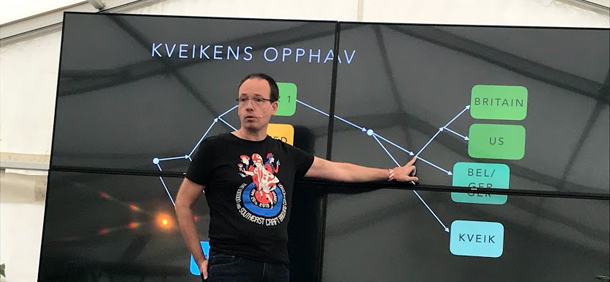
Lars Garshol talks about kviek in Bergen, Norway
Lars Garshol points out where kveik belongs on the family tree of yeast during a talk at the Bergen Ølfestival last September.

Burnt City Brewing in Chicago will host the Inaugural Kveik Fest Sept. 7. Three days later, Garshol will appear at Kveikstokk in Toronto.

Appropriately, Kveik Fest is sponsored by Omega Yeast, which made kveik strains available in the U.S. more than two years ago. The one-day invitational will include traditional and experimental beers fermented with kveik from 30 Chicago-area and national brewers. Tickets are $75.

“Kveik is particularly exciting to so many brewers because it contributes great combinations of flavors to beer and is extremely versatile when it comes to brewing different styles,” Ben Saller, head brewer at Burnt City, said for a press release. “Once we started experimenting with the Norwegian yeast strains available from Omega Yeast in the past couple of years, we soon had this idea to design an event around highlighting yeast as an ingredient. Creatively, there’s so much that can be done with kveik and the range of citrus and tropical flavors and aromas it can bring to the table.”

Escarpment Labs, which funded sequencing of kveik strains and helped establish that they are genetically distinct, and Burdock Brewery will host Kveikstokk. Garshol will be talk about his travels in Norway, documenting the living farmhouse brewing traditions as well as some of the special ingredients in use. There will be kveik-fermented beers on tap brewed by Burdock, Escarpment Labs and friends. Tickets are $25.

Monday beer briefing: worthiness, consolidation and Baas Becking

04.08.19, BEER AND WINE LINKS, MUSING

Bill Wesselink, Dovetail Brewery
I spent about 21 hours during two days midweek at Dovetail Brewery in Chicago. It was quite noisy as times — I understood that the brewery sat next to the city’s Brown Line, but I didn’t know it had built a nest between two train tracks. Yet, when trains aren’t running it can be flat out quiet, particularly in the coolship room, looking at wort sometimes produced using decoction, and other times with a turbid mash. The turbid mash itself is less peaceful; co-founder Bill Wesselink raised an ugly looking blister doing some of the mixing by hand. Not until I was catching up Friday did I realize what a noisy week I had happily missed much of, one with many stories that intersected. So a different format today, and here goes . . .

Read more

For Monday beer briefing, complete this sentence: “Beer is …”

02.11.19, BEER AND WINE LINKS

Eleven days into February and do you know where your flagship beer is? Or what a flagship beer is? My contribution to #Flagshipfebruary posts Friday, and that’s when I’ll add more thoughts here. So this is a No Flagship, No Corn roundup. If you somehow missed the Chronicles of Corn you should be reading Alan McLeod’s Thursday posts.

A Long, Strange Trip — Wicked Weed is Opening Something in Atlanta, But They Don’t Know What it is Yet.
A story as strange as the headline suggests. Wicked Weed co-founder Walt Dickinson rambles just a bit throughout, and there is no single takeaway. He asks, and answers, the question I find everywhere I go these days. “For me, the big line is, ‘How big can we get without compromising the quality?'” Dickinson says. “And I know there’s incremental compromise that happens with scale, but not from production. I think that’s the biggest myth I’ve ever heard.” He provides an interesting example, but I suspect it is not that simple.

Brewers are ready for the low-ABV revolution. But are beer drinkers?
Because this is the way many people think. “First, you take the serving size of your beer. Then, you multiply by the ABV. Divide by the price, and there you have it: the absolute value of the buzz in your bottle.”

Read more