Corn vs. rice in beer: Been there, done that

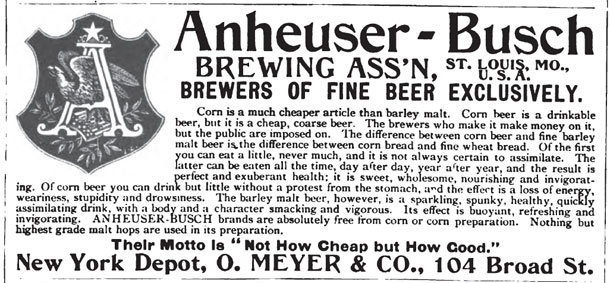
A-B advertisement decrying use of corn

This particular advertisement appeared in Puck magazine Feb. 22, 1893 as part of a national campaign mounted by Anheuser-Busch. It does not mention that A-B used rice rather than corn, so it would seem that the rather constant referral to the use of rice in Super Bowl commercials that just aired is a step toward truth in advertising.

In all fairness, A-B long ago quit obscuring the fact that Budweiser was brewed with rice, as Bud Light is today. As soon at large breweries began using adjuncts in the final decades of the nineteenth century there were arguments about whether corn or rice was superior.

On January 30, 1881, well before A-B took aim on beers brewed with corn, the author of a full-page article in the Chicago Daily Tribune chose the side of rice in the rice versus corn debate. The author stated, “Corn beer is not a drink for Americans or Germans. It is good enough for the Spaniards, Greasers, Indians, and the mongrel breeds of South America.” Instead the author lauded the exceptional crisp taste that resulted with rice, and added, “for years the ‘blonde,’ or light colored beers have been fashionable and grown into public favor in America.” The author also suggested most breweries in Chicago used rice, while Milwaukee brewers used corn.

Anheuser-Busch founder Adolphus Busch, who ultimately had made the decision to brew Budweiser with rice, spoke often and bluntly about his distaste for beers made with corn. “Our main argument must be the quality of our product, that we do not use any corn,” he said in 1895. “While nearly every other beer brewed in this country, with hardly one exception, is made of cheaper material, viz: corn; that such a beer is not as wholesome or digestible as pure barley malt beer, the small addition of rice only improving it, and that the use of corn makes a very inferior article. The difference in the cost of manufacture between a barley malt and rice beer and corn beer is one dollar per barrel in favor of the latter, as a matter of course.”
Kveik: Time to think outside the farmhouse?

Kveik paparazzi
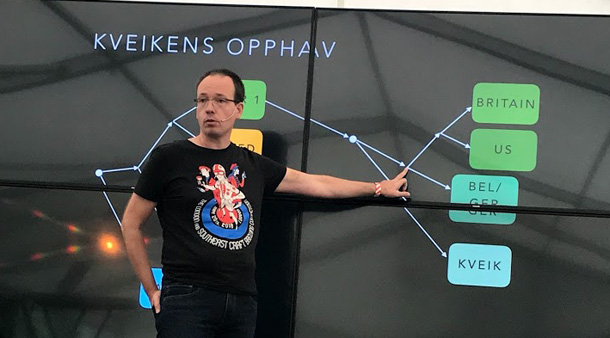
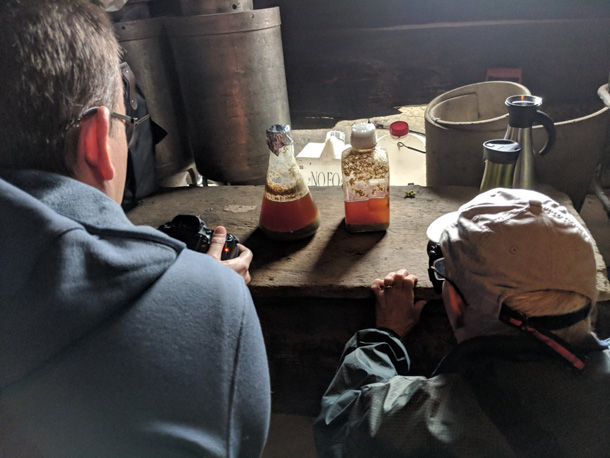
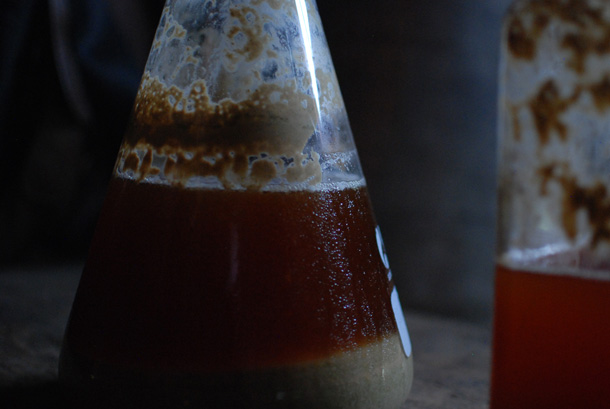
Joe Stange posted the photo above on Twitter, captioning it “Kveik and the paparazzi.” That’s Lars Marius Garshol on the left and me on the right. The photo below provides a close up look at kveik, but maybe not as clear a picture as we got today with the release of a paper in frontiers in Microbiology titled “Traditional Norwegian Kveik Are a Genetically Distinct Group of Domesticated Saccharomyces cerevisiae Brewing Yeasts.”

Kveik - just waiting for the wort to finish boiling
Backing up just a bit, not long after I landed in Norway two weeks ago I posted a short video of foam pouring out of an overcarbonated beer that have been fermented with kveik. That prompted this question: “Doing research for a future book, I hope?” The answer is that I am not working on a book involving Norwegian farmhouse beers, kveik, farmhouse beers from other regions, or other ancient drinks. Garshol has that under control, and although it seems the research part never ends (because it really doesn’t ever end) the result will be a book from Brewers Publications in 2020.

I was in Norway at the invitation of organizers of Bergen Ølfestival, a two-day event featuring more than 40 Norwegian breweries in the stunningly beautiful city of Bergen. I gave a rather technical presentation about hops to brewers the evening before the festival started, then a less technical one for the public on the first day. Of course, one of the ways Rolv Bergesen convinced me to make the trip was a chance to visit Norwegian farmhouse breweries. We (Daria, who arrived a few days after I did, Stange, and Garshol) headed to the Dyrvedalen valley south of Voss the day after the festival, and Sjur Rørlien took us to two farms where beer is still made. I will have details in a future issue of Zymurgy magazine.

Now back to kveik.

Lars Marius Garshol
Although Garhol’s presentation at the festival was in Norwegian the graphics made it easy to follow, and he laid out much of the information published today. He also posted an excellent summary in his blog, although this doesn’t really summarize easily.

At a geek level there is this: “The results were quite surprising: kveik belongs to Beer 1. This is the group that has Belgian/German strains on one side, and UK/US ones on the other.” Too geeky? If you are looking for background, I wrote about the family tree of yeast for All About Beer magazine last year.

At a disrupting the beer landscape level there is the fact that kveik ferments at much higher temperatures than other yeast strains without creating off flavors and it isn’t wild. It may have resulted from a beer from Beer 1 mating with a wild yeast, but it is POF- rather than POF+ (again see the family tree story).

When kviek started showing up in the United States less than two years ago brewers I talked to were interested in using it in “farmhouse” beers because it came from a farmhouse. They expected saison attributes because too often, and incorrectly, saison and farmhouse are used as synonyms. The brewers who will be creating new and interesting beers fermenting them with kveik are the ones who appreciate it for its difference. What might a porter made with kveik taste like, or a brown ale, or a beer made with two-row malt and three types of basil?

Community

Two men in a pubIn Monday’s links I pointed to one where Martyn Cornell wrote, “Let’s be clear. There is no ‘craft beer community’, any more than there is a ‘Stella Artois community’ or a ‘Nescafe community’ or a ‘sourdough bread community’.”
Boak & Bailey chose to disagree on Wednesday, writing “The Community Is Real, Even if You Don’t Go to the Meetings.”

I don’t have anything new to say, because the topic has come up more than once before (which is not to say the reminder Cornell started with is not worth the reminding). Three previous thoughts:

– There is a symbiotic relationship that develops when brewers care about what their friends will be drinking, and consumers take pride in consuming beer made by people they know. This occurs within a larger (but likely still small) community. Indeed, butchers, bakers and others whose job titles do not begin with b may develop the same relationships.

– The time Shaun Hill said, “I’m still trying to figure what the best way is to build community, or interact with the local area.” And I quoted Bowling Alone.

– It seems we had a rather lengthy discussion on this topic here nearly seven years ago, provoked, no surprise, by Alan McLeod. Do not be put off by the occasional snippy exchanges along the way, because the final comment from Jan Biega is worth your time.

(Just so you know, comments are turned off for that post, as they are for all older posts here, because they become magnets for spammers.)

Monday links: CBD beers, lawnmower beers, tasting terroir

BEER AND WINE LINKS, MUSING 07.09.18

The Short History and Uncertain Future of CBD Beer.
a) This appeared in The Ringer, a sports and pop culture website.
b) True fact: Breweries experimenting with CBD beers are taking a risk by simply hoping to slide under the regulatory radar. “Of making sure Coalition’s CBD beers stay in compliance, (Elan) Walsky grinned and said, ‘We probably put our lawyers’ kids through college four times over.'”
c) New Belgium Brewing uses an experimental hop known has HBC 520 in The Hemperor. No, you won’t be the first to suggest it should have been called HBC 420.

Keeping it local: how UK brewers are tapping into provenance and terroir.
It only appears I am contractually obligated to link to every story that mentions beer terroir. I actually pass on a few. This one raises an interesting question. “Even if it is hard for the average consumer to taste the difference, they will understand the general principle that natural products grown in a particular area will take on a unique set of characteristics, and that is a concept I can see becoming increasingly popular in the future.” If you can’t taste the terroir is is really terroir?

So They Brewed Their Own Beer — The Northern Clubs Federation.
This is what can happen when breweries get bigger. “What becomes clear is that the Fed (the club brewery) quickly grew into a very substantial concern with plenty of money sloshing about, wood-panelled boardrooms, colossal egos, and in all that more or less indistinguishable, at least in cosmetic terms, from the private breweries its founders had set out to overthrow.”

Read more

Session #136: How you gonna keep ’em down on the farm?

The topic for The Session #136 today is Farmhouse Brewing. This is excerpted from the fourth chapter of Brewing Local, so was written n 2016.

Piney River Brewing

Brian Durham was listening to National Public Radio on his drive to work one morning when he heard a report about preserving Pawpaw French, a disappearing dialect in the Ozarks. “I thought, ‘That’s it. We’re getting some pawpaws, we’re buying some French (saison) yeast,'” he said. Piney River Brewing was going to brew Paw Paw French Saison.

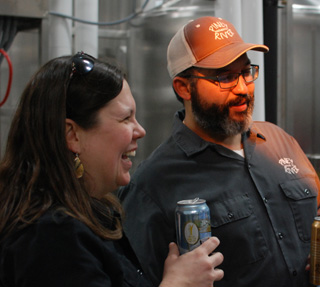
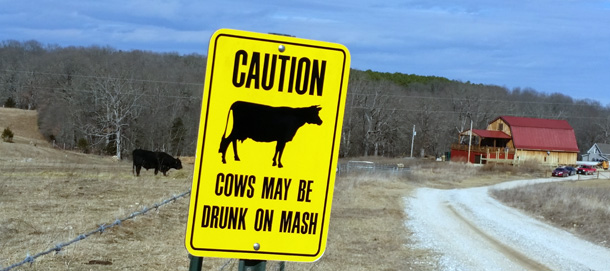
Joleen and Brian DurhamPiney River is located on a farm five winding miles outside of Bucyrus, Missouri, because Brian and Joleen Durham live on the farm. They bought their house in 1997 and the rest of the 80 acres they live on five years later. They raise beef cattle on the property, but were too busy with the brewery in 2015 to get around to selling any. They feed spent grain to the cattle and a sign on the long gravel driveway leading to the brewery warns, “Caution, cows may be drunk on mash.”

They are not afraid of wordplay. When they renovated a 75-year-old barn that became their brewery tasting room they christened it the “BARn.” Each of the beers has a name that connects it to the Ozarks, and a story to back it up. Float Trip Ale, which won a gold medal in the 2014 World Beer CupSM American-Style Wheat Beer category, is the most obvious example. It makes perfect sense to those who frequent the Ozarks, but not necessarily to residents of New York or Los Angeles. Their description: “A float trip is the quintessential Ozark experience. A canoe, kayak, raft or tube and a pristine spring-fed Missouri stream creates a lasting memory of our wild and beautiful outdoors. Our hand-crafted blonde ale is the perfect accompaniment to your day on the river or to simply bring back float trip memories.”

Read more