The essence of beer lies in its aromatic gas

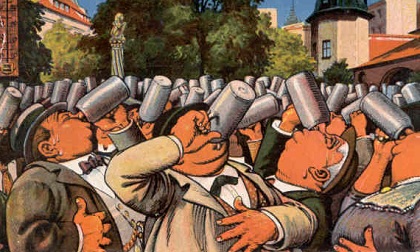
Emptying beer mugs in Munich

It was nearly one hundred years between the time philosopher Henry Finck proposed humans literally have a “second way of smelling” and University of Pennsylvania psychologist Paul Rozin established the role of retronasal smell in perception of flavor.

In 1886, Finck suggested that smell was responsible for at least two-thirds of gastronomic enjoyment. In an essay titled “The Gastronomic Value of Odours” he began: “Amusing experiments may be made showing that without this sense (smell) it is commonly quite impossible to distinguish between different articles of food and drink. Blindfold a person and make him clasp his nose tightly, then put into his mouth successively small pieces of beef, mutton, veal, and pork, and it is safe to predict that he will not be able to tell one morsel from another. The same results will be obtained with chicken, turkey, and duck; with pieces of almond, walnut, hazelnut . . .”

This parlor trick may also be attempted with beer. Much of what we call the flavor of beer — particularly hop flavor — seems to be happening in the mouth, but really our olfactory system is responsible.

Further in his essay Finck turns to the topic of beer. Perhaps it will help you in studying for the Cicerone exam.

Tea and coffee might be called feminine beverages, inasmuch as the fair sex seem on the whole to be more addicted to their use than men. But for the drink next on our list the female population of most countries does not show such a decided appreciation. The reason commonly given by ladies why they do not like beer is that it is “so bitter;” but the real reason is that women are rarely enabled to drink beer under favourable circumstance. The essense of beer lies in its aromatic gas. If that is allowed to escape the beer tastes stale, flat, and bitter, and gives rise to headaches and indigestion; whereas, with the gas, it is palatable, wholesome, and an aid to digestion. To get it in this state it must be taken from a keg freshly tapped and runk on the spot without much delay; and since women of the higher classes in this country (the United States) do not frequent localities where beer is kept on tap, they never have an opportunity to find out how good beer really “tastes,” for bottled beer consumed at home is always vastly inferior to keg beer. In Munich, however, which is the paradise of beer-drinkers, women are fond of beer as the men, because it is considered perfectly proper for the best families to visit the festively illuminated beer-gardens in the evening.

In Munich, too, every mug and glass has a lid to prevent the gas from escaping too rapidly. This gas must not be confounded with the artificial foam which dishonest bar tenders produce in a glass by holding it far below the faucet, a practice which not only compels the gues to pay for half a glass of empty foam, but which allows the real gas to escape prematurely. Every beer glass in Munich has a mark up to which the liquid must reach by a legal enactment, consequently little or no foam is dished up with beer, and the brewers admit that the best beer has no foam on top. Waiters, in pour out bottled beer invariably make the mistake of holding up the bottle as high as possible so as to get a foam.

From wine and most other drinks beer differs in this, that it must be swallowed in large doses to be full appreciated. The most confirmed beer-drinker is overcome with nausea if he attempts to empty a glass with a spoon; and under no circumstances should a glass serve more than three or four swallows. The greatest amount of bliss is apparently vouchsafed to those who can gulp down a whole pint at ounce. Such magicians are as common as blackberries in Germany; and they often give vent to their satisfaction by a sort of gastronomic grunt — a prolonged ääh! A Munich Fliegende Blätter once had a picture of an artist sitting in front of a country tavern drinking beer. The host watches him with a look of dissatisfaction, and finally asks: “Don’t you like my beer” “Certainly, replied the arits; “it is very good.” “Why then,” retorted the host, “don you say ääh! when you finish a glass.”

Drink up.
So who’s drinking all this ‘new’ beer?

Maps, tents, mountains, beer. Taking a piss by the side of the road. Set to music. I’m a sucker for these sorts of things. Don’t know how I missed this video — about a) Deschutes beer, b) central Oregon, c) young people with tattoos, d) freedom, e) fill in the blank — for more than a year. I suggest watching it full screen, and that you won’t be back. That’s OK. It stands on it’s own.

I found “Landmarks” because about a week ago Deschutes Brewery began selling beer in St. Louis amidst considerable excitement, and a local story included a link. It’s a commercial, yes, that speaks to a specific audience. Enjoy it and move on, or if you plan to spend part Monday thinking about the FUTURE OF BEER (please read that with your James Earl Jones voice) then understand this is part of it.

Why the old beer conversations are new again

Good tasting, huh?At the risk of repeating myself . . .

A) If you want to start a heated online conversation then making beer rating the theme seems to be the way to go. Witness the dust up at Beer Advocate that was followed by commentary in 718 722 beer blogs. Or the 57 comments (so far) following Stephen Beaumont’s Sh*t Online Beer Raters Do (But Shouldn’t) post.

Several of the comments in the second focus on serving size. Well, I checked and it turns out NEW BEER RULE #3: You must drink at least two servings of a beer before you pass judgment on it is almost four years old.

B) Yesterday Alan McLeod wrote about the arc and width of beer. His essay drew upon several blog posts and a multi-contributor Twitter conversation. Give it a read to to make complete sense or settle for the conclusion.

When industrial brewers – or, for that matter, any brewers who believes that beer should only taste as they conceive – demand our obedience we are being asked to believe. To believe there was a mythical big bang of flavour when it was truer and more perfect is to believe that you are not a participant in the process.

The latest from wine columnist Matt Kramer seems relevant here.

Today, if you want to experience a wine that is at all different from anything that might be understood as “mainstream,” you have to drink “small.” Put simply, big wineries are all about predictability.

I’ve written about this phenomenon before, suggesting that today’s wine landscape is divided between what I call “wines of fear” and “wines of conviction.” True, small wineries can be fearful and make their wines accordingly. But mostly they don’t, while big wineries almost invariably do.

And, by golly NEW BEER RULE #4: The god of beer is not consistency seems to apply. (And I will be sure to file this in the Beers of conviction category.)

It makes me think I should be writing about something new. Except for many people only recently more interested in beer these topics are new. And there are new revelations within the conversations for and from those who’ve been chatting away a while — witness the Twitter exchanges Alan refers to.

Certainly, there are new areas to explore. In fact, as soon as I hit publish here I must return to examining why two people can smell the same dry hopped beer and one will describe exotic tropical aromas and the other cat pee.

When making beer predictions remember ‘fashion takes strange freaks’

Picking hops in Washington

‘Tis the season for predictions. The Future of Beer, or at least for 2012. The rise of gluten free beer, discovering gruit, more hoppy beers, fewer hoppy beers, old school beers, new fangled beers.

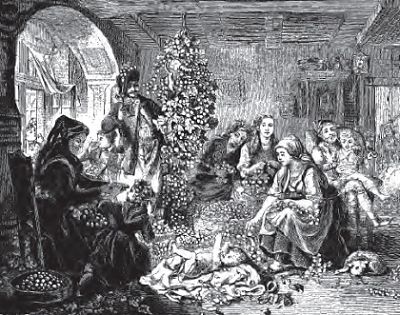
There are more where those came from. They can’t all be right in 2012, but they could be in the long run. Because that’s the way beer works. Consider this from Hop Culture in the United States, published in 1883. The subtitle, Practical Treatise on Hop Growing in Washington Territory, pretty much summarizes the contents. (The pastoral image at the top, showing a family comfortably picking hops, is taken from the book.) The back of the book includes a variety of statistics and contributions from elsewhere. The sources aren’t always obvious, but this was surely written by somebody in England.

Influence of fashion on the use of hops

“The brewing industry is not exempt from the influence of fashion. A careful survey of the types and descriptions of beers in vogue at different times, will show that fashion has had something to do with our trade. Without going back to the olden days, when our Saxon forefathers imbibed freely of ale and mentheglin made from barley and honey, without any admixture of flavoring herbs, we may refer to the period when the introduction of hops into this country gave quite a different character to the national beverage; instead of the sweet and mawkish ale, a true beer, flavored with aromatics essence of the hop, came into fashion.

“This took place in the sixteenth century, since when, hopped beers have been more or less in fashion. Towards the end of the eighteenth century, there was a great rage of black beers, and so great was it that our metropolitan brewers found their trade rapidly increased by the production of this article; porter was consumed in enormous quantities, and it seemed at the one time as if light-colored beers would become things of the past. We know now that fashion for porter and stout is in the decline. Large breweries, at one time engaged solely in the production of these specialties, have altogether discontinued the brewing of black beers.

“Toward the end of the last century and at the beginning of this, the taste of the public inclined to very strong ales. The old-fashioned stingoes and strong stock ales were consumed in large quantities and with thorough relish at this period, probably because the habits of life which then prevailed, caused the physiques of the people to be stronger than the present times. In those days, beer was brewed regardless of cost in many a household, and the modern private trade brewer had scarcely started into existence. Gradually the taste for lighter and cheaper beers grew, until the year 1851, when the great Exhibition marked an era in brewing, as it had done in other industries. The splendid productions of Messrs. Bass and Allsopp, then attracted much attention, and from that time the taste for high-hopped beers has gone on increasing until lately, when there has been an evident tendency to fall back again upon milder and less bitter beers.

“During the last two or three years, brewers have experienced a demand for beers of very low gravity, and containing less of flavor of the hops than was fashion on some twenty years since, and of course it is their bounded duty to comply with the dictate of fashion in this respect. We will not further refer to the threatened introduction of lager beer into this country, than to say fashion takes strange freaks, and it will be well for brewers to be prepared for all eventualities.”

Their bounded duty to comply with the dictate of fashion.

What’s news to me might not be news to you

If you’d like to see what my head looks like on a platter, you might try to reconstruct1 the happenings on Twitter last week when I naively noted: “Sorry, but it seems strange to call an unconfirmed rumor one of the ‘Top 5 beer stories'” of the year'” along with this link.

Because this was the final post in a multi-part series, I hadn’t seen the first, which included a bit of an explanation: What follows is a list of stories that either resonated with Beernews.org readers or got coverage in the mainstream media. I guess I should have understood the story wasn’t just the substance of what Anthony Bourdain suggested — that “Big beer” was responsible for Discovery Channel pulling the plug on the Brew Masters program — but that he tweeted it and it got retweeted. A lot. This was made clear to me.

(In this case, my vision was clouded by the fact that Bourdain’s2 tweet was as stupid as if he had typed “Harwood invented porter”3 and considerably more irresponsible. That’s really an aside, but I did a lousy job of explaining myself in the 140-character exchanges that followed.)

I’m not oblivious to the importance of social media (even though I might appear clueless trying to balance Twitter, Facebook and Google+), nor the importance of what proceeded these virtual water coolers — water coolers themselves. I worked at newspapers back when people spent enough time with them in the morning to get their hands inky black. I sat in on a dozen meetings a week during which we debated how and where to display stories that were “important” versus those that people were talking about around the water cooler.

These days there are ways for people to talk about stuff they really care about that didn’t exist before, and ways to track/measure those conversations. Is following them pandering or simply remembering the news consuming public ultimately decides what is news? That’s a discussion for another space. As well as one about what is news? or even what is beer news?

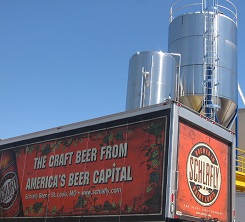
OK, a bit more about the last one, and a quick example of what one day can bring. Saint Louis Brewery founders Tom Schlafly and Dan Kopman announced last Wednesday that a group of local investors had bought a 60 percent (thus, controlling) interest in the brewery. This was not a surprise, because they said more than a year ago they were looking for buyers, and wanted the brewery to remain locally owned. The big picture news will come when we find out if the new owners plan to build another brewery, since the current one (pictured at the top) is at capacity. The same day, Paul Harden at The Wine and Cheese Place posted a note he had received a shipment of Firestone Walker Union Jack that had been bottled only a week before. That’s fresh IPA a 20-minute walk from my house. One a short term basis, just as big.

Coincidentally, a few days before I considered what do people read? from a different perspective. Because I spent not as much time around here the second half of December, rather than dumping comments Akismet flagged as spam on a daily basis I got to them every three days or so. There’s something startling about seeing 10,000 comments from users calling themselves names like acai berry pure, ugg and stealth hid pile up in less than three days. In the course of looking to see if there was any rhyme or reason to what posts attracted such love I ended up with a semi-accurate list of 2011 most popular posts. And no clue about the spammers.

The list is not perfect, because some/many of you read these posts via a feedreader, some when they are fresh, some when they are older. I’m too lazy to sort that out. You might notice some of the best read stuff is from years past. I’m not sure how I should feel about that.

Anyway, the list:

10. What the heck is a nano brewery?
9. Book review: Tasting Beer.
8. Pierre Celis: That was one long shadow.
7. So Americans no longer drink Budweiser?
6. 10 beers that changed America.
5. Who is the world’s most influential beer writer?
4. Blue Moon: Peter, Paul & Mary or Trini Lopez?
3. Reinheitsgebot or Einheitsgebot?
2. The beer that launched 1,600 breweries.
1. Session #49 – Regular beers are part of the revolution.


1 I should probably be able to do that for you, but I blame cognitive failure, being well past 45 years old.

2 That’s not to say I don’t find Bourdain entertaining. How can you not like a guy who appreciates Louisiana as much as he does? I’d be happy to spend a drunken afternoon with him.

3 See The Oxford Companion to Beer: a dreadful disaster? and scroll down to Harwood.