This afternoon Jeremy Danner (@Jeremy_Danner) of Boulevard Brewing “mentioned” (via Twitter) a story a wrote a little while ago for CraftBeer.com that was published today.
I’d kind of forgotten about it, and that I planned to post some outtakes here. So before I resume deciding how many words to allocate to hops from Caucasus one more post for 2011 (despite my previous claim).
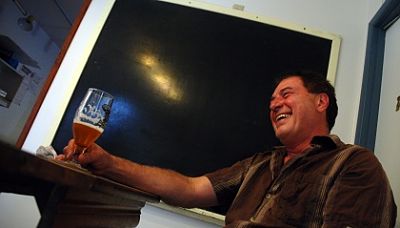
a) That’s Dave Logsdon at the top, formerly the yeast guru at Wyeast and now a partner at Losgdon Farmhouse Ales in Oregon. Just wanted you to see a picture of a guy lovin’ what he’s doing.
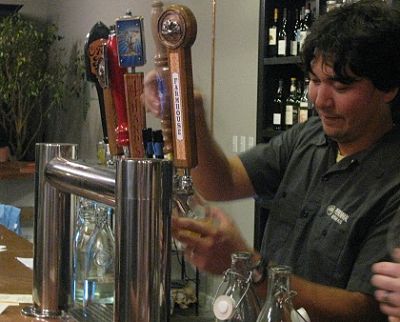
b) This is Phil Wymore, founder of Perennial Artisan Ales in St. Louis. He really helped put the story in focus. It’s a challenge to describe beers inspired by Belgian brewers but made by Americans (with the help of yeast that previously went to work in Belgium). At least when you’re addressing style-obsessed Americans.
Beyond what he said, a little background and a little more detail.
At the time I wrote the story, Perennial had recently released Strawberry Rhubarb Tart and Peace Offering was in the fermenter.
Strawberry Rhubarb was inspired by strawberry rhubarb pie. Strawberries and rhubarb are available locally in the summer, so if the beer appears again that’s when it will. A witbier yeast turned it from wort into beer.
Peace Offering was a spiced squash ale. The base beer is an American Brown (6.3% ABV) with about 200 pounds of maple-roasted cushaw squash, which was pureed and added to the beer during primary fermentation. It was spiced with cinnamon and clove prior to packaging. An American ale yeast fermented that beer.
And Wymore had this to add about what to call these beers.
“The other element of brewing ‘our own versions of Belgian-inspired beers,’ is that we do not want to be held responsible for mimicking all the techniques (e.g. turbid mashing, aged hops, cool ships, open fermentation, etc.) depending on which style we are making. We are not trying to clone our favorite Belgian beers, nor do we have the resources to make them all true to style. Rather, we are choosing our favorite styles and doing our best to create great base beers — to our liking — and layering them with other ingredients to create some complexity — all the while being mindful of striking a thoughtful balance amongst the flavors in the beer.”
c) More from Matt Potts of DESTIHL Restaurant and Brew Works, the Bloomington-Normal, Illinois, brewery whose sour beers had lines clogging the aisles of GABF. He provided geeky process details:
“. . . essentially all of our sours go through a standard primary fermentation with ale yeast, but then we do a spontaneous/wild secondary fermentation and aging in barrels of various types (whether spent bourbon barrels, wine barrels, etc., anything except for the poor unfortunate barrels cut in half and for sale at Menard’s). We use the barrels as our cool ships by leaving them open for some time to expose them to our apparently wonderful downstate Illinois wild farm air. Each barrel is thus truly unique as we do not blend or inoculate the barrels with any lab cultures, for doing so takes away from the spontaneous philosophy of our St. Dekkera Reserve Sour Ale series. There is something about blending that, to me, destroys the fun, uniqueness and genuineness of spontaneous fermentation/aging. If we were to blend, then we just as well inoculate with lab cultures too.
“One question we have for ourselves going forward is whether the beer connoisseur will prefer the uniqueness of spontaneous fermentation in each barrel and each bottle as we grow or if they will prefer to know exactly what to expect (i.e., expect the same) from each bottle of St. Dekkera . . . thus requiring blending and inoculation. Perhaps some day we will have to do that with some of the mainstay sours, like Sour Strawberry, Sour Hawaii Five-Ale or Flanders, but I hope not. Even without blending, our wild air here in Normal, and our process produces sours that have the same underlying very refreshing/thirst quenching, ‘brighter’ sourness/tartness on the palate and balanced natural acidity.
“Each barrel is aged for at least one year and up to three-and-a-half years in the case of our oldest Framboise and Lambic barrels. The average age of the beers at GABF was two to two-and-a-half years old, except for the Framboise . . . a true tart bomb.”
Although Potts referred to “each bottle of St. Dekkera” DESTIHL does not package its beers. That’s in the planning state, so perhaps next year.
 It’s Monday, so a few links. Big picture and 2011 recap stuff. Some are lists.
 Or maybe it is Things I never thought I’d see . . .