Setting a few brewery numbers straight

A couple of times recently I’ve read stories — or, yikes, tweets — that mentioned how many brewing companies remained in operation in the United States in the 1970s and 1980s, then reported the current number of breweries. That’s not exactly apples to apples. Many brewing concerns operate multiple breweries, and the proper comparison would be breweries to breweries and concerns to concerns.

So, for the record, here are a few useful numbers to remember.

The boom years for breweries
(From History of the Brewing Industry and Brewing Science in America, by John P. Arnold and Frank Penman)

Year      Breweries      Barrels produced
1867         3,440         6,207,402
1868         3,756         6,146,663
1869         3,203         6,342,055
1870         3,286         6,574,617
1871         3,147    7,740,260
1872         3,475         8,659,427
1873         4,131         9,633,323
1874         3,282         9,600,879
1875         2,783         9,452,697
1876         3,293         9,902,352
1877         2,758         9,810,060
1878         2,830         10,241,471

The number of breweries never reached the 1878 level again, drifting below 2,000 by 1892 and to 1,092 in 1918, the year before Prohibition began. However, overall production went straight up , to 20,710,933 in 1886, to 30,487,209 five years later, passing 40 million barrels in 1901, 54 million in 1906 and 63 million by 1911.

Many of those breweries operating in 1878 were quite small. BEER, Its History And Its Economic Value As A National Beverage, by F.W. Salem, provides a complete list of production numbers for 1878 and 1879. Thus we can see that G. P. Pfannebecker in Paterson, N.J., brewed 48 barrels in 1878 and 152 in 1879. The biggest dozen breweries in 1879 where:

George Ehret (New York)     180,152 barrels
Philip Best ( Milwaukee)     167,974
Bergner & Engel (Philadelphia)     124,860
Joseph Schlitz (Milwaukee)     110,832
Conrad Seipp (Chicago)     108,347
P. Ballantine & Sons (Newark)     106,091
Jacob Ruppert (New York)     105,713
Christian Morlein (Cincinnati)     93,337
H. Clausen & Son (New York)     89,992
William J. Lemp (St. Louis)     88,714
Flanagan & Wallace (New York)     84,825
Anheuser-Busch (St. Louis)     83,160

Before the renaissance
(From American Breweries II by Dale P. Van Wieren)

1983 – 51 brewing concerns operate 80 breweries. This is the low water mark for number of breweries.
1984 – 44 brewing concerns operate 83 breweries.

19th century startup
(As long as I’m digging through history books, some facts from 100 Years of Brewing, published in 1903)

More than 100 years before Sierra Nevada launched in California, Adolphus Busch bought an interest in a St. Louis brewery owned by Eberhard Anheuser. A brewery had been operating at the same location for 15 years, yet in 1865 sold a modest 8,000 barrels. By the time the name was changed to Anheuser-Busch Brewing Association in 1875 annual production has risen to 34,797.

In the next 10 years production increased by 10%, 48%, 32%, 41%, 34%, 42%, 22%, 22%, and 5% before falling 1% to reach 318,085 barrels. Sixteen years later sales passed 1 million for the first time.

That year, 1901, the plant covered about 60 acres and as well as a brewhouse that could produce 6,000 barrels a day, it had ice plants with 650 tons daily capacity, malt houses with 4,500 bushels daily capacity, a cooling capacity of 2,650 tons per day, storage elevators for malt and barley of 1.25 million bushels capacity, stock houses for lagering purposes of 400,000 barrels capacity, and a power plant with 60,000 square feet of heating surface (equal to 7,750 horse power).
Bent (but not Broken) Nail IPA

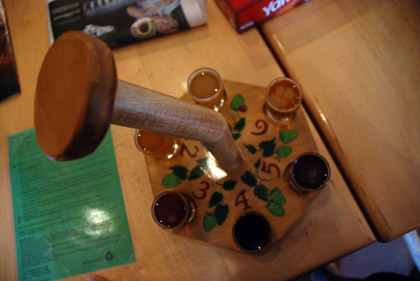
So the story behind the taster tray and the Bent Nail IPA at Red Lodge Ales in the Montana town of the same name is the same.

The beer was named as a tribute to the construction workers who were among the brewery’s first customers. “They said it (the beer) made for a lot of bent nails,” a bartender explained. It’s a solid beer, nicely balanced, worthy of the bronze medal it won at the 2007 Great American Beer Festival (as an American-style Strong Pale Ale).

The handle for the taster tray features the same bent nail. Easy to carry and nicely decorated. Customers use the green sheet, on the left, to order, writing numbers next to the beer name on the laminated menu with a grease pencil. Very efficient.

Broken Nail Double IPA was not available when we visited. My nephew, whose wedding we headed north to attend, assures me it’s worth returning for. We must may.

‘Craft’ beer & existentialism: an identity crisis?

In the front matter of his new book, Great American Craft Beer: A Guide to the Nation’s Finest Beers and Breweries, Andy Crouch revisits the never-ending discussion about “What the heck is craft beer anyway?” If you’ve followed this online, including at Crouch’s blog, this won’t be new.
That he notes it is (at least in part) an “existential debate” seems relevant to a guest post this week at WashingtonCityPaper.com. Greg Engert, the beer director for the Neighborhood Restaurant Group, which includes ChurchKey and Birch & Barley, writes that “Craft Brewing Faces an Identity Crisis.”

The debates that continue to arise as to what craft brewing is are inevitable and often interesting. What I find more interesting is the need for craft beer drinkers, myself included, to pin this down, to specifically signify when identifying something as craft-brewed. And these debates always seem to intensify in the face of further complexity, as if craft beer drinkers need to maintain a sort of ownership and authority over a product that is becoming harder and harder to identify by definition. Perhaps even more importantly, the industry is becoming more complex and more difficult to understand and define just as it is also becoming more popular and—dare I say it?—mainstream.

Engert concludes, “In the end, debates about what craft beer is may in actuality be a burgeoning debate about who craft beer may be.”

Existentialists, have at it.

Should we call it the Artisinal Trap?

Today’s New York Times has an article about artisinal ice cream. There’s that word again. The story focuses on the price of high-end (as in expensive) ice cream.

Read both pages, and not only because I guarantee Taos Cow makes great ice cream. Think about it in terms of our previous discussion.

In case you are on the fence about taking the time, a few excerpts:

  • “Since when is ice cream so expensive?” asked one mother.
  • Stefano Grom serves what may be America’s most expensive ice cream cone: $5.25, with tax, for a “small,” which works out to about $150 a pound.
  • Dairy technology has advanced to a point that consumers often can’t tell the difference. Expensive ice cream is often described as “artisanal” or “housemade,” but neither term has a meaningful definition as relates to ice cream. An “artisanal” gelato shop might only be adding water to a dry mix somewhere on the premises.
  • If you hang out here much you know I think many beers that can fairly called artisinal are underpriced. That doesn’t mean I can’t be offended when a marketer describes a product as “artisinal” just so a company can charge more.

    Found, a cowboy bar (The Mint, Sheridan, Wyoming)

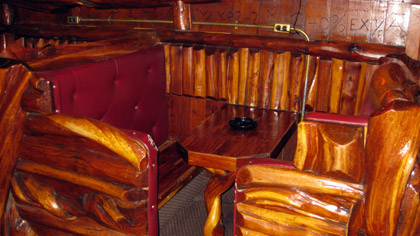
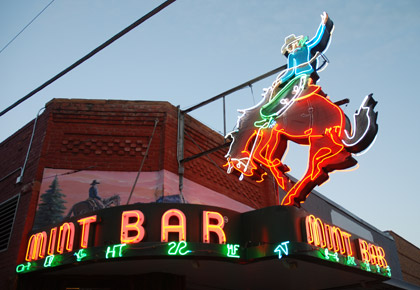
    The Mint Bar in Sheridan, Wyoming, is as impressive inside as the cowboy neon out front. Although not as expansive as The Million Dollar Cowboy Bar across the state in Jackson and certainly not fancy, it holds its own on a per capita basis.

    It is not exactly classic wild west, but with your leather cowboy boots and all, this place looks like it fast.

    The place was hopping Monday evening. People come here to drink — there is no food — to talk, and many to smoke. The wall across from the bar is covered with complimentary clippings and the booths in the back are exceptional (see below).

    We knew about this place before we reached Sheridan, so this wasn’t exactly a lucky discovery. Nonetheless it surpassed expectations, including the beer — eight taps, two of them serving Alaskan Amber and New Belgium Fat Tire.