A new description of beer hell

“. . . stuck in the timewarp of Tennent’s Lager, Belhaven Best and Guinness.”

From a simply brilliant post at I might have a glass of beer.

It’s about a pub outside of Glasgow (you know, Scotland), and includes this paragraph (the italics are mine): “It’s a 15 minute train journey and a 20 minute cycle from the nearest station to the pub. Not as far as it looks, though we got lost in the forest the first time. Once you know the way it’s easy.”

Go read it, please (the last word added after the original post in in deference to Mr. B).


GABF Fantasy Draft 2010 has begun

So the first brewery chosen in The Beer Mapping Project’s Fourth GABF Fantasy Draught was Magnolia Gastropub & Brewery.

I was a little surprised too.

Turns out that RedRover, who had the first draught pick, was busy with something that must be really important since he put it ahead of beer, and he let the Beer Mapping computer make a random choice. Picked since were Cigar City Brewing, Chelsea Brewing, Pizza Port Carlsbad, Miller Brewing, Firestone Walker Brewing, and AleSmith Brewing.

Should I back up and explain? Beer Mapping Project founder Jonathan Surratt organized the first draught in 2007. When you are the floor at the Great American Beer Festival as competition manager Chris Swersey reads the names of the winners and you mention to the woman next to you that the brewery he just called out is on your “team” she’s likely to say something like, “Cool. How’s that work?”

And you explain that if Pizza Port Carlsbad wins a gold medal you earn three points, a silver two points and a bronze one point. Last year brewmaster Jeff Bagby ended up with seven medals, four of them gold, which is the major reason my “team” won the competition. This year, like in 2008 when we were in Switzerland, I’m just watching. Mostly because I figured there’s no way to duplicate last year. Carlsbad was my second round pick, and my fourth round pick won four medals; there were first round picks that won none.

But also because I thought it would be fun to offer commentary on the Beer Mapping discussion board, Twitter or here. I now realize I must wait until next week and most of the picks are made. Right now it would be rude to type something like, “Hey, I can’t believe Firestone Walker hasn’t been draughted yet.”

Meanwhile you can watch it unfold.
The ‘State’ of beer blogging & other links

There are at least 515 “Citizen Beer Bloggers” in North America, according to the organizers of the Beer Bloggers Conference.

In “The State of Beer Blogging” they write, “We define citizen beer bloggers as those who blog about beer or the beer industry and whose blog is not designed to promote a brewery or other business. There are another 45 beer examiners on examiner.com, at least 78 English-language beer blogs in other countries, and probably hundreds of brewery-related beer blogs. These statistics compare to an estimated 1000 wine blogs and 12,000 food blogs.”

I’m not sure how “other business” might be defined since many of the blogs on their extensive list have advertising or promote something (like Brew Like a Monk).

That’s really an aside. Sure the overview was assembled to promote the Nov. 5-7 Beer Bloggers Conference, but it has plenty of useful information and usable tips for any blogger. That and the most recent update about the conference agenda make it clear the gathering will be about more than drinking beer and tweeting.

Personally, I’m still thinking about what this tidbit might mean: “If there is no established trade for beer journalism, the public might easily seek out beer bloggers for advice.” I was under the impression there is a trade for beer journalism and that blogging was just another branch.

  • Virtual Colorado Beer Tasting. It’s tonight, at 7:30 p.m. and organized by Zephyr Adventures, planner of the Beer Bloggers Conference. Both Oskar Blues and Breckenridge Brewery recently sent emails asking fans to participate (Facebook, Twitters, blogs) through their own sites or gather at brewery pages. (I know, this sounds awfully confusing but – for instance – you could follow Breckenridge on Facebook or Twitter [BreckBrew] or use a hashtag on Twitter.) You can read more about the plan here, although as I type this the page says that 7:30 Mountain is the same at 9 Eastern. No, it’s 9:30.
  • British beer: Booming or boring? Seventy-eight new breweries have opened in the United Kingdom in the last 12 months, for a net gain of 56 breweries. So things are booming, right? Writing in The Independent, Will Hawkes does not take it easy on British brewers: “Maybe, maybe not. The growing popularity of American beers in the UK suggests that things are not quite so rosy. The innovative, hop-heavy character of Yank beers is clearly filling a gap in the market, a gap that British brewers have failed to fill.” He points to Meantime and BrewDog as exceptions, but there are many more – Thornbridge and Marble for starters.
  • Beer apps. Evan Benn recently compiled a list for mobile apps for beer drinkers. I’m already getting enough press releases about other new apps, so it could be dangerous to acknowledge any of them. However, credit to Beerby because they added an Android version (not so much credit because their splash page has you looking for Pabst Blue Ribbon). And I have to mention the Belgian Beer Tour in Brussels not because, to be honest, I know if it is worth $2.99 but because it is Brussels. Reviews of either are welcome.
  • Consolidation started long before Prohibition

    Here’s what the beginning of brewery consolidation looks like.

    Last week I dug up a bunch of figures about the number of breweries and how much beer they made more than 100 years ago. Mike asked for a little perspective. So this chart starts in 1870 (the number of breweries peaked in 1873) and includes how much beer each brewery produced, on average, as well as per capita consumption by a growing population.

    It tracks until 1920, the year Prohibition went into effect and picks up in 1935, a couple of years after repeal. The number of breweries steadily declined after 1935, while per capita consumption eventually surpassed 1910, peaking at 23.8 gallons a head in 1981. By 2000, of course, the three largest breweries produced more than 80 percent of American beer.

    Year     Breweries    Barrels    BBL/Brewery    Per capita
    1870       3,286 6.6 million       2,089 5.3 gallons
    1875       2,783 9.1 million       3,414 6.6
    1880       2,741 13.3 million       4,852 8.2
    1885       2,230 19.2 million       8,610 10.5
    1890       2,156 27.6 million       12,801 13.6
    1895       1,771 33.6 million       18,972 15
    1900       1,816 39.5 million       21,751 16
    1905       1,847 49.5 million       26,800 18.3
    1910       1,568 59.5 million       38,010 20
    1915       1,345 59.8 million       44,461 18.7
    1920       478 9.2 million       19,312 2.7
    1935       776 45.2 million       59,008 10.3

    Data from the History of the Brewing Industry and Brewing Science in America and the U.S. Brewers Association.

    A good brewery museum is worth supporting

    The Christian Science Monitor’s feature “5 famous pork projects: Beer museum and more” includes, as you might have guessed, funding for the National Brewery Museum in Potosi, Wis.

    In 2004, The Potosi Brewery Complex restoration project received a $449,574 grant from the Federal Highway Administration’s National Scenic Byways Program to help renovate the building in order to attract tourism. Straddling the Mississippi River in Wisconsin, the renovated brewery became home to the National Brewery Museum, the Potosi Brewing Company Transportation Museum, a Great River Road Interpretive Center, and a micro brewery.

    I don’t understand why this is a bad thing. As far as government projects go a half million dollars isn’t much. Efforts to create a national museum have failed elsewhere. Beyond the fact the museum houses rotating exhibits of items on loan from members of the American Breweriana Association there’s the Research Library. What could be more important?

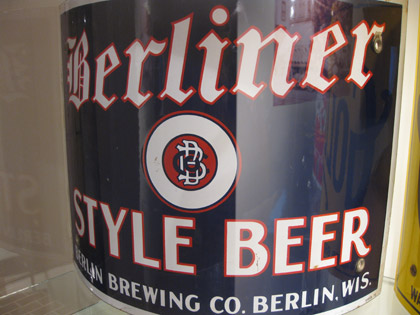
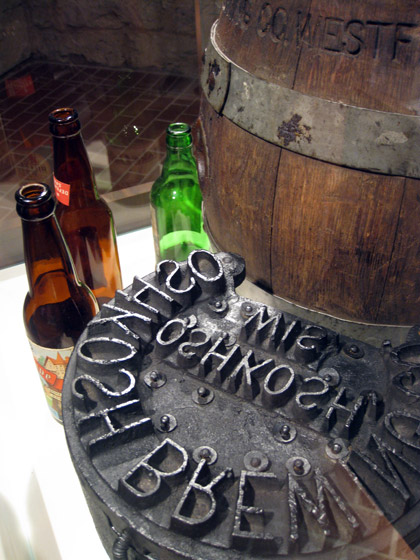
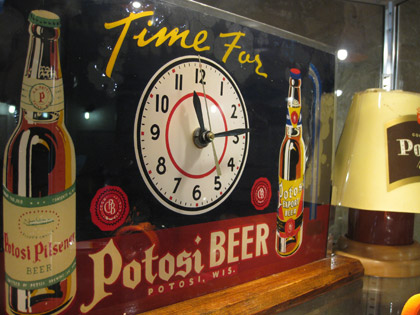
    A few photos from when we visited a couple of years ago: