Perhaps Vince Cottone was not the first to use the words “craft” and “beer” together, but in his 1986 “Good Beer Guide: Brewers and Pubs of the Pacific Northwest” he put definitions of “craft brewery” and “true beer” into words when nobody else did.
Cottone — who today runs Sound Systems, a company that offers brewing equipment for sale as well as consulting services — answered the “who was first” question via email:
“I can’t swear I was the ‘first’ to use the term, but I also don’t remember any source I borrowed it from. Possibly CAMRA used it in the UK before me, and in fact I traveled there in 1984 and ’85. If they did use it their usage was probably very casual and I don’t think they made any attempt to define it or promote it as an something like an appellation. I know of no brewing company who used it prior to my book.”
When his book first appeared North America was home to scores of small breweries that opened only since 1980, not hundreds (or eventually more than 1,500). Consider that context. Also, that at the time Cottone wrote for many publications, both within beer trade and outside (such as the Seattle Post-Intelligencer and The Washington Post).
I use the term Craft Brewery to describe a small brewery using traditional methods and ingredients to produce a handcrafted, uncompromised beer that is marketed locally. I refer to this beer as True Beer, a detailed definition and description of which appears in the following section.
The name Craft Brewery is used in lieu of several other terms which have been used recently to describe small breweries,: “boutique brewery,” used by Michael Jackson in his Pocket Guide to Beer; “cottage brewery,” favored in Canada; and “microbrewery,” the term adopted by most American small breweries. I chose Craft Brewery because it better describes the breweries we are discussing.
The term “microbrewery” has arbitrarily been defined as “a brewery” producing less than 10,000 barrels of beer annually.” But some, if not most, of the Northwest’s small breweries will eventually produce more than that amount. And, since it’s possible for a microbrewery to be other than a Craft Brewery and vice versa, the term is both more specific and more versatile than any of the others.”
In fact, 10,000 barrels provided to be an arbitrary enough figure it was not much later changed to 15,000 (where it remains today). As points of reference: Sierra Nevada and Redhook Ale Brewery both sold 10,000 barrels for the first time in 1987, and two years later Sierra Nevada sold 20,884 barrels and Redhook 15,000. Anchor Brewing, of course, was bigger, but was not a startup.
Cottone’s discussion of “True Beer” is rather complete. He discusses ingredients as well as process, explaining when adjuncts might be permitted, investigating finings, filtration and pasteurization. He didn’t pull any punches: “North American Industrial Brew does accomplish a few things True Beer can’t: it is made to ship and store well. As such, it is technically as flawless as beer can be. It is unfortunate that beer must lack taste in order to survive time and travel, but that is an unalterable fact. If beer was judged by its stability alone, Industrial Brew would have to rate as the world’s finest.”
The basics are in the introduction, but his full definition made it easy to tap a glass (or a bottle) and say, “Yep, qualifies” or “nope, not this one.” Not as simple 25 years later.
The problem of defining the category of beers covered by this book was not easily solved. I’ve chosen to call our ideal brew True Beer in order to distinguish it from brews that I feel don’t measure up to the standards set for the ideal, uncompromised beer.
The choice of the term True Beer was partly by default. “Traditional” has been badly overused and misapplied to beer. “Authentic” has been used in promotional material by a major beer importer, and I don’t feel that most important beer, having usually been pasteurized before shipment, then transported great distance, qualifies as “uncompromised.” “Honest” is part of a trade name of a locally-produced lager. Finally, “real” was ruled out because I didn’t want to borrow too heavily from Britain’s Campaign for Real ale (CAMRA), protectors of the empires national tipple.
So I’ve chosen the term True Beer to describe the ideal, uncompromised beer, beer that’s hand-made locally in small batches using quality natural ingredients, served on draft fresh and unpasteurized.
He did not begin using these terms for marketing purposes. Sure, the words “craft beer” soon got used that way. And they certainly provoke debate that we don’t really need to revisit.
You might want to compare what Cottone wrote to the official Brewers Association definition, but remember that reporters may choose not to be so specific when the write about “craft beer” and the person on the stool next to you is also entitled to his or her own opinion.
 We’re headed north in the morning (attention burglars: somebody will be watching our house), eventually to Montana and Wyoming because my brother’s son is getting married in a week.
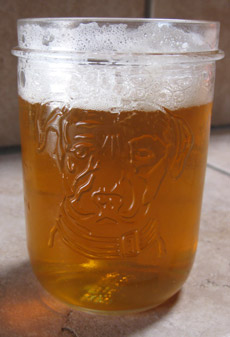 I think the Lagunitas glassware pictured on the left has been around a while. However it’s just now that I’m looking at a press release dated 3.5.10. It arrived yesterday and it made me laugh out loud. So I will pass it along without comment, other than to note I hope you enjoy it as much as I have: