Do you feel the hate? Do you feel the love? Do you drink the Bud?

Questions, questions, they abound today in the beer blogosphere.

* Mike Sweeney at STL Hops asks, “Can a beer ever be life changing?” It sprang from a tweet about Pliney the Younger: “Great beer = yes! Life changing = no” Read the answers (comments).

* Mark Dredge of Pencil an Spoon fame tries various beers with Jambalaya. As much as he loves Thornbridge Jaipur it doesn’t work with the dish. But Budweiser does.

I’ve got no problems drinking Budweiser and as a beer it fascinates me, particularly its history. It’s very pale, doesn’t bellow out a huge aroma (most people drink it straight from the bottle so forget late hops), but has that classic bite of apple. It’s clean and crisp, cold from the fridge it’s uncomplicated and easy to drink: it is what it is. With jambalaya… it was perfect. I wanted it to just be ok, but it was spot on.

I ask, why aren’t more people who take the time to drive across a town or a country to find a beer different this open minded about Budweiser?

* Alan McLeod, not surprisingly, manages to pose a pocketful of questions without using a question mark. (Disclaimer, and he politely links this direction.) You need to head on over to understand the headline at the top.

I had just viewed Zak Avery’s video salute to Bell’s Hopslam before I got to reading Alan. Curiously — those of you studying Struck and White today will understand no irony was involved &#151 when I went to add comment that this is where he could find love and good video I found he’d already done that himself.

Drink that IPA now (please)

Six of the top eight new “craft beer” brands in the United States in 2010 were IPAs of some sort (sometimes “imperial” or “double,” sorry Mr. B), according to Symphony IRI, which tracks beer sales in various channels.

Curiously, although “American-Style India Pale” annually draws more entries than any other category at the Great American Beer Festival, before 2010 no single brand could be found at Walmarts across the country. Now there are three — Sierra Nevada Torpedo, New Belgium Ranger IPA and Samuel Adams Latitude 48. Sierra Nevada introduced Torpedo in 2009, the other two were new in 2010 (Latitude for just the last four months and still it was the second best selling new “craft beer,” behind Ranger.)

What does this mean? That IPA is going mainstream, going viral, about to trend on Twitter? Something like that. Plus thousands more people will get the story behind India Pale Ale wrong. (Save yourself the pain — just tell them to go buy Amber, Black & Gold and/or Hops and Glory.)

One bit of explanation. Symphony IRI tracks packaged goods through a variety of channels, such as supermarkets, convenience stores and big box stores. The places lots of people buy lots of stuff. IRI doesn’t get data from every single liquor store, including perhaps the one where you buy special beers. They don’t track sales in bars or brewpubs. Places where IPA was already on the radar.

However, when the Brewers Association finishes collecting information from its members and announces “craft beer” sales totals for 2010 they’ll likely reflect what Dan Wandel of IRI told BA members in a conference call on Thursday. He reported that dollars sales of what IRI calls craft beer (pretty much the same definition as the BA) increased 14 percent and case sales 12 percent.

Supermarket sales of Torpedo soared 154 percent in 2010. IRI now lists it as the 11th best selling craft brand (its definition, so no Blue Moon White, which would be No. 1). However that’s classifying seasonals and variety packages as brands. The top-selling six actual beers are Sierra Nevada Pale Ale, Samuel Adams Boston Lager, New Belgium Fat Tire, Shiner Bock, Widmer Hefeweizen and Torpedo.

Two more data points: IRI began tracking 53 additional IPA brands in 2010 and IPA’s share of what constitutes the IRI craft universe grew from 9 percent to 11 percent.

Many of these new drinkers may well tweet “I’m drinking such and such IPA at such and such pub” without even knowing that’s short of India Pale Ale (see above). That might be just as well, because they start hearing about beers brewed for a long journey as sea, built to last, full of hops that act as preservatives and they’re going to be tempted to stick a few in their cellar to see how they age.

An interesting idea, but not necessarily a good one for American IPAs. To quote from the Brewers Association style guidelines, “The style is further characterized by fruity, floral and citrus-like American-variety hop character.” And those American hop aromas — love ’em or hate ’em — are highly volatile. Much more so than the hops that would have flavored nineteenth century India Pale Ales.

After a couple of months many of those floral, citrusy, catty aromas that identify an American IPA will fade from even the most carefully bottled and handled beers. Subject them to a little bit of heat or agitation in transit — you know, like on a moving boat — and they’ll be plain old pale ales even sooner.

The best time to drink an American IPA and have it taste like the brewer intended was 600 words ago, when you read the headline.

‘Craft’ beer and degrees of sucking

ABSTRACT

You may declare that a beer sucks because it is genuinely flawed. For instance, you spot the tail of a mouse in the bottle. You might say it sucks because you’ve had the beer before and it was much better then. That’s probably not the word I’d use, but I understand. You might yell that it sucks because it isn’t too your taste. Say it’s a cucumber beer (I’ve picked on pumpkin beers enough). Now we’re talking like people who’ve maybe had a few beers.

THE BACKGROUND

Today Max takes us nicely from Point A to Point B to Point C. Before quibbling with his conclusion and providing a longer answer than fits in a comment at A Good Beer Blog, the suggested reading:

Mark Dredge is promoting a larger discussion about if using the term “craft beer” in the UK is in order. Good comments there, and further chatter in various UK blogs. But I particularly like Barm’s response at I Might Have a Glass of Beer. Beyond the fact it is simply good reading he makes it clear this is not a discussion for Americans to join in. It is about a different beer culture.

To move the conversation along, a takeaway from Dredge:

It (“craft beer”) is a suggestion that what you are getting has more investment than a hefty marketing budget; it has a heart and soul, it’s made for people who prefer taste to TV commercials.

And from Barm:

Everyone knows the beer range of the third-rate microbrewery. There’s the 5.0% boring golden ale; the 4.2% brown bitter that tastes mostly of toffee; the 3.7% session ale, suspected to be the 5.0% ale with more water in it; and the seasonal beers which are the 4.2% bitter rebadged with a lewd cartoon on the pumpclip. I don’t see any reason to dignify this stuff by labelling it “craft”; nor do I understand how, if we are to refuse it the label “craft”, we can objectively distinguish — other than by taste — between it and beers that we like better. In which case, the definition has become “beer that I like”.

Now, on to Max:

Passion could serve well as an emotional reserve when things aren’t going too well, but real success depends on other factors: proficiency, professionalism, seriousness, business talent, knowledge of the market, determination to do things well and respect for the consumer, specially for small brewers.

My quibble would be that it is passion, or conviction, that sometimes takes a beer from “better than good enough” to great. Because the brewer invests in better ingredients and better equipment.

CONCLUSION

The road to excellent beer is paved with good intentions. They are not enough.

Which takes us full circle to the question Alan asked: “Is It Fair To Say A Brewery Sucks… Or Even A Beer?” My comment: To the questions in the headline: Yes, and yes. As long as you are prepared to say why, and why you are qualified to make the judgment.

It was late, so I was thinking quite literally rather than in any philosophical sense (remember that Alan was a contributor to “Beer and Philosophy” and you never know when he’s going to go all Socrates on you). I arose this morning to this fair question: “Who is qualified? What is sucking?”

The comments that followed answer this pretty well. Most beers fall between “awesome” and “this sucks,” although we tend to overuse both of those words. And beer appreciation is subjective.

But there are objective measures, which I was referring to in my literal comment. Quality control is quality control. Were somebody to finance us we could start pulling bottles off the shelf and putting them through their paces. Any wild yeast? Buttery diacetyl (don’t shoot – not always bad)? How’s the dissolved oxygen? There are other measures, but you get the point. Not only could we say, “This beer sucks” but we’d be able to say “This one will soon.” And at some point we might decide, “This brewery sucks.”

(OK, a brewery can’t account for a consumer who buys a six-pack of beer and leaves it sitting on the sunny-side of the car on a hot day for two hours. That beer is screwed.)

It takes just as much conviction for a brewer to focus on process as stuffing “wow” in the bottle. Those are the brewers who invest in laboratory equipment, and people who understand how to use the equipment. That’s easier when a brewery is growing — or “achieving scale” — even if it makes it look a little less “crafty.”

Just to be clear, I still want the “wow” factor (well, sometimes). I’m not abandoning New Beer Rule #4. It takes something special for a brewery to make great beer decade after decade. Certainly passion on the part of somebody. But passion goes beyond brewing great beer. It includes delivering great beer.

What beer would you lick off a table?

I’ve already figured out I’m going to be behind what almost everybody else in the beer world is reading for all 2011, accepting that learning a hell of a lot about hops is a fair trade. Thus this three-week-old entry from Miss Manner just hit my radar.

Dear Miss Manners:

My boyfriend and I were sitting at our kitchen table having a beer the other night. He accidentally knocked his beer over, spilling some out onto the table before it could be turned upright.

I was absolutely shocked when he proceeded to loudly suck up the spilled beer from the table.

My face apparently showed my shock. A long argument then ensued over the questionable appropriateness of his action and my reaction.

Can you please help me to better articulate why sucking up a spilled drink from a table is just flat wrong?

Try explaining that any behavior that would be considered offensive in a dog is also offensive in a human being (although you needn’t alarm your pet because the reverse is not necessarily true).

Miss Manners suggests that you head off further trouble by informing your beau that just as he is barred from licking the table when he is thirsty, he is also barred from chewing your slippers when he is hungry.

A great answer. But I’m betting Miss Manners has never spent a dollar an ounce (or more, particularly on premise) for beer. Not good for your image to be spotted licking a table, I agree, but — be honest — could you see yourself doing that? I’m guessing if so your decision would follow a quick calculation about how much the bottle cost, how hard it would be to replace, how clean the table was, and what you had to gain by such a display.

After all, you might have an image to uphold.

The wide, wide, wide world of beer drinkers

“I am special, I am special! Please, God, please, don’t let me be normal!”

— Louisa, from The Fantasticks
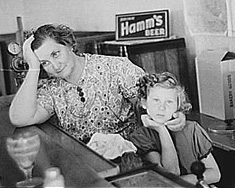
Beer drinkersWould you think me more special if I had tasted every particularly rare beer on the Rate Beer or Beer Advocate top howmanyever lists?

Is your palate better than mine because you appreciate the subtleties of low alcohol, lightly hopped beers and if I can’t taste a big-sized dose of Simcoe/Citra/Amarillo hops I’m bored silly?

Do you watch American Idol?

If you answered yes to any of the above I’m not quite sure why you are here. But, please, don’t leave. It’s little fun drinking alone; the point of drinking beer would be lost.

I’ve been considering this for almost two weeks, since Zak Avery posted his questioin about Elitism in Beer. To understand you should read that post and the comments, skip over to Alan’s follow up (again, the proof is in the comments), then back up to Tandleman’s Beer Blog, particularly this post (and, ahem, the comments).

Now indulge me by following one more link, this one to W. Blake Gray’s essay about “Why all wine lovers just don’t get along.”

He starts with a “study” from Constellation Brands a few years back that divided wine drinkers into six categories. The two he zeros in on are “Image Seekers” (he renames them “Quality Seekers”) and “Enthusiasts,” writing “The former spend the most money on wine; the latter expend the most verbiage on it. These are the only two who care enough about wine to read articles or blog posts about it.”

Hmmm. The others are: Overwhelmed (buy wine but don’t know anything about it); Satisfied Sippers (buy the same brand); Savvy Shoppers (look for discounts); and Traditionalists (like old wineries and are brand-loyal). I’m pretty sure that beer drinkers who would fit into similar categories can read, and I hope they do.

Anyway, I can’t resist this analogy: “And like a marriage entered into after one date, they are stuck together even though they’re incompatible, with verbal sparks flying all the time.”

To make the distinction clear he reduces it to one word (well, one word each, two in total).

Quality (or Image) Seekers want “great.”
Enthusiasts want “interesting.”

The beer-wine analogy is not perfect, but Gray says that Image Seekers (in this case I like the Constellation verbage) spend more and enthusiasts are reluctant to — in part because they understand how many great choices there are at more reasonable prices. “Quality Seekers would spend four times as much to get a wine that’s 10% better,” he writes.

Now to the nut.

What strikes me is how deaf both sides are to the other. The 100-point scale debate, for example: I’m always astounded that Enthusiasts want to take information away from Quality Seekers, and don’t even try to understand why they would want it.

Meanwhile, on the Quality Seekers side, they look at Enthusiasts the way people with jobs looked at tie-dyed student protesters. Yeah, yeah, you love the sound of your own voices. The louder you yell, the less I’m going to listen.

Go back and read the comments in the links above. You catch a bit of that sort of attitude, but you also get the sense that the participants understand (in part because they live in a relatively small country) they might some day continue their discussion in person rather than via a keyboard and computer screen.

Over a beer. So it will be civilized.

Which is what makes beer great.