
Pierre Celis: That was one long shadow

Pierre CelisPierre Celis died Saturday. He was 86 and best known for resurrecting the Belgian White “style” and an otherwise extraordinarily engaging gentleman whose influence cannot be overstated.
He was 40 years old, delivered milk for a living and had little brewing experience when he produced his first official batch of Oud Hoegaards Bier in 1966. Celis brewed fourteen times that year, producing 350 hectoliters (less than 300 barrels). Just over 5 feet tall, from the beginning he described himself as a “small brewer.”

Of course his brewery grew much larger and his became a big story, one that will be retold many times in the coming days. You’ll have to settle for a couple of small stories here.

* Rob Tod was working at Otter Creek Brewing Company in Vermont in 1994, when he sampled Celis White for the first time. “People were traveling, and they’d bring back beer. Every few weeks we’d have a tasting,” Tod said. On June 30, 1994, he left Otter Creek to start Allagash Brewing. One year to the day later, he put Allagash White on tap at Portland’s venerable Great Lost Bear.

Allagash has earned considerable fame for the range of beers the brewery now sells, but the White still accounts for more than three quarters of sales. Traveling in Belgium on Sunday, Todd told 5,000 followers on Twitter something they probably didn’t now. That Celis was dead. “Very, very sorry to hear the news of the passing of Pierre Celis… he was obviously a huge influence on Allagash.”

* Kevin Brand was an engineering and chemistry student at the University of Texas when he visited the Celis Brewery in Austin, a few years after Celis founded it in 1991. “It dawned on me that beer could be brewed here, not just in St. Louis,” Brand said.

A dozen years after he graduated and moved to the San Francisco Bay area, Brand returned to Austin and started (512) Brewing Company. He had only been open a month or so in 2008 when Pierre’s daughter, Christine Celis, who remained in Austin after the Celis Brewery closed in 2000, called to say her father would be visiting from Belgium and wanted to stop by (512). (Credit to Austin 360 for taking the photo at the top at that time.)

When he did he drank (512) Wit. It is not the best selling beer in the (512) lineup, but Brand likes the idea of keeping the Austin connection to wit alive. After he learned Celis would be coming he tracked down a distinctive heavy Hoegaarden glass, the heavy “jar” so closely associated with the brewery, so Celis could autograph it for him. “He had some great stories,” Brand said. He also talked shop, going into detail at times, providing Brand with ideas about how to improve his beer.

Pierre Celis deserves to be introduced as the man who popularized “Belgian White” beer literally around the world, who accelerated American interest in Belgian-inspired beers and encouraged greater creativity with projects like his own cave-aged beer. But just as important he remained a “small brewer,” one who proved to others “that beer could be brewed here.”

Perspective

In 2001 Anheuser-Busch began an expansion to boost capacity at its Fort Collins, Colorado, brewery 28% increase to 8.2 million barrels annually. A few years ago I toured the brewery and I’m pretty sure I heard production had reached 15 million barrels.

Monday, the news that Anheuser-Busch (InbBev) bought Goose Island, which produced 127,000 barrels in 2010, probably chewed up more bandwidth than the Fort Collins brewery has in its history.

Since everybody else has an opinion about what the Goose Island sale means I’ll be honest and type, I don’t know. And unless you’re drinking beer with Dave Peacock and Carlos Brito right now there’s every chance you don’t know either.

Instead, meet me for the Goose Island tour in 2014. We’ll see what’s available in the tasting room after the tour ends.

It’s just strange enough to be compelling

Relatively early in Ska Brewing’s parody of the “Brew Masters” series on Discovery Ska co-founder Bill Graham hints that perhaps what we are watching could be more tightly edited. He’s right, but for some reason I couldn’t quit watching.

It makes much more sense if you saw the first episode of “Brew Masters.” And as long as they were going to begin with an allusion to “Star Wars” they might as well have asked Sam Calagione to appear as Yoda during his gracious cameo.

But, as I’ve written before, beyond excellent beer there are many reasons to like (even in a Facebook way) Ska Brewing. This video reflects that.

Session #49: Regular beers are part of the revolution

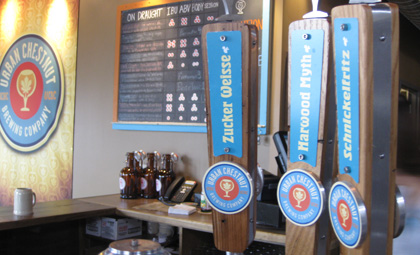
Reverence taps at urban Chestnut Brewing Company

This is my contribution to the 49th gathering of The Session. The theme is “regular beers” and my post is a bit late, but I have a good excuse. Besides, as the host I guess I can do any dang thing I want. Just to make sure all the dispatches from far flung outpost have arrived I will wait until Tuesday to post the roundup.

What kind of beer do you drink after a Mardi Gras parade?

The SessionOK, maybe it depends on how much you were drinking while begging for beads, but for the sake of what follows let’s agree it would be a “regular beer.”

Saturday much regular beer was consumed along the Soulard Mardi Gras parade route that stretches from Busch Stadium in St. Louis to the Anheuser-Busch brewery, and plenty more in parties that continued into the night. That’s another story, including how Mardi Gras in St. Louis compares to Mardi Gras in New Orleans (much colder).

This one’s about how beers of the revolution often become regular beers. Because standing in front of the taps at Urban Chestnut Brewing — located pleasantly out of the way of the madding Mardi Gras crowd — it appears that regular beer might reside on either side of the line demarking what UCBC calls beers of revolution and beers of reverence.

Urban Chestnut, which was still waiting for brewing equipment to arrive when I visited St. Louis in November, began serving its beer little over a month ago. Its menu describes the Revolution Series as “Our contribution to the renaissance of craft beer ~ brewing artisanal, modern American beers.” The Reverence Series is “Our celebration of beer’s heritage ~ brewing classically crafted, timeless, European beer styles.”

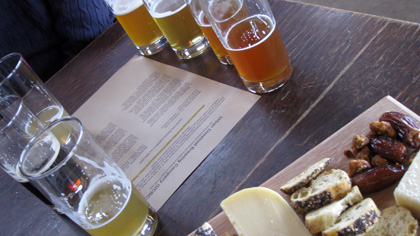
Beer and cheese samplers at Urban Chestnut Brewing

The seven beers available Saturday are pictured (along with the cheese sampler) above, the Reverence Series on the left, the Revolution Series on the right. They are described in detail at the brewery website, along with plans for other beers.

I was impressed, impressed enough to consider what beer I would bring home in a growler were the keepers of the airways willing to let me do that. Were it to share with friends looking for something different it would have been the Hopfen (a “Bavaria IPA”) or the Zucker Weisse (“essentially a Berliner Weisse,” with more bready/doughy character than I can remember tasting in any commercial version of anything called Berliner Weisse). To drink myself, that would be different. TBD or Wasandis, the unfiltered pils.

But when you call your brewery Urban Chestnut and you make a beer with chestnuts chances are that’s the beer people from out of town will be talking about. Winged Nut is the sort of beer that you wake up one morning and they are pouring on the Today Show.

Saturday we watched a couple — Baby Boomers, if you care about demographics — come in and order without surveying the draft board. Obviously not their first visit. They took their goblets of Winged Nut to a table by the window, hauled out their books and began to read.

Brewing a beer with chestnuts is not totally new. In fact, Italian brewers produce more than 40 different chestnut beers. However, I’m not sure any of them ferment those beers with a yeast most often used in fruit-rich/spicy Bavarian weissbiers. It’s different, it’s good, and at 6.5% alcohol by volume it packs a punch. Saturday it appeared some drinkers have already made it their regular beer.

The Session #49: Regular beer (guest post II)

The SessionThe topic for today’s 49th gathering of The Session is “regular beer.” Since I’m the host I offered to publish posts from readers who don’t maintain blogs. This is the second of two.

By Bill Farr (a semi-regular commenter here)

How I gained a regular beer and wrestled with virtually every issue related to “good beer”

The beer I drink most often is Arrogant Bastard Ale. For me to get to the point of having a regular beer, I managed to hit pretty much every topic that appears in the beer site forums – among others, scarcity’s perceived effect on flavor, variety, drinking “local,” the perceived quality of a brewery, the evils of marketing – and one that rarely gets addressed except to be quickly dismissed. I’ll close with that one.

I live in Illinois, and up until a year or two ago, Stone Brewing Co. didn’t bring their beers to Illinois. I learned of Arrogant Bastard years back through my brother-in-law, who had found a clone homebrew recipe for the beer in Zymurgy back in 2003. He tried the recipe and raved about it. I tried his brews, and he was right. Of course, who knew how the homebrew compared to the actual beer?

Well. I became aware that Stone was available in Indiana, and occasionally was able to cross the border and pick up their brews. Loved them. LOVED them. Waxed rhapsodic in written reviews. Especially loved Arrogant Bastard, and occasionally mentioned that it was my favorite beer, or one of two (neither of which I could get regularly). Wondered how much of this was due to only having a few bottles a year.

In the meantime, I drank like the stereotypical craft beer drinker as portrayed in, um, our literature. There was always a different beer or three in my fridge, and I was always trying something new. Believed in drinking local brews – frequented my local brewpub, drank a lot of brews from relatively local brewers. And . . . and eventually realized that certain brews and breweries kept re-appearing, because I liked their stuff.

And Stone entered the Illinois market. And by this time, there’s a backlash against Stone by some folks on the beer site forums – the beer’s too pedestrian, too gateway, too behind the times, no longer as good since they opened the larger brewery, too reliant on marketing, only as popular as it is because the company bullies others. “Huh,” I said, being unable to imagine a world where Arrogant Bastard would be deemed “pedestrian” or a “gateway” brew. And bought a bottle or three, and it was as good as it ever was.

And now I buy a bottle or two a week, and often it’s the only beer I drink in a given week. And I’ve learned a couple of things. One is that, for me, here’s a case where the beer’s former rarity didn’t make it taste better. It’s really good, and more often than not, it’s what I want to drink when I want beer. I explore other brews when I visit places, or when somebody recommends something, but . . . I’m not minding that, say, half the beer or more I drink in a given year is Arrogant Bastard. A corollary to this is that my experience drinking Arrogant Bastard and other Stone brews hasn’t provided any evidence of a change in quality in the beer produced by Stone over the years. Nor a diminishing in complexity, nor any evidence that other breweries have passed Stone by. Which suggests to me that the next great thing doesn’t mean it’s a thing not to be missed – I don’t need to try everything from every newly-loved and praised brewery. I don’t feel my life is somehow less full for not yet having the chance to try X, or perhaps never getting the chance to try Y. It’s ok. I’ve found things that bring me joy.

I’m a bit perturbed that my drinking locally has diminished, but . . . if my local breweries don’t produce something I want to drink as consistently, what do I do? Reduce my enjoyment? It’s tricky – rarely are all the ingredients of which a beer is made local to where the beer is made, so it comes down to local jobs and pride. And I guess that for me, if the local guys are able to sell all they make, I don’t have to feel guilty. It’s presumably going to folks who enjoy it as much as or more than I do.

Whether marketing is a bad thing — well, if people care, more power to them. The beer’s good.

So, having a regular beer has helped me make personal peace with many of the burning arguments on the RateBeer and BeerAdvocate forums. But it hasn’t helped me resolve one issue that rarely comes up on the forums except to be quickly dismissed. That issue is whether I (and others in the good beer community) drink too much for my (or for their) own good. Arrogant Bastard is over 7% abv, and only comes in a 22 oz. bottle. I already know I am susceptible to problems drinking — even a glass of beer or two at night might mess up my sleep and hence my effectiveness the next day, and a bomber of Arrogant Bastard is a bit more than a glass of beer. I know it affects my weight negatively, because I like to eat when I drink. And I know that, after a certain amount of alcohol, I’m going to want more alcohol. It’s here where the fact that Arrogant Bastard comes in single bombers rather than, say, six-packs helps — if I only buy one at a time, I can only drink one at a time. But that one bottle is still a lot of alcohol, and a lot of calories.

I’ve learned that it’s easy for me to stop drinking for weeks at a time, and that drinking socially is easy. But I also know how easy it is to drink too much in the comfort of my own home, and how easy it could be to do it all the time. And I read the folks who contribute to many of the beer site forums, and I wonder if the pursuit of enjoyment and camaraderie and connoisseurship has moved to the point of potentially dangerous drinking for many of them. And, well, to each their own, but no one does this in a vacuum, and there are family and friends and co-workers who are affected, and every time I see a “how do I convince my significant other it’s ok?” thread, I cringe. It’s not necessarily OK, and I wish we did a better job recognizing that. Beer is a great thing, and can bring joy and promote friendship. And yet it can bring pain and problems depending on what we do with it, be it session beer or wine-strength brew. We do ourselves a huge disservice by minimizing this aspect.

PS – By the way, that Zymurgy clone recipe for Arrogant Bastard? Surprisingly close!