Which beer is not like the others (III)?

This might have been more fun the first time than the second, but that won’t keep me from asking again. (However, I do promise not to roll out a quiz on St. Patrick’s Day, the next official beer drinking holiday.)

The goal is to identify the outlier and explain why it doesn’t belong on the list. There may be more than one answer, although I happen to have a specific one in mind.

a) Rogue Chocolate Stout
b) Foothills Brewing Sexual Chocolate
c) Meantime Brewing Chocolate
d) Dieu Du Ciel Aphrodisiaque
e) Boulevard Smokestack Chocolate Ale

What would Elvis drink?

Before I stick my nose back into academic papers focused on terpenoids, sesquiterpenoids and preserving hop aroma and flavor . . . a few things I’ve been reading.

* The New York Times reports full-service gyms are losing members. “In the 70s, they came for community. Now they come in and disassociate themselves from everyone in the club. It’s killing the health club,” says a marketing consultant. A sign that “third places” revolve around community rather than design.

* Excellent observations (if “grim reading”) in Tandleman’s Beer Blog about dwindling beer sales and number of pubs in Great Britain.

Society is changing in ways we could never have predicted. The web, social networking, time shifting multi channel TV, more comfortable homes, price, health awareness, recession, job insecurity, generational attitude shifts and more, dictate that a pub will never again be on every street corner, bursting at the seams and the only place to go for an entertaining interlude.

And:

There’s a mountain to climb. Nonetheless, the pub trade still refuses as a whole to face up to this and the fact that to attract customers and keep them, it has to be better. It has to offer a smile, a warm welcome (that just means a “hello” or a “thanks”), good surroundings, decent food and an experience that is attractive and competitive against other offerings. It has to offer good service and a wide range of beers that people actually want to drink, rather than the ones they can buy cheaply and sell dear.

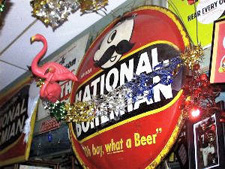
Natty Bo at Nacho Mamas* Draft National Bohemian beer is returning to the Baltimore area. To the rest of the country this is like the return of PBR. For those of you thinking huh? . . . Natty Bo was a long time Baltimore fixture, with a history that pre-dates Prohibition. Carling bought the brewery in 1975, then Heileman acquired it, then Pabst. Today MillerCoors brews Natty Bo for Pabst.

Fact is that when we are next in Baltimore we’ll likely be drinking something brewed in Maryland and more expensive than Natty Bo. However, while I can’t tell you the last one of those better tasting beers I had when we last visited Charm City a while back I do remember where I was sitting when I last had a Natty Bo . . . almost 10 years ago.

We were in Nancho Mamas, one of the few places you could still find Natty Bo in bottles inn 2001 (and you drank it straight from bottle). Friends of ours took us there, because they understood we had to see a place where every available inch is covered with a picture of Elvis Presley or a photo from old Baltimore (mostly sports) or a piece National Bohemian memorabilia. These included signs large and small, a gallery of bottle caps on the wall at the front entrance, buckets hanging at the bar and more.

Lots of tourists, and lots of regulars (many with tourists in tow). These days reviews at Yelp mostly talk about the nachos and margaritas, but indicate in passing the decor remains intact. I hope the regulars are as well. Beer, communities, pubs (or bars) — they all make each other better. And a little Elvis on the side is OK.

Stuff that matters: Ska Brewing

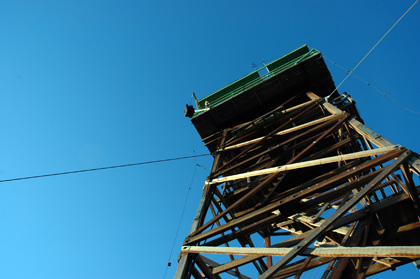
Jersey Jim Lookout Tower

If you’ve been to Durango, Colorado, you’ve been in love at least once in your life.

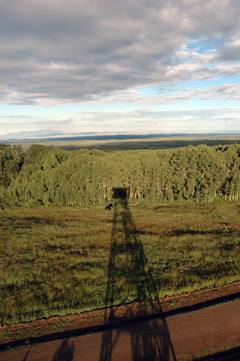
We first visited Durango in 1993 because we wanted to sleep in a nearby fire lookout tower called Jersey Jim (above). Eating breakfast at a diner on Durango’s Main Street we quickly realized we were in the midst of tourists (like us), locals who had been around forever, and people who had a bit more money and weren’t scared by the skyrocketing real estate prices.

It was the first place we heard people say, “If you want to be a millionaire in —– (in this case Durango) you need to start with two million.” On that morning the punch line was, “But it’s not Telluride.”

Jersey Jim Lookout TowerWe drank our first beer from New Belgium Brewing on this visit. It wasn’t Fat Tire. Call it chance, but a tiny store in Mancos (shuttered in each trip since) had Abbey Grand Cru in the cooler. It was a small run of a stronger version of New Belgium’s Abbey Ale.

We were still flatlanders at the time, the tower is 9,836 feet and we had to make several trips up the stairs with our camping geer. By the time we got around to opening the beer it packed quite a punch.

We’ve come to know Durango and the San Juan Mountains much better since, and going there is always a treat. I can wear you out with photos taken during the season of your choice, including ones of the town’s breweries (two packaging, two brewpubs).

Instead, one quick point. Those breweries make Durango a better place (and maybe Durango makes them better breweries). Not just because you can easily find fresh beer. They are all members of the Bootlegger’s Society, initially formed to raise money in support of community causes. Their first event was a “Pint for Pint” blood drive (rewarding blood donors with a pint of beer) that’s since been emulated by blood services organizations throughout the country.

The foundation was laid more than 15 years ago. Ska Brewing was still a somewhat crazy idea co-founders Dave Thibodeau and Bill Graham were considering when they were introduced to Bill Carver, who already ran a successful brewpub in town. When they told him what they were thinking about he looked his potential competitors over for just a moment.

“We’ll put you guys on tap,” he said.

“We’ve been a guest tap at Carver’s for 15 years,” Thibodeau said a while back, talking about his brewery’s 15th year of business and the fact it was about to outgrow its “microbrewery” status, producing more than 15,000 barrels.

“That set a precedent for how we’d run our business.”

So I had to smile when a press release arrived the other day declaring Ska Brewing Co. was named Durango’s “Business Of The Year” by the Durango Chamber of Commerce.

“We usually like to poke fun at awards, but to be honest this has been an incredible year for Ska,” Thibodeau said for the press release. “This award is because of what our employees do every day at work. We’re truly grateful for the team we have and we’re happy to have the Durango Chamber recognize their efforts.”

Oh, wait, there is a new beer style

Shame on me for being sloppy and hats off to Chad for noticing. I overlooked the addition of the American-Style Brett Ale in the 2011 Brewers Association Style Guidelines. Geez, it was in the press release.

That addition led to changes in the description of American-Style Sour Ale. I’m pulling Chad’s comment from the Bock 2010/2011 post and putting it here, then providing the 2011 descriptions for Brett Ale and American Sour, then the 2010 American Sour.

From Chad:

“All this chatter and no mention of the most ludicrous style possibly ever created . . . American Style Brett ale. Since when does Mr. Brett become a style and how is it an ale? Other then that it can be any color, any taste, any alcohol, pretty much it can be anything but exhibiting oaky, sherry, or bourbon characteristics. That’s not a style, that’s a catch all for a yeast genus. Oh well.”

FROM 2011 GUIDELINES

American-Style Brett Ale
American Brett ales can be very light to black or take on the color of added fruits or other ingredients. Wood- and barrel- aged sour ales are classified elsewhere. Light to moderate and/or fruity and contributed by the Brettanomyces yeast. The evolution of natural acidity develops balanced complexity. Horsey, goaty, leathery, phenolic and light to moderate and/or fruity acidic character evolved from Brettanomyces organisms may be evident, yet in balance with other character. Acidity may also be contributed to by bacteria, but may or may not dominate. Residual flavors that come from liquids previously aged in a barrel such as bourbon or sherry should not be present. Wood vessels may be used during the fermentation and aging process, but wood-derived flavors such as vanillin must not be present. In darker versions, roasted malt, caramel-like and chocolate-like characters should be subtle in both flavor and aroma. American Brett ales may have evident full range of hop aroma and hop bitterness with a full range of body. Estery and fruity-ester characters are evident, sometimes moderate and sometimes intense, yet balanced. Diacetyl and sweet cornlike dimethylsulfide (DMS) should not be perceived. Chill haze, bacteria and yeast-induced haze are allowable at low to medium levels at any temperature. Fruited American-Style Brett Ales will exhibit fruit flavors in harmonious balance with other characters.

American-Style Sour Ale
American sour ales can be very light to black or take on the color of added fruits or other ingredients. There is no Brettanomyces character in this style of beer. Wood- and barrel-aged sour ales are classified elsewhere. If acidity is present it is usually in the form of lactic, acetic and other organic acids naturally developed with acidified malt in the mash or in fermentation by the use of various microorganisms including certain bacteria and yeasts. Acidic character can be a complex balance of several types of acid and characteristics of age. The evolution of natural acidity develops balanced complexity. Residual flavors that come from liquids previously aged in a barrel such as bourbon or sherry should not be present. Wood vessels may be used during the fermentation and aging process, but wood-derived flavors such as vanillin must not be present. In darker versions, roasted malt, caramel-like and chocolate-like characters should be subtle in both flavor and aroma. American sour may have evident full range of hop aroma and hop bitterness with a full range of body. Estery and fruity-ester characters are evident, sometimes moderate and sometimes intense, yet balanced. Diacetyl and sweet corn-like dimethylsulfide (DMS) should not be perceived. Chill haze, bacteria and yeast-induced haze are allowable at low to medium levels at any temperature. Fruited American-Style Sour Ales will exhibit fruit flavors in harmonious balance with other characters.

For both of these original gravity, final gravity, alcohol content, bitterness and color all “vary with style.”

FROM 2010 GUIDELINES

American-Style Sour Ale (Fruit and Unfruited)
American sour ales range from golden to deep copper to brown in color. Wood- and barrel- aged sour ales are classified elsewhere. Acidity from lactic, acetic and other organic acids are naturally developed with acidified malt, in the mash or in fermentation by the use of various microorganisms including certain bacteria and yeasts. Acidic character can be balanced by several types of acid and characteristics of age. The evolution of natural acidity develops balanced complexity. Horsey, goaty, leathery and phenolic character evolved from Brettanomyces organisms and acidity may be present but should be balanced with other flavors Residual flavors that come from liquids previously aged in a barrel such as bourbon or sherry should not be present. Wood vessels may be used during the fermentation and aging process, but wood-derived flavors such as vanillin must not be present. In darker versions, roasted malt, caramel-like and chocolate-like characters should be subtle in both flavor and aroma. American sour ales may have an evident hop aroma, medium hop bitterness, low to medium hop flavor and low to medium body. Estery and fruity-ester characters are evident, sometimes moderate and sometimes intense, yet balanced. Diacetyl and sweet cornlike dimethylsulfide (DMS) should not be perceived. Chill haze, bacteria and yeast-induced haze are allowable at low to medium levels at any temperature. Balanced fruit flavors will be evident in fruit flavored American-Style Sour Ales and be in balance with other characters.

Original Gravity (ºPlato) 1.040-1.060 (10-15 ºPlato)
Apparent Extract/Final Gravity (ºPlato) 1.006-1.012 (1.5-3 ºPlato)
Alcohol by Weight (Volume) 3.3-7% (4-8.7%)
Bitterness (IBU) 20-40
Color SRM (EBC) 6-26 (12-52 EBC)