Bock, 2010 and 2011

The Brewers Association made a few changes to its style guidelines for 2011. The most talked about likely will be renaming the beer formerly known as American-Style India Black Ale, now calling it American-Style Black Ale. The press release also notes several beer style descriptions have been significantly updated.

I thought you might be curious what that means, and probably don’t have your own copy of the 2010 guidelines lying around so you can compare to the old and new. Here are both versions of the description of Traditional German-Style Bock.

2011
Traditional bocks are made with all malt and are strong, malty, medium- to full-bodied, bottom-fermented beers with moderate hop bitterness that should increase proportionately with the starting gravity. Malt character should be a balance of sweetness and toasted/nut-like malt; not caramel. Hop flavor should be low and hop aroma should be very low. Bocks can range in color from deep copper to dark brown. Fruity esters should be minimal. Diacetyl should be absent.

Original Gravity (ºPlato) 1.066-1.074 (16.5-18 ºPlato)
Apparent Extract/Final Gravity (ºPlato) 1.018-1.024 (4.5-6 ºPlato)
Alcohol by Weight (Volume) 5-6% (6.3-7.5%)
Bitterness (IBU) 20-30
Color SRM (EBC) 20-30 (40-60 EBC)

2010
Traditional bocks are made with all malt and are strong, malty, medium- to full-bodied, bottom-fermented beers with moderate hop bitterness that should increase proportionately with the starting gravity. Hop flavor should be low and hop aroma should be very low. Bocks can range in color from deep copper to dark brown. Fruity esters should be minimal.

Specification unchanged from 2010 to 2011.
Which beer is not like the others?

Can you identify the outlier?

a) Goose Island 312 Urban Wheat
b) Blue Moon Summer Honey Wheat Ale
c) Samuel Adams Honey Porter
d) Yuengling Black & Tan
e) Leinenkugel’s Honey Weiss Bier

Yes, there may be more than one correct answer (perhaps even one I haven’t thought of), so please include an explanation.


Belated Happy New Year, links included

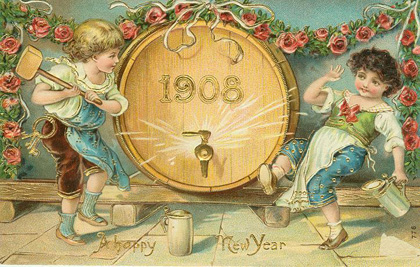
Happy New Year - Party like it's 1908

  • Beer is a local product. A study commissioned by SABMiller found that travelers want to drink the beer of the region when they are abroad: “When asked why they would choose to drink a local beer brand in a foreign country, 70% of respondents said that they did so because it is a crucial part of the overall travel experience, whilst 27% felt that it is important to support the economy of the place you are visiting and 25% said it was because they wanted to try something new.”

    Additionally, “The findings are backed up by figures which demonstrate the local nature of beer around the world, with only 6% of global beer volumes drunk outside their market of origin.”

  • Wine tasting: subjective or objective? Disregard that it’s wine and focus on the matters in the title as well as “the physiology, psychology and neurobiology of perception.”
  • Fine wine uncorks record gains. Notice that it’s wine and be happy that no matter how silly beer prices seem you’re not drinking an “asset class.”
  • Speaking of beer prices. The Six-Pack Equivalent Calculator is available as an android app. The math isn’t really that tough, but if you have trouble remembering that 750ml equals 25.3 ounces and working from there this makes price comparisons a little easier. Like which is the better deal for the same beer, the 750ml bottle at $9 or the 4-pack at $14?
  • Decoction and other stray beer thoughts

    Fine post at DesJardin Brewing centered on Jason Oliver, Devil Backbone Brewing and the excellent lagers Oliver brews there. Oliver gets a chance speak at length about why decoction (during which some of the mash is removed, boiled and returned to the original mash, often two or three times) matters. Good stuff, but I do wish he hadn’t said this:

    What you can’t substitute is the romance of decoction! Even if you do not notice any difference in a beers taste, the fact you did one is not made any less valid. Craft brewing is a craft, and using a traditional method to brew a traditional beer is something to be celebrated not denigrated. My advice is if you can decoct it then do it on special brews, it makes it extra special, extra traditional, and extra authentic.

    He and I talked a while back about how decoction adds flavor and texture to some beers. If you take the time to read “Decocting with Jason Oliver” you’ll notice not everybody agrees.

    A few years ago Martin Krottenthaler, a professor at the Weihenstephan brewing university north of Munich, talked about research comparing decoction mashing and less-time consuming infusion mashing. He flipped through PowerPoint slides, explaining why lesser malts once made decoction necessary. “Boiling is boiling,” he said, showing benchmarks that the chemists recorded were different throughout the two processes but the resulting worts produced almost identical profiles.

    Then he introduced the human element. A tasting panel basically confirmed the results, because few of its members could tell the difference — but Krottenthaler was one of those who could pick out the beers produced using decoction. “For me it was significant,” he said.

    Krottenthaler’s experience is what decoctionist (yes, I just made that word up) should be talking about. I agree with Oliver that brewers make a statement about the artisanal aspect of their craft when they choose to use decoction. But it’s an empty gesture if the beer they create doesn’t actually taste better. It feels like we’ve stepped into the dreaded realm of marketing.

    The reason to value traditional brewing methods is not simply that they are traditional but that they result in beers that tastes better. Try the ones from Devils Backbone and you’ll understand.

  • Thanks to @olllllo for this link to “Foodies gone wild: A plea for calm among foodies from a part-time food writer who’s part of the problem.”. Adding context to the discussion about “regular” beer.
  • I haven’t not looked at Beer Magazine since it first came out, but George de Piro (brewmaster at C.H. Evans Brewing Company’s Albany Pump Station and an occasional bloggers) does not seem to be giving it a thumbs up:

    If that’s not enough for you, here’s a gem from page 27, where the author eloquently states the purpose of hops is to “…provide balance to the beer just as a girl’s left boob does for her right. One without the other is a freakish carny.”

    And that’s the stuff you can print in a family blog.

  • TIME profiles Sam Calagione, and provides a look at “craft brewing” from the outside in. Among other statements: “Such lack of brand loyalty may actually force smaller brewers to constantly release new concoctions, lest their fickle audience lose interest.”

    Is the writer talking to you?