No commentary necessary, but Pete Brown has the story behind this video.
musing
Is that a beer fault? Or intentional choice?
Rather than languishing as the 22nd comment on the previous post this question from Tom seems worth making a new post.
There seems to be a conflation between intentionality and fault running through a good portion of the comments here. My question: if AB continually produces a beer with a particular flavor profile, with components that are marked as a fault by certain drinkers but not by others, doesn’t that point to a certain level of intentionality on AB’s part that makes that fault not so much a fault but an intentional choice by the brewery? Sure, some people may or may not like it, but to call something a fault would imply the brewer didn’t intend it to be in the beer. And I’m guessing AB wants that flavor in their beer. Whether we as drinkers like it or not. A rough similar analogy would be with diacetyl/butter flavors in British beers–there seems to be a lot more tolerance for this as a flavor component of beer in England than in the United States. Thoughts?
Not to rehash the analytic versus hedonistic argument of last week but acetaldehyde hardly seems to be what provokes such vitriol toward Budweiser and its brethren at the beer ratings sites.
Just for the heck of it I took a quick look at the Budweiser ratings at Rate Beer. (As a quick aside, seems curious that Bud had been rated 2,994 times, while the “impossible to get” Westvleteren 12 a comparatively high 1,886 times.)
No mention of green apple, grassy aroma or flavor or acetic (vinegar) character, all attributes of acetaldehyde.
Anyway, Tom asks a good question.
Will blogs go the way of Miller Chill?
Stuff recently noticed, perhaps because a press release headed my way or I was goofing off.
How do you compare a pils to an imperial stout?
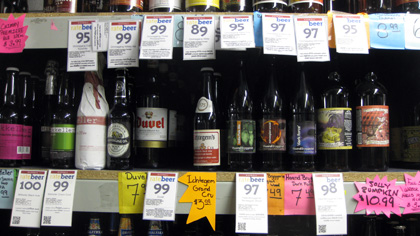
I have not so much made peace with “best” lists as run out of new ways to say why I don’t care for those that don’t provide sensible context. Thus when the latest lists from Rate Beer and Beer Advocate (in its print edition) arrived I sat silent.
Sure, I was amused reading the conversations that followed Martyn Cornell’s “Why extremophiles are a danger to us all” — both the comments on his blog and posts (such as this one) it inspired — but I didn’t have anything to add.
However, by taking a sledgehammer to college rankings in the current New Yorker magazine Malcolm Gladwell provoked a thought.
Gladwell begins his assault by examining the way Car & Driver ranks automobiles, writing the magazine’s “ambition to grade every car in the world according to the same methodology would be fine if it limited itself to a single dimension.” And, “A heterogeneous ranking systems works fine if it focuses just on, say, how much fun as car is to drive.”
Which leads to what the essay’s really about, rating colleges.
A ranking can be heterogeneous, in other words, as long as it doesn’t try to be too comprehensive. And it can be comprehensive as long as it doesn’t try to measure things that are heterogeneous. But it’s an act of real audacity when a ranking system tries to be comprehensive and heterogeneous — which is the first thing to keep in mind in any consideration of U.S. News & World Report’s annual “Best Colleges” guide.
This is not to say that Rate Beer uses the same methodology to compile its lists as U.S. News does for colleges. But it does endeavor to be comprehensive and heterogeneous (even though the top of the list is dominated by homogeneous, i.e. imperial, beers).
And therefore we are left with rankings that imply we might compare an imperial pumpkin beer to an elegant, well-balanced, low-alcohol cucumber beer. Could we would then use this as a guide when choosing a beer? Doesn’t work, does it?
(In all fairness to the beer rating sites they also group beers “by style,” making some homogeneous comparisons possible.)
Anyway, while I was reading Gladwell’s article — which delves into the subjectivity involved in setting “objective” standards — Pandora managed to feed me song after song that I didn’t feel the need to skip. It’s been a while since The New York Times explained how “The Music Genome Project” works, but it’s still a fascinating story. And one you may hear repeated in the coming months, because Pandora has filed for a $100 million IPO.
Some elements that these musicologists (who, really, are musicians with day jobs) codify are technical, like beats per minute, or the presence of parallel octaves or block chords. Someone taking apart Gnarls Barkley’s “Crazy” documents the prevalence of harmony, chordal patterning, swung 16ths and the like. But their analysis goes beyond such objectively observable metrics. To what extent, on a scale of 1 to 5, does melody dominate the composition of “Hey Jude”? How “joyful” are the lyrics? How much does the music reflect a gospel influence? And how “busy” is Stan Getz’s solo in his recording of “These Foolish Things”? How emotional? How “motion-inducing”? On the continuum of accessible to avant-garde, where does this particular Getz recording fall?
There are more questions for every voice, every instrument, every intrinsic element of the music. And there are always answers, specific numerical ones. It can take 20 minutes to amass the data for a single tune. This has been done for more than 700,000 songs, by 80,000 artists. “The Music Genome Project,” as this undertaking is called, is the back end of Pandora. [Note: The article is from 2009 and those numbers have grown.]
Would it be possible to do something similar for beer? I’m guessing homogeneous would work better than heterogeneous — there’s a reason that Frank Sinatra songs never show up on my Chris Knight station — and finding volunteers for research would be easy.
George Orwell’s favorite (favourite) pub
Back in November I linked to an essay from George Orwell about picking hops. Now Charles in Canada has added an article Orwell wrote about his favorite pub, Moon Under Water.
If you are asked why you favour a particular public-house, it would seem natural to put the beer first, but the thing that most appeals to me about the Moon Under Water is what people call its “atmosphere.”
And then there was the Dallas brewpub by the same name. If you blinked in 1996 you missed it. As I recall, it took more than a million dollars to open and caused quite a stir. It closed in, what?, about a month. In a state known for brewpub failures this was probably the most grand.
Reviewing Moon Under Water, the Dallas Observer offered commentary that seemingly haunts Texas brewpubs 15 years later: “Brewpubs are kind of like West Texas cows: It takes a lot of acreage to support even one.”