We skipped the light fandango
turned cartwheels ‘cross the floor
I was feeling kinda seasick
but the crowd called out for more
The room was humming harder
as the ceiling flew away
When we called out for another drink
the waiter brought a tray
And so it was that later
as the miller told his tale
that her face, at first just ghostly,
turned a whiter shade of pale
– Procol Harum, “Whiter Shade of Pale” (1967)
Better than another Black India Pale Ale, I guess. And if calling these beers White IPAs was part of the process of creating two delightful variations on a collaborative recipe from Boulevard Brewing and Deschutes Brewery then I can live with the less delightful name. Just so nobody petitions to make it another category in some beer competition.
Make no mistake, this collaboration between Steve Pauwels of Boulevard Brewing and Larry Sidor of Deschutes Brewery resulted in two distinct beers. Same recipe, same basic ingredients, including the yeast, but different beers. I’ll leave it to others to call one or the other better. (For instance, here.) They’re both keepers.
Boulevard labels the ‘White IPA” Collaboration No. 2 and packages it in 750 ml corked bottles (part of the Smokestack Series). Deschutes calls their’s Conflux No. 2 (No. 1 hasn’t been released; another story) and sells it in 22-ounce bottles. They both contain 7.5% alcohol by volume. Looking as his computer screen Pauwels said Boulevard’s version measures 57 IBU. Deschutes “beer geek information” says Conflux clocks in at 60 IBU. Probably because I’m pretty sure it’s illegal to call a beer any sort of IPA in Oregon if it doesn’t have at least 60 bitterness units.
Sidor and Pauwels started discussing a collaboration about two years ago. They wanted to include components from each brewery. They began to settle on the idea of a hop forward (Sidor wrote the chapter on hops for the Master Brewers Association of the America’s technical manuals) and wheat beer (Boulevard’s specialty).
“Larry was talking about how hard it was to make their Cascadian Dark (known in some quarters as a Black IPA)” one moment, Pauwels said, and the next they had a plan. It would be a White IPA, and they’d be making up the rules as they went along. They expected to have hours together to work on the recipe during a layover in the Denver airport, but that became minutes when Pauwels’ flight was delayed.
Deschutes made a test batch, then another and another, and each time Sidor would ship a growler from Bend, Oregon, to Kansas City. The beer evolved along the way. The first batch at Deschutes wasn’t particularly cloudy; the final one shimmers brightly. They added sage and lemongrass to the recipe and eventually settled on this:
Fermentables
Pilsner
Malted wheat
Unmalted wheat
Flaked oats
Hops
Bravo (for bittering)
Citra
Cascade
Centennial
Other items of note
Whole leaf sage
Sliced lemongrass
Milled coriander
Ground sweet orange peel
Yeast
Wyeast 3463 (Forbidden Fruit)
Pauwels thinks sage was a key addition. “We just couldn’t get the white beer character,” he said. And adding more orange peel and coriander would created an unpleasantly overspiced beer. “It would have become fake; the flavor would have been fake. Like somebody put drops of (flavoring) oil in it.”
Both versions are brimming with citrus character, which shouldn’t be a surprise looking at the hop bill. The sage adds herbal notes, to my nose more in the Boulevard version than Conflux No. 2. It’s easier to smell and taste than it is to describe, but if you’ve visited the two breweries the reason why is obvious. Deschutes uses hop cones and has a hop back. Boulevard uses pellets and must rely on late additions of hops and dry hopping to recreate the flavors you’d experience rubbing hop cones together at harvest.
One happens before fermentation and one after, and I’ll spare you the details, but that makes a difference.
Back when the theme for The Session #39 was collaboration I wrote about what Luke Nicholas and Kelly Ryan learned brewing together. Talking to Sidor and Pauwels it’s obvious that occurred here as well. “It was sure a lesson for me about using the brewhouse to get more out of the hops,” Pauwels said.
Myself, I’m wondering what the beers might have tasted like if they hadn’t skipped the light fandango.
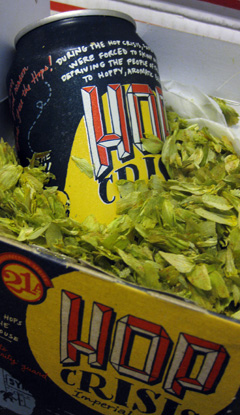 Oops. Forgot to send a change of address to the guys at 21st Amendment Brewery. (The fact is the people who bought our house in New Mexico likely will be receiving stray beers for years. Should have advertised that when the house was on the market.)