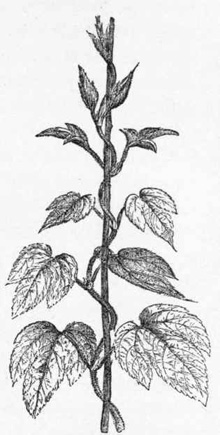
Why name a hop Apple Puddings?

Hop bineI don’t have an answer, but I like the sound of names such as The Grape Hop and Canterbury Jacks.

They were part of the English hop landscape more than 100 years ago, and a curious soul might wonder what beers brewed with them would smell and taste like.

Would they offer “new flavors” or old ones? Would they stir up the same excitement Simcoe, Citra and Sorachi Ace do today simply because they are different?* Probably not, to be honest, because they were mostly variations on a theme. The new generation of hops have been bred from a wider range of ancestors.

*(Quick aside, Sorachi Ace is a great name, but I can’t visualize is growing alongside Golding in the hop gardens of Kent.)

Idle thoughts, really, while reading “English Hops: A History of Cultivation and Preparation for the Market from the Earliest Times.” Some other hop names from the 1919 book: Golden Tips, Pretty Wills’, Cobb’s Hop, Amos’s Early Bird and Old Jones’s Hop.

Old Jones’s Hop was “well-shaped, of good colour, of medium size, and of good flavour. The bine is short and green. it was cultivated under the name of Jones’s hop as early as 1798, but is now little grown, as it bears only a small crop.”

Even then the lesson was plain for a hop plant: Produce or be gone.
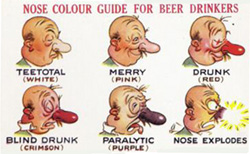
Hold your nose, then sip

Is that your nose?OK, not necessarily something you want to do in public. But both a good way to learn a little more about the beer you are drinking and your own senses.
I was reminded of the value of tasting without first smelling while grinding through an academic paper related to hops (I try to tackle several a day because I have quite a collection). In this case the researchers were evaluating the bitterness intensity of various samples, and panelists wore nose plugs.

No need to do that at home. A simple squeeze will do. Take a sip without the benefit of “olfactory influences,” then one with. Or vice versa. Doesn’t even have to be a hop-heavy beer, although the results can be pretty interesting with a dry-hopped one.

In search of a bigger, maybe hoppier, high

Today’s Wall Street Journal explains the “current flavor boom.”

“The more you taste something, the more you need to taste it,” says Mitchell Davis, vice president of the James Beard Foundation, a New York-based non-profit that works to preserve American culinary heritage. “You always need something spicier, something more, a bigger high.”

What does this tell us about bigger, bolder, more intense, hoppier beers?

Go read the story about how “bold is replacing boring.” Connect the dots. I’d love to join the conversation but we’re boarding a plane. Tomorrow I’ll be visiting a hop yard.

What would you ask a hop queen?

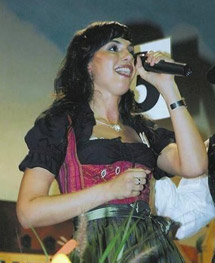
Mona EuringerNo, seriously.

Next week judges stream into Chicago to taste their way through 3,500 or so entrants in the World Beer Cup and soon they will be joined by thousands of brewing industry members for the Craft Brewers Conference.

I expect only the toughest will make it up Saturday morning for “Brewing Belgian White and Wit Beers,” the panel I’ll be moderating. Fortunately there will be many more exciting moments. First up, Wednesday afternoon is a chance to meet the Hallertau hop queen, Mona Euringer. She’ll be in Chicago along with members of the German Hop Growers Association.

She’ll give a brief talk about life on a hop farm and also be around for the trade show Thursday and Friday. Last year the hop growers caught some grief when it was suggested Nicol Frankl, the previous hop queen, was invited along only because she has a pretty face.

Not true. “To be elected hop queen, you have to have grown up and helped work on a hop farm all of your life, you have to know hops, hop farming, and all the machinery involved,” said Eric Toft, brewmaster at Private Landbrauerei Schönram, who doubles as a representative of the hop growers.

I promise to find out just how much she knows. So if you have a question you want asked please leave it as a comment. As long as it’s not rude I’ll ask her.

The hop growers will also be serving a variety of beers. Toft wrote the recipes and Victory Brewing in Pennsylvania made the beers. They will include three different Belgian-style pale ales — each brewed with a single German aroma hop varieties: Hallertauer Mittelfruh, Smaragd, Hersbrucker — a new Bavarian-style pale ale, and a tripel hopped with Saphir.

I promise to ask questions first and drink beers later.