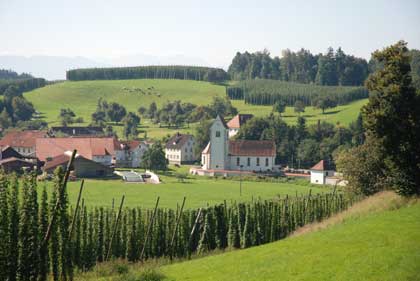
This is hop terroir

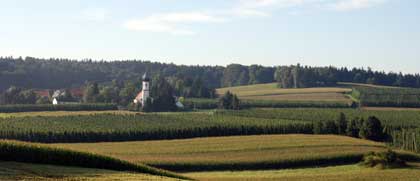
Hops growing in Tettnang

The Tettnang hop growing in the southwest of Germany. (And the photo that has replaced one taken along the Beartooth Highway leading into Yellowstone as my desktop background.)

More next week, but if you’re of a mood to consider terroir Zac Early has a “new, looser interpretation” (music included).

Edelstoff: A beer fit for a hop queen

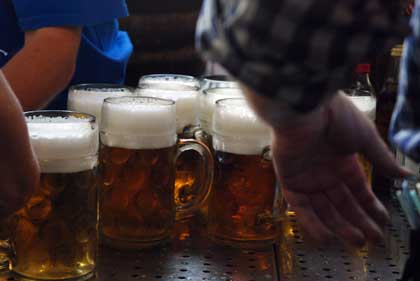
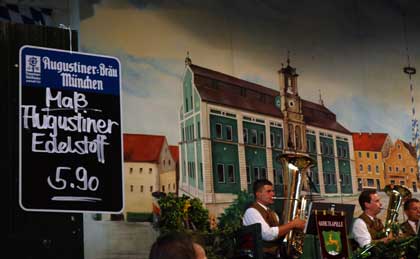
Did I mention the Edelstoff from Augustiner was from the wood, and a lot cheaper than beer at Oktoberfest in Munich?

Veronika Springer, Hallertau Hop Queen

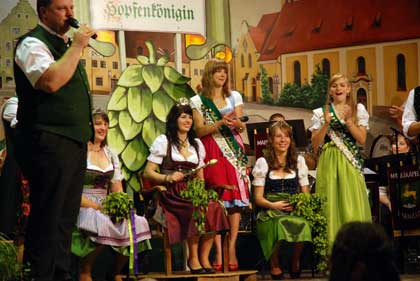
Last week Veronika Springer was crowned Hallertau Hop Queen (Hopfenkönigin) for 2011-2012. I didn’t vote for her, but she received 62 percent (1,478) of the votes. The Wolnzach Volkfest tent was rocking, packed with hop farmers and friends washing down traditional festival food with liters of Augustiner.

Veronika Springer, Hallertau Hop Queen

The new queen is well qualified, having grown up on a hop farm and currently working at NATECO2, an extraction plant where hops are the biggest part of the business. She didn’t get my support, or that of several of the brewmasters I was seated with, because she seems to be skeptical about the future of “flavor”1 hops.

Change is afoot in Germany and these are brewers who want to be part of it. That doesn’t mean they are about to abandon tradition, but it does mean the range of flavors from Halltertau hops will soon be broader.2 The crew at the Hop Research Center at Hüll is not interested in copying American hop flavors, but I was there maybe three minutes before I thought, “These guys are not going to be left behind.”

1 With the line between what were once known as “bittering” and “aroma” hops already blurred — and the term “dual purpose” just not cutting it — I’m not sure how the idea of “flavor hops” will fit in, but I heard those words in the UK, Germany and Czech Republic. These could also be called “impact hops.” To the continental palate Cascade is a “flavor” hop; while you’ve got to throw something like Citra or Simcoe at an hop-experienced American for impact. Sound confusing? At least you don’t have to sort it out for a book.

2 These hops are also going to show up in beers brewed in America. I can’t wait.

And the band played on

The Spalter POV

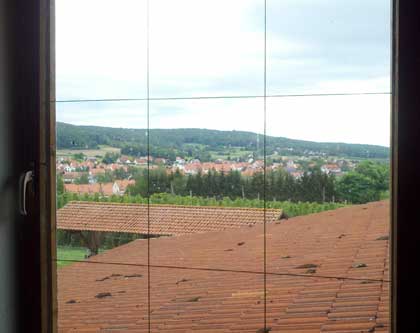
View from hop drying floor in Spalt

This is the view from the first (remember, on this side of the Atlantic the ground is 0 and the first floor one above it) story of a pretty typical hop drying barn in Spalt, Germany’s oldest hop growing region. Hops, trees, enchanting village . . . there’s a lot more to Bavaria, but I favor those ingredients.

Although Spalt holds Germany’s oldest hops trademark, awarded in 1538, and was once a large hop growing region these days its 75 growers tend to only 370 hectars (a hectar equals about two and a half acres). In contrast, 73 growers oversee production of more than 16,000 hectars in Washington, Oregon and Idaho.

In the Spalt region, hops is a family business rather than a growth business.

“It used to be you’d see hops every direction you looked,” Hermann Wissmüller, a local doctor, said between sips of Spalter Leichte Weisse at lunchtime. “One year there would be many new yards, and the next farmers were taking them out.”

Wissmüller owns part of Stadtbrauerei Spalt in the middle of town. Simply because he’s a resident. It is the only community owned brewery in German, and presumably in the world. “There are 5,000 of us, so I own one five-thousandeth. And so does she,” he said, pointing to the woman who poured me a Spalter Pilsner.

“No big brewery is going to take over this one,” he said. “It is ours.”
Morning in the Hallertau

Morning in the land of hops

The picture gets small fast when you try to capture the expanse of hops. The yards are everywhere. I knew this. We’ve driven through here in December, but it’s quite different when hops are growing.

A more amusing photo would have been me trooping through the test plots at the Hop Research Center at Hüll. I had to wear blue booties, like the ones you see people wearing in hospitals for some antiseptic reason. In this case, they don’t want any foreign critters tracked into the yard. I didn’t even tell them that I’d been in and out of English fields a few days before.

Palate readjustment

Last beer yesterday: Fuller’s Chiswick Ale in the pub on the brewery grounds. Four different hops. Five different hop additions. Just what a 3.5% abv English bitter should be.

First beer today: Augustiner Pilsner after driving through scores of German hop fields sparkling in the late afternoon sun. No stopping for photos on the autobahn, but maybe I can post one or two tomorrow. Augustiner is one of the sponsors of the Hallertau Volkfest that starts Friday. Tuesday they choose a new hop queen. I will report back.