Category 23: Looking for harmony in beer

Samuel Adams Longshot Homebrew Contest Category 23Perhaps it’s because I live in a state where Area 51 is famous, but Category 23 has an ominous ring to it. Particularly when you are asked to judge the category in a homebrew competition. Strange beers, experiments, successful and otherwise.

This year the Samuel Adams LongShot American Homebrew Contest is all about Category 23. There will be no judging of pilsners, pale ales or stouts. Just beers that fit in Category 23 as defined by the Beer Judge Certification Program (BJCP): “This is explicitly a catch-all category for any beer that does not fit into an existing style category. No beer is ever ‘out of style’ in this category, unless it fits elsewhere.”

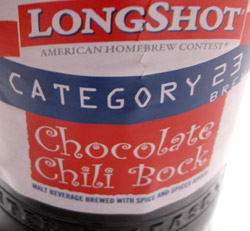
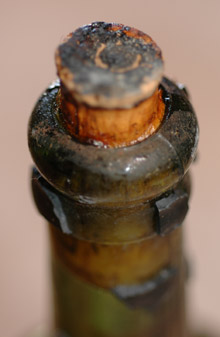
Not every beer entered need be crazy. This is the category where you’d enter a honey ale, for instance. But it is one where wild and inventive beers are welcome (a honey ale aged with wild yeast and wood chips). A bottle of Chocolate Chili Bock — released only to make a point and not for sale to the public and pictured above — accompanied the press release about the contest.

“. . . as the years go on, the number of entries with unique ingredients that don’t fit into the first 22 traditional categories have multiplied,” Boston Beer founder Jim Koch said for the press release. “So why not channel all the creativity that we know is out there in the homebrewing community and see what they can come up with? My taste-buds are ready!”

Boston Beer celebrates its 25th anniversary this year — today, in fact, because it was on Patriots’ Day 25 years ago that Koch began deliver beer. The Wall Street Journal had a story today, the Boston Globe last week.

Maureen Ogle, author of “Ambitious Brew,” summed it up nicely in the Globe when she said Koch “remains innovative and he’s constantly experimenting. A lot of the other craft brewers lost sight of that when they expanded.”

It seems fair to add the turn the LongShot contest has taken to a list that starts with Triple Bock (1993).

Back to the contest. This isn’t like the knife fight in “Butch Cassidy and the Sundance Kid.” There are rules. You can read them here. What’s noteworthy, given plenty of discussion in the blogosphere about the proliferation of “beer styles” and beer evaluation in general is that a) Category 23 makes room for “beers without homes” (to steal a phrase from Tomme Arthur of Lost Abbey Brewing) without adding new categories and b) because of what’s central in judging this category.

In part: “A harmonious marriage of ingredients, processes and beer. . . . The overall rating of the beer depends heavily on the inherently subjective assessment of distinctiveness and drinkability.”

Isn’t that how we should assess all beers? Of course. It’s just more obvious when you aren’t focused on if a beer conforms to style guidelines.

A few details

* As in the past, three regional judging competitions will take place to narrow the entries down. Three finalists from each region (9 finalist total) will move on to a second round of judging.

* The second round of judging will take place in Boston, with four finalists earning a trip to the 2010 Great American Beer Festival, where winners will be announced. The two winning beers will be brewed and distributed nationally.

* Details are at the Samuel Adams website. After signing in, click on No. 4 on the right, then the Longshot logo.

No, these beers aren’t about marketing

This started as a comment within the conversation following the previous post, but when it hit the third paragraph I thought it better to start anew.

Perhaps I should have made myself clearer.

– This is the opposite of marketing. We now have a broader choice of beers — some obviously better than others, and some pretty terrible — because brewers did not, and still do not, listen to marketers who said/say drinkers will not buy beers with distinctive flavor (America in the 1960s and 1970s). Sierra Nevada Pale Ale never would have got out a focus group.

Which is not to say that some breweries aren’t trying to attract attention by promoting they have the beer with the most this or the most that.

– The Halltertau hop growers started coming to the Craft Brewers Conference in 2007, obviously to promote sales of their hops. They do this by bringing beers that showcase their hops. Eric Toft, who grew up in Wyoming but who has lived in Europe for more than 20 years and been brewmaster at Private Landbrauerei Schönram for almost a dozen, writes the recipes for the beers. Victory Brewing in Pennsylvania brews them because a) Eric has a long-standing relationship with Ron Barchet and Bill Covaleski, b) Victory has contracts for barley and hops with Bavarian producers, and c) the logistics of licensing and shipping.

The pale ale was not created to sell anywhere, but to illustrate to other brewers (mostly American) that Hallertau hops make an excellent addition to beers other than those intended to mimic those from Bavaria. Basing a recipe, let alone a marketing campaign, on my tastes would probably lead to disaster, but my opinion is they are right. I’d much rather try a new not particularly high gravity pale ale made with Saphir or Smaragd (two newer varieties) and one amped up on another addition of Northwest hops. I like those beers, but well-done versions exist and it seems to standout brewers feel compelled to simply dial up the flavor intensity.

Just my opinion, but I’m not sure you will find a better spokesperson for tradition in Germany that Eric. He pitches his yeast cooler and conducts primary fermentation cooler than most, automatically adding time to the production process. He uses only aroma hops, but makes some of the hoppiest (this is a relative thing) beers in Germany. That means more hops, more expense.

Workers at the brewery skim the fermentation every day (open fermenters, also a pain in the brewers’ butt) so the bitterness is more mellow. Schönramer Gold, which won a gold medal in the World Beer Cup, lagers 10 weeks. That’s after the longer primary. You really need to visit the brewery restaurant (it’s not far from Salzburg) because its the only place you can get Schönramer Pils and Dunkel unfiltered.

He believes that drinkers can taste the difference. Landbrauerei Schönram has doubled production since Eric took over (this wasn’t a start up; been around for more than 230 years). At the same time consumption in Germany has shrunk dramatically, so maybe he’s on to something. Just as Ken Grossman and Jim Koch were a while back and Alex Ganum is today.

– The new wave of beer drinkers are asking questions other than “which beer has the most alcohol?” or “which one has the weirdest ingredients?” Some ask just that, but also about where the beer is from, about the ingredients, about production practices. They talk about flavor, and want to try new ones — sometimes “extreme.” But here’s what you should really love about them, Mike. They drive marketers crazy. The don’t just advertisers make things up.

So I met the hop queen – but what else?

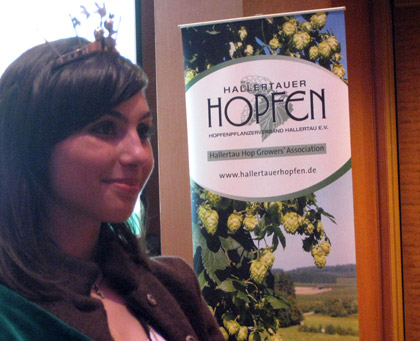
Last Wednesday, just hours after arriving in Chicago for the Craft Brewers Conference, I dutifully posted a photo of Halltertau hop queen Mona Euringer, linked it to via Twitter and Facebook and after that pretty much went back to 1998 or some other CBC in a different technological era. Blog? Tweet? I didn’t even attend the seminars on social media. Sorry.

I did use Google maps on my phone when those of us on the “bus from hell” finally seized control after an obviously clueless bus driver drove around in circles for more than an hour and a half before delivering us to a destination less than 5 miles from the hotel. As an aside, I was on the bus that got lost (not quite an hour extra that time) at the 2008 Craft Brewers Conference. Charles and Rose Ann Finkel were on also on both buses. The takeaway? Never get on the same bus with the Finkels and I at CBC.

This wasn’t exactly planned. I expected to blog and tweet a little more. And it didn’t happen because wi-fi in the host hotel was fleeting and cell reception in the trade show worse yet (both true). Or because there was a rather high level of social activity each evening (obviously true). It’s just that I don’t transition well from information collection mode to dispersal mode. And when I wasn’t at a seminar (like “Proper Storage, Shipping & Handling of Hop Pellets”) there was a conversation awaiting. I particularly like CBC in the even years because of the World Beer Cup competition — judges from 27 countries attended this year.

I’ll be years (yes, really, another book project, details soon) writing about what I learned, so for now here’s one overarching observation from the conference, after the promised report from my conversation with the hop queen and the truth about Bavarian-style pale ale.

Euringer, who turned 23 during the conference, still works on the family farm (hops, corn, and sugar beets — about 38 acres of hops) but also is studying business in school. Her great grandfather was the first in the family to grow hops, but her father has told her that she and her brother, Simon, are free to pursue whatever careers they want.

Since Todd asked . . . Euringer, who began drinking beer when she was 16, likes the fruity flavors hops add to beer. She’s serious. She put in five hours each day at the trade show, often refreshing her glass with one of the five beers showcasing Halltertau hops that Victory Brewing made for the conference. “I can’t drink so much bitter beer,” she said.

I asked her about Schönramer Pils, a 40-plus IBU beer that won gold at European Beer Star Awards last fall. “I like it because of what it tastes like,” she said. “But I can’t drink five bottles of it.”

The day before the conference began she visited New Glarus Brewing in Wisconsin with the rest of the Halltertau hops contingent, and particularly enjoyed the new Two Women pale lager.

Since Ron asked . . . The “Bavarian-style pale ale” created for the conference is a beer description, not a new style. A little confusing because for logistical purposes what we tasted was brewed in Pennsylvania, but it is Bavarian, pale and an ale, fermented with Weihenstephan #68, a top-fermenting yeast otherwise used to create weiss beers.

The grist is 100% pale Franconian barley malt, and it was mashed (single-decoction) for a high attenuation. It was hopped with Hallertauer Mittelfrüh, Hersbrucker, Tradition, Select, and Smaragd in five separate additions. The starting gravity was 16 ºP, the final abv 7.2% and the IBU about 45.

Now the observation, which is not exactly new, given that “microbrews” have been with us a while and these days the CBC seems awfully grown up (most of the sessions I attended focused on making beer, but options included “Craft Brand and SKU Proliferation: Great Opportunity of Great Danger” and “Intellectual Property law: Options and Protections for the Brewing Industry”):

Sales wouldn’t still be growing if somebody didn’t want to drink all these beers. But the beers wouldn’t exist at all if people (we call them brewers) weren’t excited about what they make and how their work is received.

Part One. Beer and food. I’m with Alan when he writes about the “need to ‘pair’ beer with food.” But shortly before the Gala Awards Dinner (for the World Beer Cup) on Saturday I spent a few minutes with Randy Mosher and Sean Paxton, who together created the menu that Sean then executed.

Sean’s attention to detail and creativity defy description (hop scented hard boiled eggs in the salad, just amazing). But, as Randy pointed out, the meal stuck to the notion that beer shouldn’t be fussy, and therefore beer meals shouldn’t be either.

Two evenings before Goose Island treated conference attendees to an equally amazing food experience, inviting more than a dozen Chicago chefs to create special dishes that were served with a couple of dozen of Goose Island beers. There were also a dozen variations on Bourbon County Stout served with a dozen chocolate desserts. All in the midst of about 1,000 barrels.

My point would be that this food and beer thing excites brewers, just like Part Two.
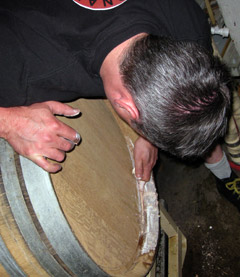
Vinnie Cilurzo repairing a barrelPart Two. Beers aged in barrels, sour and otherwise. Attendees filled the chairs, lined up along all the walls and took seats in the aisles for Vinnie Cilurzo’s talk called “Toothpicks, Garlic and Chalk: Three Key Ingredients to Any Brewery’s Barrel-Aged Sour Beer Program.” (In the photo on the right Cilurzo is using those tools to plug a leaking barrel at the Russian River brewpub.)

It seemed like half those in the room raised their hands when he asked if they’d like to attend a pre-conference seminar next year (when CBC in in San Francisco) on barrel-aged sour beers. These beers intrigue brewers. They want to make them, and sometimes that’s all that matters.

Again, not exactly new territory, but Friday afternoon I was reminded about the traits shared by people who make beer and people who drink beer when Mike Kallenberger of MillerCoors was talking rather specifically about craft beer drinkers (“What’s important to them when they’re not drinking beer, and why it matters when they are”).

Summarizing Kallenberger is never easy, because he tends to tackle complicated subjects, so I’m going to grab one thread and hope I don’t tangle it. Craft-beer drinkers take risks because they they think they are worth taking, if there’s such a thing as a “responsible rebel” that’s them, and they see themselves as “making their own rules” rather than simply “breaking the rules.”

Because they know they are right.

Didn’t we just describe brewers as well? Recipes-by-focus-group don’t work for them on any level. Not telling them what new, new flavor drinkers will embrace. Certainly what they can’t do, what wouldn’t work, what people wouldn’t drink.

They know better.

Some are wrong. Some will fail. Some will make horrible, unbalanced beer. But I think we can tell the difference.
The Session #38: 1 beer or 1001?

The SessionWere Mr. Sixpack (otherwise known as Don Russell) to participate today in our monthly session then he might quote liberally from his entry in 1001 Beers You Must Taste Before You Die Three Floyds Dark Lord Russian Imperial Stout.
“The Dark Lord exists mainly by reputation. His power is rumored, his character praised with cultlike obsession, yet he is rarely seen. Until, that is, Dark Lord Day, a holiday ritual for the devoted who flock from around the world to Three Floyds Brewing in Munster, Indiana, for his annual appearance.”

I don’t have such a description or such a beer to offer for this session, for which you’ll recall, Sean Inman provides these guidelines:

What beer have you tasted recently (say, the last six months or so) that is worthy of their own day in the media sun?

And to add a little extra to it, how does “great” expectations affect your beer drinking enjoyment?

AND If you have attended one of these release parties, stories and anecdotes of your experience will be welcomed too.

I’m not opposed to standing in line, literally as well a figuratively. On the first day of March I spent four straight hours calling a number in Colorado with hopes of getting through to book two nights in Jersey Jim, a former Forest Service lookout tower can you rent, and then I did the same the next day. Some years we get lucky and some years (like this) we don’t. I can drive to Mancos (where reservations are taken) in four hours and probably would if they accepted in-person applications.

Anyway, back to The Session. I’ve had a beer or two in the last six months as worthy as Dark Lord, but I wouldn’t exert as much effort to acquire any of them as I would for another night in Jersey Jim. Still one of these years I might try to make it to Dark Lord Day for the experience.

I promise to write about it.

(Head on over to Beer Search Party for more Session entries.)

The Session #37: Just open it

The SessionThis is my contribution to the Session #37: “The Display Shelf: When to Drink the Good Stuff” or, if you prefer, “Raid the Cellar.” Visit The Ferm for links to more posts.

Is there a perfect beer for every particular special moment? Is there a time in every beer’s life when it tastes better than it ever otherwise will?

SirRon’s open-ended assignment for The Session spells certain trouble for me. I’m perfectly willing to spend all sorts of time contemplating questions that do not have answers.

Anyway, the topic this month seems particularly timely because we’ve recently been treated to a flock of stories about cellaring beer. Don Russell made it subject of his column last week, there was a story this week in The Washington Post food section, and a rather long feature in the Los Angeles Times (worth clicking through to for the photo alone).

Could this be dangerous? Although these stories emphasize the importance of picking the right kind of beers to lay down and having a proper cellar it’s easy to envision a reader skimming the story, grabbing who-knows-what beer, sticking it in the back of a closet and forgetting about it until it’s time for the next garage sale.

Last Christmas friends of ours brought out a large corked bottle of Budweiser that somebody had given them (thank goodness) at an estate sale. It was bottled in 2001 for the brewery’s 125th anniversary. We have no idea how it was stored, but that didn’t really matter. We opened it, sipped, talked about wet cardboard and dumped the contents. We could only dream about what that beer might have tasted like fresh.

Thomas Hardy's aleI must confess I’m a serial cellarer. When we moved to New Mexico and left our Illinois basement behind the idea was “no more laying down beer.” Didn’t take. Bought a chest freezer, hooked it up to a temperature controller and we were good to go.

But only a small portion of beer spends much time in that pseudo cellar. We buy beer, we drink it. Beer shows up at our door, we drink it. It seems it would be rude to do so otherwise. Oh, that beer you sent last week, we’ll open it in 2014 and let you know how it is doing.

So a few things I learned in February:

  • The bottle of Deschutes Jubel 2010 suggested it would be best consumed after Jan. 11, 2011. And now we’ll be buying a couple bottles to find out. I had a taste of Jubel 2000 (the last time the big brother of the season Jubel was bottled) in 2006 and that turned out to be too long to wait. This edition already hints of an old ale, with muted hops that will further fade with time (much as the classic Thomas Hardy’s Ale). Husky malt character, perhaps augmented by tannins from time in pinot noir barrels, leaves it a bit coarse on the tongue. Just feels like it is going to age well, and I suspect it will hold up more than six years this time.
  • Because Stone Brewing sent a bottle of 2010 Old Guardian Barley Wine I hauled out a 2006 Old Guardian (a $6.99 price tag still on the bottle) to share with friends before we went out to dinner (where some non-driving members of our group enjoyed Santa Fe Brewing’s Chicken Killer Barley Wine on draft). Two very different beers; not surprisingly the hops are much more apparent in younger beer, earthy and spicy. Some of that’s going to be gone a few years down the road, and while a luscious beer (like the 2006 edition) may emerge for some now is the time to drink this beer. Of course I headed to the store to make sure I’ve got a couple bottles of 2010 so I can make that comparison on a few years.
  • The Lost Abbey’s Angel’s Share Grand Cru takes Angel’s Share to a new level. Given what went into the blend that shouldn’t be a surprise. However, words can’t prepare you for the remarkable rush of flavors. If you don’t like spectacular or intense (such beers don’t work for everybody) stay away. Like many Lost Abbey beers there are layers of flavor. After you reset your palate, subtle textures emerge. Some of the beer in this blend is already four years old, so I’m calling it pre-cellared. If it gets much better I don’t know if Russell can find a piece of cheese to stand up to it, or if he’ll survive the experience.
  • Less can be more in a vertical tasting. Three vintages of Firestone Walker anniversary beers seems like a good number. Granted, we tried seven different Thomas Hardy’s a couple of years ago but those were smaller servings. One Sunday afternoon four us got together for the Firestone beers — one brought Firestone XI (2007), one Firestone XII (2008), one Firestone XIII (2009) and one a lovely selection of cheeses. That worked out to a little over 5 ounces of each beer apiece, a proper amount of leisurely sipping.
  • The beers were really good, but you knew that. I liked XII better than a year ago, and we might have talked about that over the course of about two hours. I’m not sure. Not until I was driving home did I consider that three of us tasted Firestone 10 together, Firestone XI the next year, Firestone XII the next and now XI-XII-XIII.

    We’re not some crusty war veterans who need an excuse to get together, but this is a nice little tradition that I expect will continue. So to SirRon’s question about “finding a drinking occasion that lives up to the reputation of the bottle,” I’d suggest sharing beer with friends should be occasion enough.