NOLA Brewing: Tales of the un-cocktail

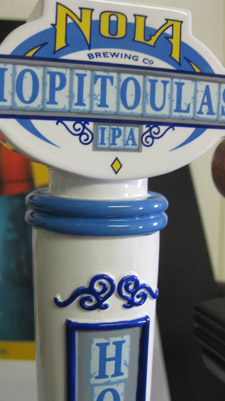
NOLA Brewing Hopitulous IPAThis week New Orleans hosts Tales of the Cocktail.

We went last week.

Not because we have anything against cocktails, but because that’s when the birthdays fall. In fact, we drank hurricanes at Pat O’Brien’s and cocktails at the Carousel Bar in the Hotel Monteleone. We also had pretty good wine with dinner at Irene’s Cuisine.

But mostly we drank beer. Finding flavorful beer in New Orleans has been relatively easily for a long time. Thank the students at Tulane for supporting places like Cooter Brown’s and The Bulldog. However the city was, and is, the poster child for BMC (Bud Miller Coors) markets. “When we opened a year and a half ago (they) accounted for 95 percent of beer sales,” said NOLA Brewing founder Kirk Coco. “I don’t mean all light lagers. Just beers from Bud, Miller and Coors.”

NOLA (New Orleans Lager and Ale) hasn’t even begun to approach the status of Abita, but the fact that Crescent Pie & Sausage, located in Mid-City and one of the city’s hip new dining spots, offers three NOLA beers on tap signals that change is at hand.

We built our itinerary around eating, and there was much to be said to finding Abita or NOLA beers available at almost every turn. Beer and food should go together in New Orleans, Coco said. “We have the right attitude. We’re not afraid of calories.”

He pointed out New Orleans’ shortage of diet po-boy shops and promised, “You’ll never see a NOLA Light, not as long as I’m alive.”

These are not necessarily “Big Ass Beers” (as seen on signs throughout the French Quarter). NOLA Blonde, 4.9% abv, outsells all the others three-to-one. Coco’s favorite is NOLA Brown, at 3.9% abv tame but rich. A beer some would surely describe as quaffable.

Hopitulous IPA — the brewery is located on historically important Tchoupitoulas Street; Tipitina’s is at the corner of Tchoupitoulas and Napoleon and if I need to explain Tip’s please just Google Professor Longhair — was supposed to be a seasonal, but proved too popular not to keep brewing. It’s more about hop flavor than bitterness (60 IBU, calculated). Brewmaster Peter Caddoo, a veteran of Dixie Brewing, adds Nugget hops while running wort into the kettle. He uses Warrior for bittering, Columbus and Cascade for flavor, Simcoe late in the kettle, then more Simcoe in the whirlpool. He dry hops it with Simcoe and Amarillo.

It’s a fine food beer. I might just mail in “eating the Mixed Grill (a plate of house-made sausages) at Crescent Pie and Sausage served Hopitulous” as my entry for The Session #42. Each made the other better.

*****

Two other bits I should probably save for future stories, but can’t resist passing on:

– When did Peter Caddoo begin homebrewing? “The day John Lennon died.” That was Dec. 8, 1980 and he was a student the the Culinary Institute of American in Hyde Park, N.Y. He and the other students made “Lennon Lager” and drank it on New Year’s Eve.

– Although Cooter Brown’s, The Bulldog and d.b.a. (in the Marigny/Bywater neighborhood) remain fine places to drink and have been joined by Bulldog Mid-City, The Avenue Pub on St. Charles has vaulted to the top of the class.

This joint has been around forever (maybe the nineteenth century). Story is that more recently celebrity chef Emeril Lagasse played pool in the back room after he go off work. When we first visited several years ago the beer was OK, and sitting beside one of the windows looking onto St. Charles was pretty terrific. However, a few years ago (not long before Katrina and on a Jazz & Heritage Festival weekend) somebody suggested it hard turned into a dive.

Not today. After her father died Polly Watts turned it into as good a beer place as any of us should need. For instance, Garrett Oliver of Brooklyn Brewery is in town this week for Tales of the Cocktail so the pub is featuring special Brooklyn beers all week. Oliver will make an appearance Friday.

Perhaps he heard that Craig and Kim Giesecke of J’Anita’s took over the kitchen after their place on Magazine closed. They’re not afraid of calories.
Saint Arnold plans ‘Moveable Yeast’ series

“Brewers make wort, yeast makes beer.”
   – A veteran brewer or a clever yeast salesman

Saint Arnold Brewing in Texas just announced a “Moveable Yeast” series of beers, quarterly releases with the first in August.

From the press release: “The concept behind the Movable Yeast series is to focus on the flavor contribution of yeast. Each release will be created by brewing a regular batch of a Saint Arnold beer and then splitting the wort into two 60-barrel fermenters. One fermenter will be pitched with the yeast normally used in that beer and the second fermenter will be pitched with an alternative yeast and the beer given a different name.”

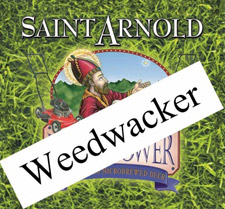
Saint Arnold WeedwackerFor the first release Saint Arnold’s brewers will create the base wort for the best-selling Fancy Lawnmower Beer, a 4.7 percent beer made with mostly pilsner malt and a little bit of malted wheat, light and thirst quenching in gawdawfulhot Houston. They’ll ferment half as they always do and half with a hefeweizen yeast sourced from Bavaria. That strain typically adds banana and clove character to a beer (see geeky details).

This beer will be called Weedwacker and won’t be filtered.

“People spend a lot of time talking about the malt and hops used in beers, but yeast is discussed little and probably understood even less. We thought this would be fun, tasty and educational,” Saint Arnold founder Brock Wagner said for the press release. “We’re hoping that bars and restaurants will offer both beers at the same time so that people can compare the flavor differences.”

The beers are scheduled to go on tap Aug. 16 in select restaurants and bars. A 60-barrel batch will yield about 20,000 12-ounces servings so don’t expect the beers to be around long.

Saint Arnold Weedwacker will be followed in mid-November by Saint Arnold Altared Amber, Amber Ale wort pitched with a yeast sourced from a Belgian Trappist brewery. In mid-February 2011, the brewery plans to release Saint Arnold Bitter Belgian, Saint Arnold Elissa IPA wort also pitched with a Trappist yeast. In mid-May 2011, Saint Arnold Brown Bitte is due, which will be Saint Arnold Brown Ale wort pitched with an altbier yeast.

Now, the geeky details

Feel free to stop reading now. Different yeast strains create different esters and phenols during fermentation that we perceive as flavor and aroma. Strains used by Bavarian brewers to make weizen beers and by some Belgian brewers (including those in Trappist monasteries) share certain characteristics.

Two key players are an ester called isoamyl acetate and a phenol known as 4-vinyl guaiacol. The former is responsible for banana and other fruit flavors and aromas, the latter for the clove character you expect in a hefeweizen or the spiciness in a Belgian tripel (or clove, which is not such a good thing in a tripel).

Although brewers long ago mastered delivering the clovelike aroma and flavors that help define German weizen beers, and to a lesser extent Belgian whites, not until the 1970s did they discover that weizen and other “Phenolic Off-Flavor” (POF+) yeasts convert ferulic acid to 4-vinyl guaiacol. These include weizen and wit yeasts in varying degrees, but also yeast used to ferment Belgian strong ales and even English ales.

A key, however, is shaking ferulic acid free of malted wheat, barley or oats. Different experiments have yielded various results but a rest (sensibly enough called a “ferulic acid rest”) during the mashing process somewhere in the range between 104 and 113° F seems to yield the best results. A longer rest, more clove. I’d be surprised if that rest was part of production at Saint Arnold. I’d sure like to be in Houston in August to taste the results.

My presentation at the recent National Homebrewers Conference included a little compare and contrast between weizen yeast strains and Belgian strong ale strains (such as those Saint Arnold will use in future beers in this series). Kristen England brewed four batches with varying combinations of grains, mashed them in different ways and fermented them with different yeast strains. Attendees rated them (it was a “blind” tasting) on how much wheat character they exhibited, overall fruit, banana, and clove/spice. When I have time to make sense of the results I’ll post that with the presentation at Brewing With Wheat.

And if you want to get really serious about yeast then start saving your pennies to buy “Yeast: The Practical Guide to Beer Fermentation” from Brewers Publications. It should be available in September. As I’ve mentioned before it is the first in a series of books about beer’s major ingredients. I’m writing the hops book.

Weekend beer reading (and viewing)

So let’s get right to this World Cup football thing. Story in Yahoo! Sports (thanks to Neal Stewart) points out the financial benefits for sports bars and large breweries.

This video from Freetail Brewing in San Antonio (which is approaching 50,000 views on YouTube) indicates they are more widespread. My local brewpub (Turtle Mountain Brewing) is the only official U.S. Soccer Bar in New Mexico and has been open at 8 a.m. most days during the early rounds.

  • The Rise and Fall of New Albion Brewing. CraftBeer.com profiles Jack McAuliffe, including bits of history I’ve never read elsewhere.
  • It’s not just about cheaper beer. ABC News explains how a bill in Congress that would reduce taxes for small breweries would create new jobs. Video included.
  • What I meant to say. Kelly Ryan reveals the whole story behind Epic Thornbridge Stout, the collaboration beer I wrote about for May’s Session.
  • Shopping with Tom Peters. Monk’s Cafe owners Tom Peters was creating outlandish beer dinners at a joint called Copa, Too! when your local brewer might still have been in knickers. Beer Appétit heads to the market with Peters to find the ingredients for a dinner at Monk’s. Included are interviews Tomme Arthur of Lost Abbey Brewing and Gordon Grubb of Nodding Head in this YouTube program. (Tip from the Lost Abbey blog.)
  • Wine writers and wine bloggers. With the 3rd annual Wine Blogger Conference beginning Tom Wark writes “I believe all wine bloggers are wine writers, but all wine writers are not wine bloggers.” I added this link first because the gathering is organized by the some company behind the first Beer Bloggers Conference. Second because I’m not exactly sure what point Wark is making, but it seems to point out another difference between beer and wine and remind us all that . . . Beer is not the new wine.
  • ‘Life is all about bad decisions’

    I’m finding all sorts of fun things to read when I should be finishing a “real” post here and two lengthy stories for print publications. So some quick bits before I get back to work. Please make sure to read the last item.

  • Best line from the National Homebrewers Conference. About two hours into Club Night I had my first mead, then another and then headed over to try Jeff Swearingen’s famous Tupelo Honey mead. I realized I was headed down a treacherous path one ounce at a time, which I mentioned to meadmaker extraordinaire Curt Stock. He replied, “Remember, life is all about bad decisions.”
  • I want to try this beer. Worthington E, as described by Zak Avery. “As anachronisms go, it’s pretty enjoyable, but it’s still an anachronism.” He asks a very relevant question about who this beer is for, and draws quite interesting comments.
  • They had a party to celebrate the release of the trailer for “For The Love of Beer,” (catchy title, reminds me of something) a documentary that focuses on women in the craft beer community. The party doubled as a fundraiser so Alison Grayson can finish the film. (Full report at Brewpublic.)
  • Quaffable? (There I typed it again.) Sunburn Summer Brew from Widmer Brothers. Courtesy of The Brew Site.
  • Philly Beer Week, the compleat wrapup. It appears Brian plans ten parts.
  • Regional distinction is important. Chris Maclean writes in The Publican about “The death of regional variation.”
  • Even more alarmingly, the exceptional cask beers which have recently attained national recognition were now regularly featuring across the country. Timothy Taylor’s Landlord. Sharp’s Doom Bar. These are fantastic beers and worthy of praise. They are well worth seeking out as exemplary products. But they are outstanding products within their own context. It seems to me that, rolled out nationally, they lose their provenance.

    Go read the whole thing. This is important.

    And the beer beat goes on

    You know you are at the National Homebrewers Conference when you get on an elevator at 5 o’clock in the morning (I had an early flight home) and there’s a guy who still hasn’t been to bed. He is holding a glass full of beer.

    I came home from the conference in Minnesota with a notebook full of new, to me, information. It’s still a little wet right now because despite careful packing a bottle of (sour) beer and a bottle of mead did not survive the journey back. I could smell the problem the moment I grabbed my bag off the carousel. Some of what I learned will end up here, some in stories for various publications and some (eventually) in the hops book.

    Meanwhile, one quick thought.

    Saturday morning the “When Homebrewers Go Pro: Starting Your Own Brewery” panel was packed. Like much of the conference. Steve Parkes (American Brewers Guild) said he had not spoken before audiences this size in more than 10 years. He looked around Club Night (I wouldn’t even begin to try to describe it, but the room was full of more than 1,000 people and clubs brought more than 500 5-gallon kegs) and simply smiled.

    So more than 300 people are crammed in to this room Saturday and I am thinking not all these people can really be thinking about starting their own brewery when moderator James Spencer asks just that question and for a show of hands. Scores go up. I think of something the late Greg Noonan told me a dozen years ago.

    “When the homebrewers stop entering the profession, and the backyard breweries are squeezed out, then it will become stagnant,” he said. “You gotta keep getting the guys who say, ‘Cool, I can sell the beer I make. I can do it.’ ”

    We’re not at the end of the line. Surly Brewing founder Omar Ansari emphasized that toward the end of the proceedings.

    “The next wave of brewers is coming,” he said.

    Then he posed a question. “What’s going to make those brewers different from one another?”