The Session #37: Just open it

The SessionThis is my contribution to the Session #37: “The Display Shelf: When to Drink the Good Stuff” or, if you prefer, “Raid the Cellar.” Visit The Ferm for links to more posts.

Is there a perfect beer for every particular special moment? Is there a time in every beer’s life when it tastes better than it ever otherwise will?

SirRon’s open-ended assignment for The Session spells certain trouble for me. I’m perfectly willing to spend all sorts of time contemplating questions that do not have answers.

Anyway, the topic this month seems particularly timely because we’ve recently been treated to a flock of stories about cellaring beer. Don Russell made it subject of his column last week, there was a story this week in The Washington Post food section, and a rather long feature in the Los Angeles Times (worth clicking through to for the photo alone).

Could this be dangerous? Although these stories emphasize the importance of picking the right kind of beers to lay down and having a proper cellar it’s easy to envision a reader skimming the story, grabbing who-knows-what beer, sticking it in the back of a closet and forgetting about it until it’s time for the next garage sale.

Last Christmas friends of ours brought out a large corked bottle of Budweiser that somebody had given them (thank goodness) at an estate sale. It was bottled in 2001 for the brewery’s 125th anniversary. We have no idea how it was stored, but that didn’t really matter. We opened it, sipped, talked about wet cardboard and dumped the contents. We could only dream about what that beer might have tasted like fresh.
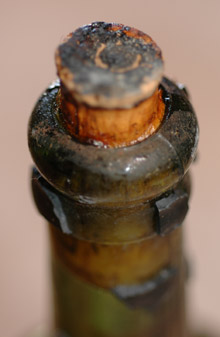
Thomas Hardy's aleI must confess I’m a serial cellarer. When we moved to New Mexico and left our Illinois basement behind the idea was “no more laying down beer.” Didn’t take. Bought a chest freezer, hooked it up to a temperature controller and we were good to go.

But only a small portion of beer spends much time in that pseudo cellar. We buy beer, we drink it. Beer shows up at our door, we drink it. It seems it would be rude to do so otherwise. Oh, that beer you sent last week, we’ll open it in 2014 and let you know how it is doing.

So a few things I learned in February:

  • The bottle of Deschutes Jubel 2010 suggested it would be best consumed after Jan. 11, 2011. And now we’ll be buying a couple bottles to find out. I had a taste of Jubel 2000 (the last time the big brother of the season Jubel was bottled) in 2006 and that turned out to be too long to wait. This edition already hints of an old ale, with muted hops that will further fade with time (much as the classic Thomas Hardy’s Ale). Husky malt character, perhaps augmented by tannins from time in pinot noir barrels, leaves it a bit coarse on the tongue. Just feels like it is going to age well, and I suspect it will hold up more than six years this time.
  • Because Stone Brewing sent a bottle of 2010 Old Guardian Barley Wine I hauled out a 2006 Old Guardian (a $6.99 price tag still on the bottle) to share with friends before we went out to dinner (where some non-driving members of our group enjoyed Santa Fe Brewing’s Chicken Killer Barley Wine on draft). Two very different beers; not surprisingly the hops are much more apparent in younger beer, earthy and spicy. Some of that’s going to be gone a few years down the road, and while a luscious beer (like the 2006 edition) may emerge for some now is the time to drink this beer. Of course I headed to the store to make sure I’ve got a couple bottles of 2010 so I can make that comparison on a few years.
  • The Lost Abbey’s Angel’s Share Grand Cru takes Angel’s Share to a new level. Given what went into the blend that shouldn’t be a surprise. However, words can’t prepare you for the remarkable rush of flavors. If you don’t like spectacular or intense (such beers don’t work for everybody) stay away. Like many Lost Abbey beers there are layers of flavor. After you reset your palate, subtle textures emerge. Some of the beer in this blend is already four years old, so I’m calling it pre-cellared. If it gets much better I don’t know if Russell can find a piece of cheese to stand up to it, or if he’ll survive the experience.
  • Less can be more in a vertical tasting. Three vintages of Firestone Walker anniversary beers seems like a good number. Granted, we tried seven different Thomas Hardy’s a couple of years ago but those were smaller servings. One Sunday afternoon four us got together for the Firestone beers — one brought Firestone XI (2007), one Firestone XII (2008), one Firestone XIII (2009) and one a lovely selection of cheeses. That worked out to a little over 5 ounces of each beer apiece, a proper amount of leisurely sipping.
  • The beers were really good, but you knew that. I liked XII better than a year ago, and we might have talked about that over the course of about two hours. I’m not sure. Not until I was driving home did I consider that three of us tasted Firestone 10 together, Firestone XI the next year, Firestone XII the next and now XI-XII-XIII.

    We’re not some crusty war veterans who need an excuse to get together, but this is a nice little tradition that I expect will continue. So to SirRon’s question about “finding a drinking occasion that lives up to the reputation of the bottle,” I’d suggest sharing beer with friends should be occasion enough.


    Harriet Beecher Stowe on beer

    Was Harriet Beecher Stowe thinking about beer?

    “To do common things perfectly is far better worth our endeavor than to do uncommon things respectably.”

    Just so I don’t get injured when an empty bottle that once held *xtr*m* beer rattles off my skull, it’s also OK to do uncommon things perfectly.


    Midweek drinks links

    Truth is sometimes I turn these lists into a post so I have the links saved for more careful reading later.

  • Why Should Terroir Matter . . . from a speech by Randall Grahm. I don’t care about “saving” high end wines, but thought provoking. I suspect most of the time we should be happy with beer along the lines of vins d’effort (wines of effort) rather than vins de terroir (wines that express a sense of place). Where still matters in beer, but there must be a better word than terroir. (From the guy who owns the domain name.)
  • Danish shakeup. Knut Albert reports Anders Kissmeyer, one of the pioneers behind the Danish craft beer movement, has been fired by the owners of Nørrebro Bryghus.
  • ‘I brew in A Major.’ Mattias Hammenlind, head brewer at Swedish microbrewery Sigtuna Brygghus is also a drummer in a hard rock band. “My brewing style is a mix of classical British and US innovation,” he says. Also, notice a sidebar with a guide to new wave beers in Sweden.
  • Birra dell’anno awards. Birrificio del Ducato has been chosen “brewery of the year” in Italy. All the results of recent judging, including the best chestnut beers.
  • Beerbot. The New York Times introduces us to “robots designed to serve and cook food and, in the process, act as good-will ambassadors, and salesmen, etc.” Head to the second page for the good part: “One entry, Beerbot, detects approaching people and asks for beer money. When it acquires enough, it ‘buys’ itself a beer. Bystanders can watch it flow into a transparent bladder.”
  • Beer and oysters. In The Washington Post.
  • Curling strategy. This chart will make wagering easier the deeper into a match you watch.


    Golden ales and Bam Bam in the Big Apple

    (Note: This post was amended Feb. 24 to eliminate babbling that got in the way of actual story.)

    Tomorrow’ s The New York Times carries an article about “tasting Belgian golden ales.” Perhaps surprisingly American beers claimed four the first five spots although half of the 20 beers tasted hailed from Belgium.

    The first and fourth favorite beers were from Dexter, Michigan — which as any card-carrying beer geek knows is home to Jolly Pumpkin Artisan Ales. Jolly Pumpkin’s own Oro de Calabaza claimed the top spot and Leelanau Good Harbor Golden, brewed under contract by Jolly Pumpkin, the fourth. Eric Asimov writes:

    “Both of these beers were unfiltered, giving them a hazy appearance, and aged in barrels, but beyond that they are completely different. While the Good Harbor was funky, the Oro de Calabaza was spicy, fruity and floral, with soft carbonation and fresh, vibrant flavors. Same man (brewmaster Ron Jeffries), different yeasts, at the least.”

    Yes, except of course, for the Dexter microflora, embraced by Jeffries.

    “The primary fermentation does indeed use different yeasts,” Jeffries wrote in an email. “The Oro is our ‘house’ strain, and for Good Harbor Golden I use either a cool fermenting clean ale strain, or ferments with a lager at slightly elevated temperatures. I can’t decide which I like best, so I bounce back and forth between the two. Next batch I might blend them. Now that would be cool.

    “The Good Harbor oak tun (1200 liters) does produce different flavors than the barrels we age the Oro in. Similar but different. If I had to pick, I would say it tastes most like the 2000L we use mainly for Bam.”

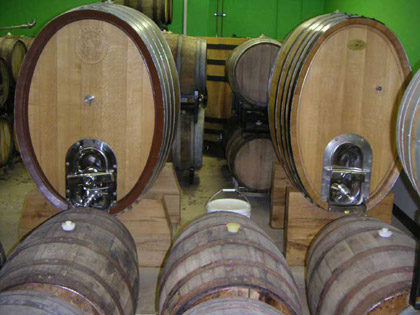
    The large barrel that Leelanau bought for use at Jolly Pumpkin is on the left side in the photo above. The rest are Jolly Pumpkin barrels.

    I first tasted Good Harbor in the spring of 2007 for All About Beer magazine’s Beer Talk. We liked the beer.

    After I had written my notes I took the second bottle the brewery sent to share with friends I get together with semi-regularly.

    When you see a bottle holding a brand you’ve never heard of, such as Leelanau, you might as well be tasting blind. But my friend, Bill, took one sniff and declared, “This is Bam.” He knew it wasn’t Bam Biere, the session Saison from Jolly Pumpkin but that was the impression.

    Only problem, I said, this beer is 7.5% and Bam 4.5%. “OK, Double Bam,” he said, suddenly looking inspired. “No, Bam Bam.”

    I don’t think I ever expected to be reading about the beer I’ll always remember as Bam Bam in The New York Times.