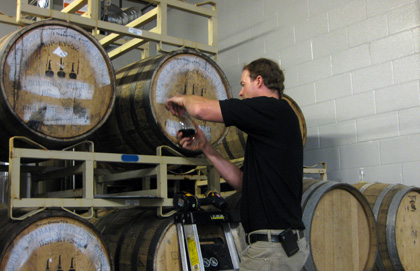
The wood, and ‘From the Wood’

Ted Rice, Marble Brewery, tends to his barrels

This is the wood. And . . .
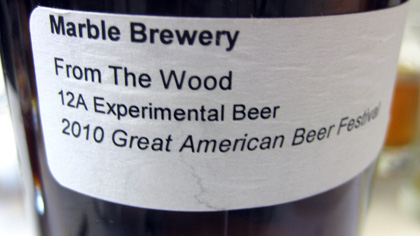
From the Wood

This is From the Wood.

Pretty nifty packaging, don’t you think?

The current Draft magazine features “The Top 25 Beers of the Year.” You can view the list here, but you have to pick up the magazine itself to see nice all the bottles and labels (The Lost Abbey Angel’s Share Grand Cru, Saboteur, Brooklyn Sorachi Ace, Dogfish Head Bitches Brew, et al.) in their glossy glory. Although From the Wood is among the 25 beer chosen it is not pictured. You can probably figure out why.

It was available on draft only, and there wasn’t really much of it. In that sense it stands as proxy for thousands of small-batch beers sold this past year in the United States. Some terrific, some terrible, most somewhere between.

Ted Rice, director of brewing at Marble, took a bit of From the Wood to the Great American Beer Festival because he likes to have something out of the ordinary to serve to attendees. That meant he was required to bottle enough beer for the Professional Judge Panel (the people who decide who wins GABF medals) evaluate. He packaged a few extra bottles to have to taste when the judge sheets came back. The bottle pictured was the last of those. The beer inside was good, but I didn’t take notes. They wouldn’t have been as evocative as those in Draft, so a bit of the description that appeared there:

“Figs and plum immerse the tongue before simultaneous waves of spicy bourbon and funky Brett wash back. Instead of battling for attention, the bourbon’s vanilla notes meld seamlessly into the flavor, achieving a stunning level of sophistication.”

This beer wasn’t just a happy accident. Rice put a strong dark beer brewed with a yeast strain that hails from Belgium in bourbon barrels he’d used twice previously, so the bourbon character was muted. He added Brettanomyces, but not with the intention of creating a “yeast gone wild beer.”

Curiously, or perhaps not, the beer did not advance past the first round at GABF, where judges evaluate a dozen beers and pass three on to the next level. Rice entered it into Category 12, Experimental Beers, because he decided the presence of Brett excluded it from the wood- and barrel-aged category, but that it didn’t qualify as “sour” (the alternative barrel choice).

One judge thought it should have been entered in the barrel-aged category, another in the sour barrel category. The third wrote, “. . . very drinkable for as much as it has going on.”

In the photo at the top Rice is taking samples of beer aged in “fresh” bourbon barrels, the contents of which will be blended into Marble Reserve (if they are ever ready, sigh). Then the barrels will be used again. Eventually, perhaps on third use, Rice might see about replicating “From the Wood.”

Beers that spend time in wood are a small percentage of a percentage point of Marble’s business, and Marble (which will brew a little over 8,000 barrels this year) is a brewery that few people outside the immediate area have even heard of. That makes it like most of the breweries (including brewpubs, obviously) in the nation. A GABF medal or a mention in a national magazine doesn’t have the financial implications that it does for nationally, or internationally, distributed brands like Dogfish Head and Duvel (also on the list).

But it validates the beers for customers (“I knew that was a good beer”) and makes brewers smile. So I asked Rice a totally unfair question: Which would you prefer, having a beer, specifically this one, win a GABF medal or be named one of the 25 beers of the year by a magazine on newsstands across the country?

He thought about it over night before emailing his answer:

“Having won several GABF medals, I know it’s a thrill. After reading the review of FTW in Draft magazine, it gave me chills and a certain glow, much in the same way a GABF medal does. What’s special about the Draft Top 25 is the colorful review for all beer lovers to see, that a judge’s tasting notes or gold medal could not convey. For this beer, which did not neatly fit in a style guideline, I’ll take the Draft Top 25. From the Wood was selected amongst the beers and breweries of the world, not just one style or country. That’s pretty special.”
The beer garden? Look for the chestnut trees

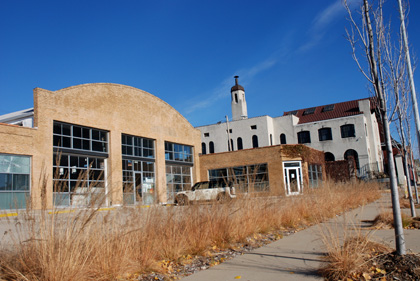
Urban Chestnut Brewing

This is Urban Chestnut Brewing in St. Louis. I was there Friday, the brewhouse arrived today, and I expect they’ll have beer long before I get back.

Founders Florian Kuplent and Dave Wolfe have a great story. Probably one of the reasons Draft magazine named UCBC one of a dozen breweries to watch in 2011 although they haven’t brewed a drop of beer.

So I’m looking forward to returning and reporting what I find. I just wanted to show you the place. The Midtown Alley neighborhood certainly is urban. They brewery occupies a building, erected in 1928, that was a garage and now is on the National Register of Historic Places (rest assured they won’t be covering the front with signs).

The massive white building looming in the background is an art deco Spanish mission mansion built in 1921 and designed by famous architect Thomas P. Barnett. It’s for sale. There’s a Baptist church across the street from that, the Salvation Army has an outpost a few blocks to the east, the famous Fox Theater is three blocks to the west, Pappy’s Smokehouse is right around the corner (next to Buffalo Brewing) and . . . well, you get the picture.

You’re gonna want to sit at the communal tables in front of the tap room (in the distance). That’s where the beer garden will be. They are planting chestnut trees.

I’m going to type that again because it makes me smile. They are planting chestnut trees.

The book that never was

Michael Jackson’s Great American Beers: And Where to Find Them

Jackson spent several months in the United States in 1995 and 1996 researching this book. He conducted “pod tastings” where brewers brought him what they considered their best beers. One described the experience: “. . . like a an audience with the Pope.”

In 2002 he explained what happened (or didn’t happen):

“I visited every state in the course of my research (even brewery-less Mississippi). Unfortunately, by the time I had written half the book, about 50 per cent of the material was already out of date. Breweries were opening and closing at such a rate, brewers moving jobs, and product-lines changing, that the task became impossible. Despite being a very fast worker, I realised that, the time I finished the book, 75 per cent of it would be outdated. I have never in my career abandoned a project, but this one is sidelined for the moment.’

Firestone Walker 11 and friends

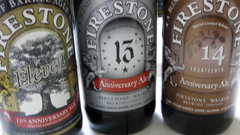
Firestone Walker Anniversary BeersFriday I snapped a photo of the three bottles of Firestone Walker anniversary beers, posted them to posterous and promised drinking notes, an oath automatically repeated at Twitter and Facebook. A bad idea, and I can’t even blame the alcohol since we hadn’t poured any beer yet. Fact is I didn’t take any notes and I’m not sure I’d have much new to tell you if I had.
You can find glowing adjectives all over the Internet, and I’ve already written about the process in detail, both here and in print. So a few brief observations:

– One of my friends at the table said he’d read some comments on the line that Eleven (released in 2007) had started to go downhill. Not the bottle we opened, at least to my taste. I have one left and will wait at least two years before opening it.

– Last year, when we pulled together bottles of Eleven, 12 and 13 we decided just two at a time was probably enough. We really should stick to that plan. The newest release and one older. Certainly they are different, more like cousins than siblings, but they also are 10% abv (if you are lucky enough to have squirreled away a 10) and stronger. Besides, it’s a anniversary beer, one that a lot of work went into, and opening a single bottle seems to be a celebration unto itself.

– I sometimes struggle to explain what I mean when using the word texture to describe a beer. It’s not just mouthfeel, but also the layers of flavors and aromas. The best way to understand what I mean it so drink one of these anniversary beers.

– The 14 (the newest, in case all these numbers we leaving you feeling a little lost) has a hop brightness not present since the 10. Will that change how the beer ages? Be patient.

Of course we talked about the beers as we drank them — even looked at the blending notes — as well as other things beer and things not beer. That’s the way it should work.

When I got home I thought of the conversation I had with winemaker Matt Trevisan that became New Beer Rule 6 (The best beer was in the empty glass.)

Once again, I ran out of Eleven first. Dang, I’m going to miss that beer. It will be a tough last bottle to open.

Making it fresh, 21 years in

“. . . on hot days there is no pleasanter place than the shady lanes of hops, with their bitter scent — an unutterably refreshing scent, like a wind blowing from oceans of cool beer.”
                                                    — George Orwell, 1931

Orwell did not exactly give hop picking a rave review. But he allowed it was not a disagreeable job in itself, and obviously took some visceral pleasure from the adventure. Crush a few fresh hop cones, give them a rub, take a deep breath and the experience lodges itself forever in our brains. We’re hardwired that way. Fresh hop ales stir those memories, not just the aroma but also the sticky, resiny texture.

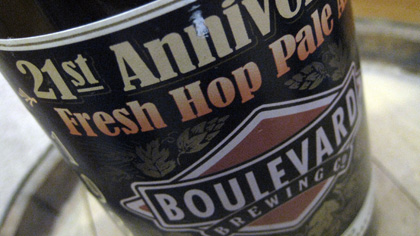
That Boulevard Brewing in Kansas City would choose to brew Fresh Hop Pale Ale to celebrate its 21st anniversary — that’s today, as a matter of fact — might seem curious. After all, Kansas City it not located in the midst of hop yards. And Boulevard’s flagship Unfiltered Wheat Beer accounts for 65 percent of its sales.

Boulevard 21st Anniversary Fresh Hop Pale Ale

However, the Pale Ale was the first beer that founder John McDonald sold and initially the flagship. There remain few experiences better than a draft Pale Ale and a burnt ends sandwich at Gates Bar-B-Q in Kansas City.

McDonald wrote the recipe, and when brewmaster Steven Pauwels joined Boulevard in 1999 he saw no reason to tinker. “I have always liked Pale Ale the way it was when I started at Boulevard and have done the best I can to keep it the same way despite brew house upgrades, increased fermenter sizes, filtration changes, bottle line changes, etcetera,” he said. “Some of the original ingredients have changed but Cascade flower hops have been a constant.”

Cascade hops provide the fresh component — 500 pounds as a dry hop* in the 125-barrel batch — because Pauwels wanted to pay tribute to the hop that “helped create the craft beer movement” as well as the original Pale.

Fresh Hop Pale is not simply Pale “grown up,” although heftier (7.2% abv and 44 bittering units compared to 5.4%/30 IBU). Different hops — for the record Cascade, Mangum, Palisade, Simcoe and Styrian Golding in the Pale; Cascade, Hallertau, Magnum, Styrian Golding and Centennial in the anniversary beer — but more importantly the 21st is built on a base of Maris Otter, the rich English pale malt.

Not as brazen as in an Americanized India Pale Ale, the hops are not shy — resiny, piney, some orange and grapefruit rind, certainly to be enjoyed fresh — but for me (your mileage may vary) the Maris Otter steals the show. Abetted and perhaps refined by bottle conditioning, it provides texture that plays perfectly with spicy hop flavors. A beer in harmony.

McDonald offers a bit of a toast at the Boulevard website, so I’ll leave the last words to him.

*****

* Yes, the “wet hops” used as “dry hops.” That’s brewing for you. Enough to make a soul think twice about writing a book about hops.