Making it fresh, 21 years in

“. . . on hot days there is no pleasanter place than the shady lanes of hops, with their bitter scent — an unutterably refreshing scent, like a wind blowing from oceans of cool beer.”
                                                    — George Orwell, 1931

Orwell did not exactly give hop picking a rave review. But he allowed it was not a disagreeable job in itself, and obviously took some visceral pleasure from the adventure. Crush a few fresh hop cones, give them a rub, take a deep breath and the experience lodges itself forever in our brains. We’re hardwired that way. Fresh hop ales stir those memories, not just the aroma but also the sticky, resiny texture.

That Boulevard Brewing in Kansas City would choose to brew Fresh Hop Pale Ale to celebrate its 21st anniversary — that’s today, as a matter of fact — might seem curious. After all, Kansas City it not located in the midst of hop yards. And Boulevard’s flagship Unfiltered Wheat Beer accounts for 65 percent of its sales.
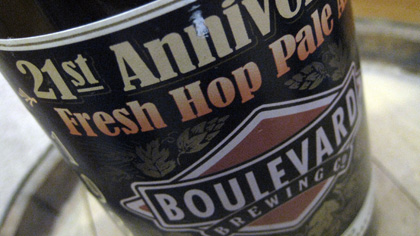
Boulevard 21st Anniversary Fresh Hop Pale Ale

However, the Pale Ale was the first beer that founder John McDonald sold and initially the flagship. There remain few experiences better than a draft Pale Ale and a burnt ends sandwich at Gates Bar-B-Q in Kansas City.

McDonald wrote the recipe, and when brewmaster Steven Pauwels joined Boulevard in 1999 he saw no reason to tinker. “I have always liked Pale Ale the way it was when I started at Boulevard and have done the best I can to keep it the same way despite brew house upgrades, increased fermenter sizes, filtration changes, bottle line changes, etcetera,” he said. “Some of the original ingredients have changed but Cascade flower hops have been a constant.”

Cascade hops provide the fresh component — 500 pounds as a dry hop* in the 125-barrel batch — because Pauwels wanted to pay tribute to the hop that “helped create the craft beer movement” as well as the original Pale.

Fresh Hop Pale is not simply Pale “grown up,” although heftier (7.2% abv and 44 bittering units compared to 5.4%/30 IBU). Different hops — for the record Cascade, Mangum, Palisade, Simcoe and Styrian Golding in the Pale; Cascade, Hallertau, Magnum, Styrian Golding and Centennial in the anniversary beer — but more importantly the 21st is built on a base of Maris Otter, the rich English pale malt.

Not as brazen as in an Americanized India Pale Ale, the hops are not shy — resiny, piney, some orange and grapefruit rind, certainly to be enjoyed fresh — but for me (your mileage may vary) the Maris Otter steals the show. Abetted and perhaps refined by bottle conditioning, it provides texture that plays perfectly with spicy hop flavors. A beer in harmony.

McDonald offers a bit of a toast at the Boulevard website, so I’ll leave the last words to him.

*****

* Yes, the “wet hops” used as “dry hops.” That’s brewing for you. Enough to make a soul think twice about writing a book about hops.
Let it snow, let it snow – Two cool contests

The Yuletide Photo Contest must be one of the very best inventions beer blogging has given us. And it’s back. There are rules, so please read and follow them. Otherwise one of these years Alan will come to his senses and then where will we go for a snow and beer porn?

Contest No. 2 has nothing to do with yule or other tides, but you can win a beer brewed in 1936. All Zak Avery asks that you do is “write something about beer and time, up to a maximum of 500 words.” (He’ll also accept videos, so you best read the rules). Figure there might be a little competition, since the prize is a bottle of beer brewed for the 1937 Coronation of Edward VIII.

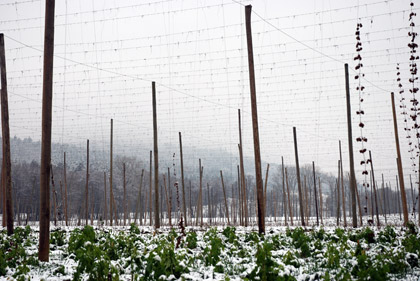
Franconian hops field

More about contest No. 1: The headline and this photo (taken in Franconia in 2008) refer to Alan’s affection for photos that include beer and snow (yes, these hop bines, not beer, but you get the point). However, having observed this contest from the get-go I can tell you is a sucker for photos featuring people, beer and conviviality.

More about contest No. 2: For the announcement Zak took a picture of the 1937 bottle sitting next to a notebook computer. Shouldn’t that be an old typewriter instead?

Sometimes it’s hard to part with that last bottle

Well, we opened the final bottle of Westvleteren beer we bought when we visited Abbey Saint Sixtus in December of 2004. It was an “8” (or “blue cap”).

It’s our wedding anniversary. Made it easy.

Great beer. Make that a really great beer, because you couldn’t taste the floaties. That’s the end of the drinking note, and I won’t bother you with the story about losing a bottle (and the sock it was stuffed inside) in transit.

Be happy for us. This is what life is about.


These are people I want to drink beer with

Officially, this is a parody of the “I Am A Craft Brewer” first released 18 months ago. But it also stands on its own. Give it a look, and a laugh, and read on if you want.

Make no mistake. These are not random people off the street. Some of them work for Rifftrax (“We don’t make movies . . . We make them funny!), so they had a creative leg up. Because the video was posted on Conor Lastowka’s You Tube channel, I asked him for a few details, provided by email:

“I live in San Diego. I’m a writer for rifftrax.com and a homebrewer/beer fan. Sometimes they show our movies at the Stone Brewery during the summer, so that’s where we saw the original video, and we were talking about some way to get RiffTrax involved in San Diego Beer Week (editor’s note: that begins tomorrow), and we decided to make a parody of their video. It’s me, my wife, two co-workers and some friends who appear in it.”

Could these guys probably create something centered around a mainstream lager that would make me laugh out loud? I wouldn’t be surprised.

Would they be motivated to?

Rhetorical question.


About those reports of more Westvleteren beer

News last week that Abbey Saint Sixtus, the Trappist monastery at Westvleteren in Belgium, might boost production of its much-cherished beer and sell it through supermarket channels led to the consumption of considerable bandwidth on beer discussion boards.

Perhaps some of the questions not addressed by that story were answered in the various threads, but not in the few I had time to read. And I didn’t see a mention of the report from Danny Van Tricht in September that the abbey had installed new lagering tanks. Gee, doesn’t that make you wonder just how much more beer Saint Sixtus might brew?

I don’t have a definitive answer, but an email response from Brother Joris — the monk in charge of brewing at Saint Sixtus — would indicate “not much” and even that won’t be on a permanent basis.

He explained, “I am not allowed to give away more details on the matter, as it should be a surprise.”

He wrote that the reports the brewery would sell beer away from the monastery are not correct, adding, “We remain faithful to our sales policy and we have no intention of opening a second channel for the distribution of our beers in the way suggested by the media.” He indicated the monastery is considering a one-time special project (that would not last for long) to raise additional funds for construction work on the cloister.. “This will however not come down to ‘Westvleteren being for sale in the racks of a supermarket,'” he wrote.

He further explained that the new tanks make the production schedule more flexible, so that brewing needn’t be delayed because beer in the lagering tanks isn’t ready for bottling. This makes it possible to produce a fixed quantity each year (currently that might vary between 4,200 and 4,750 hectoliters a year — comparable to about 3,600 to 4,000 U.S. barrels).

Digression No. 1: Stephen Beaumont has asked what will become of Westvelteren’s cult status should they become easier to buy. The notion — not Mr. B’s, should there be any confusion — that the Saint Sixtus beers might be “dumbed down” is laughable. By adding lagering tanks the monks assure that beer will not be hurried out the door. When I visited the brewery in 2004, Brother Joris explained that the 8 usually lagers four weeks but that the 12 might take two months to ten weeks, “when you get a difficult one.”

If the monks at Saint Sixtus wanted to ramp up production they already could have. The thoroughly modern brewhouse installed in 1989 could crank out a lot more wort, and the squares for primary fermentation sit idle more days than they are used. Plenty of breweries around the world have shortened lagering or aging times to meet growing demand.

Digression No. 2: In cruising through discussion boards I saw it suggested, and I’m paraphrasing, that “the monks should brew more beer to raise more money for the poor.” How come nobody finishes that sentence with what they are really thinking? “. . . and make it easier for me to buy their beer.”

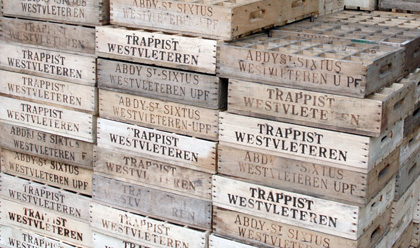
In fact, larger monastery breweries, notably Westmalles and Chimay, help support other monasteries, multiple charities and local economies. Chimay, with 150 employees in its brewery and cheese making facility, is one of the largest employers in one of Belgium’s poorest regions. Westvleteren sells its beer in wooden crates (pictured at the top) manufactured in a “shielded workplace” for those not able to work in a mainstream environment.

But that’s not why they brew. Monks — Benedictine, Cistercian and Trappist — live by the rule of Saint Benedict, written about A.D. 530. Among other things, it calls on monks to be self-sufficient through their own labor.

Brother Joris puts it quite well: “We live on brewing, but we do it so we can continue with our real business, which is being monks.”