Papa couldn’t tell us and it didn’t make no sense
When the teacher told us we couldn’t talk no French no more.
Do you hear me calling, do you understand?
Once it is gone, it ain’t never coming back no more.
Hé, mon cher garçon,
Est-ce que tu me comprends?
– Zachardy Richard, “No French, No More”
Interesting things can happen in the space where cultures overlap.
You can listen to Zachary Richard sing “No French, No More” here (in French). It is hard to imagine that visiting the south of Louisiana (“Cajun country”) would be as sublime had the French Acadian language been wiped out, because — of course — that initiative was part of an effort to flatten the culture.
Last weekend in Florianopolis, Brazil, Leandro Emmel told a story about when his grandfather was sent to prison 70 years ago for speaking German. Emmel’s company sells ingredients and equipment to homebrewers and small breweries in Brazil. His grandfather grew up in Pomerode, a town of about 27,000 just outside of Blumenau. Blumenau, population 300,000, is famous for hosting the second largest Oktoberfest in the world, second to Munich. (I’d like to see proof it is bigger than Stuttgart’s Oktoberfest, but that will have to wait. Maybe it was the beer there, but we ended up getting drunk before we were even able to find parking at Stuttgart airport, when we landed there the first time.) German immigrants settled Blumenau in 1850, and Pomerode a few years later. Like Florianopolis, they are located in the state of Santa Catarina, the most affluent in Brazil.
Blumenau flaunts its German heritage, but rightly Pomerode lays claim to being the most German town in Brazil, and hence outside of Germany itself. The schools are bilingual and about 80 percent of residents still speak German. In fact, day-to-day life often takes place in German.
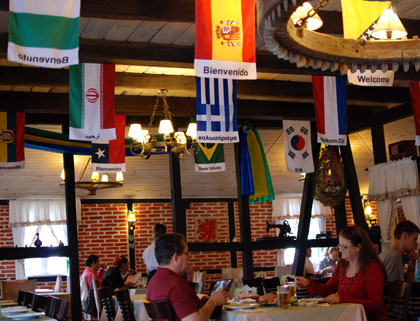
I visited Pomerode last Sunday along with eight Brazilian homebrewers, John Palmer, and Brad Smith. John, Brad and I gave technical presentatiions at Congresso Técnico para Cervejeiros Caseiros in Florianopolis. (Disclosure: the homebrewers paid our way.) On Sunday we headed north, eating lunch at Restaurante Wunderwald, then touring two breweries. The plan was to include a stop at Blumenau’s Oktoberfest grounds, but it got dark first.
The restaurant was buzzing — sure enough, the hosts at the door greeted some customers in Portuguese and others in German — and platters of meat looked and tasted of the Black Forest. I had a bottle of Bierbaum Lager, a helles brewed nearby but also tasting of Bavaria. German brewing tradition is prominent in the southeast of Brazil, which is also where most of the new small breweries (they use the word “craft”) have opened, perhaps 150 in all of Brazil, 40 in the Sao Paulo area alone. American hops are as well.
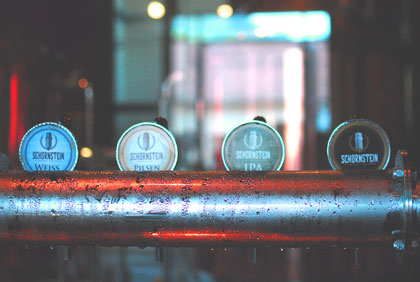
At Cervejaria Schornstein in Pomerode I drank Schornstein Weiss, properly cloudy and banana sweet, but most of the homebrewers went with the IPA. (I had that the night before at Liffey Brewpub, which makes its own beer and also serves a nice selection of Brazilian and imported beers). Schornstein operates both the brewpub and a larger packaging brewery north of Sao Paulo.
The streets of Pomerode are cobblestone and many of the houses look like they’ve been imported from Tettnang. In fact, the region has a bit of the Mediterranean feel of Tettnang, although the flora is more subtropical. There are goats and cows grazing beside the brewery.
By the 1930s, Brazil had the largest German population outside of Germany, but the country took the allied side during World II (after Nazi Germany attacked Brazilian ships). The government banned any obvious expression of German culture, including speaking German. That’s when, and why, Emmel’s grandfather was sent to prison. It’s understandable, and not as embarrassing as, say, the Japanese internment camps in California. German culture is apparently a little less prominent each year, but it is more than just a tourist attraction. Almost half of the population of Santa Catarina is of German or Austrian descent, compared to 15 percent or less in the other states.
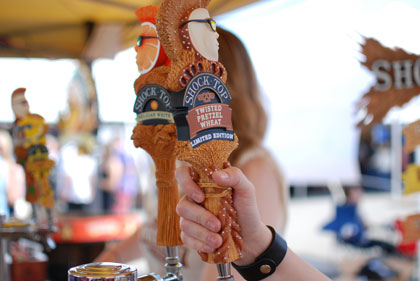
Brazil is the world’s third largest beer market, dominated by Brahma and a bunch of other pale lagers you couldn’t sort out in a blind tasting. A bottle of one of those costs what amounts to about a dollar. A bottle of Brooklyn Lager (Liffey had a Sorachi Ace tap handle, although it wasn’t pouring Sorachi Ace) is more like $4. In the Sao Paulo airport, hardly a place to price beer, a 355ml of Bohemia was $5.86, one 500ml of Erdinger Weiss $12.17, a 440ml of Guinness $12.62, a 355ml of Heineken $5.86, and 275ml of Stella Artois $5.86.
Perhaps somebody smarter than I can predict where the “not pale lager” market is going. As mentioned earlier in the week, Beeronomics wrote IPA “it is almost completely nonexistent in Brazil for example.” My sources (homebrewers) agree that’s pretty much true. But they are making hop-forward beers themselves and they know the commercial breweries that are as well. The homebrewers are also making beers with yeast sourced from Belgium and with “wild” yeast. Interesting times ahead, and my best guess is the direction will be determined by some combination of German tradition, other non-Brazilian influences and ingredients, and — this might be the most important part — Brazilian inspiration.
I brought home a bottle of Cerveja Extra Tipo Pale Ale, a collaboration between Bierland, a Blumenau brewery, and Antares in Argentina.1 Bierland has established a solid international reputation, winning awards in German and U.S. competitions across a variety of styles. I drank a lot of Antares when I was in Argentina last year. I would haven’t stopped at one were the beers no good. Tipo Pale Ale is made with hops from Argentina’s Patagonia region and guaraná — a stimulant that contain about twice the concentration of caffeine found in coffee beans — from Brazil.
This is not a beer that is going to climb the charts at the beer rating sites, but is a solid pale ale, subtly fruity, firmly bitter, a bit earthy. A good Exhibit A when arguing local ingredients need not be a gimmick. I also brought back a beer from Cervejaria Coruja flavored with pitanga fruit (apparently cherry-like; I haven’t opened that bottle), and had homebrewed beers flavors with local fruits. This is likely only the beginning. Garrett Oliver recently said, “I think Brazil, over the next five to 10 years, is going to possibly be the big story in beer.” He provided sugarcane juice as an example. And maybe he should have mentioned the unique Brazilian woods used for making barrels . . .
*****
1 More disclosure: Rubens Deeke of Bierland, one of many commercial brewers at the conference, gave it to me.