Pick the dude with the palate

Thought for the day from Mark Matheson, who brews beer at Turtle Mountain Brewing in Rio Rancho, recently started his own winery (Matheson Wines), and also directs the winemaking at Santa Fe Vineyards.

He graduated with a degree in fermentation science from UC-Davis, studying both oenology and brewing, and certainly appreciates the the value of technical knowledge. So he’s not blowing smoke when he says:

“If I had two guys, one a microbiologist and one not a microbiologist and the second one had a really good palate, then I would hire the dude with the palate. At the end of the day, what matter is does it make the beer better? What does it taste like? That’s the part you have to be good at.”

The best selling US beers, circa 2007

Commenting in another thread, Stonch asked: I’d be interested to know what the top ten selling American craft beers are? Does anyone have that info?

The lists I put together got too long to put in a comment. They are not perfect. They are based on data from Information Resources Inc. (IRI), which uses scanner data to track sales of consumer package goods in a variety of channels, but not every drop of beer sold. Their strength is in supermarkets, drug stores and convenience stores, which is where most people in the United States buy beer.

They don’t count everything sold in specialty retail stores (though some) or on draft (and certainly not in brewpubs, which account for about 10% of craft sales). They are not the only source out there — you will often seen Nielsen quoted — but supply data that corresponds quite well with the yearly figures the Brewers Association supplies. So I think they can be trusted.

BEST SELLING CRAFT BEERS
1 Sierra Nevada Pale Ale
2 Samuel Adams Boston Lager
3 Blue Moon White
4 Samuel Adams Seasonal
5 New Belgium Fat Tire
6 Samuel Adams Light
7 Shiner Bock
8 Widmer Hefeweizen
9 Samuel Adams Brewmasters Collection
10 Redhook ESB
11 Pyramid Hefeweizen
12 Deschutes Mirror Pond Pale
13 Redhook IPA
14 Alaskan Amber
15 Deschutes Black Butte Porter

For perspective, seven imports outsell SNPA (Corona Extra, Heineken, Corona Light, Tecate, Heineken Light, Guinness and Modelo) and Newcastle Brown is nipping at the heals of Boston Lager. Also, Rolling Rock and Killian’s Red would rank fourth and fifth on the list above.

Pretty much an aside: The top two selling beers in the “super premium” category (high priced beer but seldom costing as much as craft beer) are Michelob Ultra Light and Michelob Light. The original Michelob ranks seventh on this list (behind Michelob Amber Bock), selling basically the same amount of beer in these channels — and I suspect not quite as much overall — at Fat Tire.

Think about it. The flagship from small brewery founded in the basement of a Fort Collins, Colo., house in 1991 now outsells what was once the super premium beer in America. Hold that smile — even after you read the final list. [End of aside.]

The best selling styles, recognizing that few beers even broadly described as “extreme” reach these channels (I can buy Stone Ruination, the Jolly Pumpkin beers, Avery and others at Whole Foods but not Albertson’s):

1 Pale Ale
2 Seasonals
3 Amber
4 Amber Lager
5 Wheat
6 IPA

Finally, a bit more perspective . . .

BEST SELLING BEERS OVERALL
1 Bud Light
2 Miller Lite
3 Budweiser
4 Coors Light
5 Corona Extra
6 Heineken
7 Natural Light
8 Michelob Ultra Light
9 Busch Light
10 Miller High Life

Miller High Life sold three times more beer in the first half of 2007 as Sierra Nevada Pale Ale.
The 42 best beers in the world, circa 1982

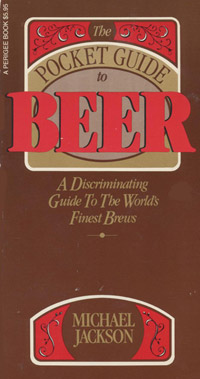
Michael Jackson Pocket Guide to Beer - 1982When somebody talks about “MJ’s list of best beers” do you think about the latest offering from Men’s Journal or one from Michael Jackson?

Me too.

Working on another project I recently hauled out his first Pocket Guide to Beer, published in 1982 and opened enough times since that the 18 pages containing Guinness through Anchor keep falling out.

This was the only pocket guide where Jackson used a 5-star rating. In following editions the highest was 4. In essence, each 5-star beer in this edition was a best of breed, so Zum Uerige Altbier represents that style, Westmalle Tripel that one, etc. (More about this at the bottom.)

Just for fun, here are the 42 beers that Jackson awarded 5 stars. (He also gave all 12 traditional Lambic brewers in the Senne Valley 5 stars “for dedication to an elusive craft,” adding “their products vary according to the good years and the bad, a greater discrimination would be illogical.”)

Czech Republic
Pilsner Urquell

Germany
Jever Pilsner
Einbecker Ur-Bock
Dortmunder Kronen Export
Zum Uerige Altbier
Kulminator 28 Urtyp Hell
Hofbräuhaus Maibock
Hofbräuhaus Edel-Weizen
Paulaner Urtyp
Paulaner Salvator
Schlenkerla Märzen
Spaten Dunkel Export
Spaten Ur-Märzen
Weihenstephan Weizenbock
Kindl Berliner Weisse

Belgium
Duvel
Liefmans Goudenband Speciaal Provisie
Rodenbach
Rodenbach Grand Cru
Westmalle Tripel
Hoegaards Wit
Saison Dupont
Chimay Red
Chimay Blue
Orval

Britain and Ireland
Brakspear’s Pale Ale
Courage Imperial Russian Stout
Fuller’s ESB
Gales Prize Old Ale
Whitbread Gold Label
Mackeson
Marston’s Pedigree
Marston’s Owd Roger
Highgate Mild
Thomas Hardy’s Ale
Belhaven 80/-
Traquair House
Guinness Extra Stout (Britain and Ireland)
Guinness Foreign Extra Stout

France
Jenlain

United States
Anchor Steam

Australia
Cooper’s Sparkling Ale

In the introduction Jackson explained a beer rated 5 stars was “a world classic either because it has outstanding complexity and distinction or because it is the definitive example of its style, and no matter whether everyone is capable of appreciating it; some people probably don’t like first-growth Bordeaux, either.”

In later editions he introduced the star ratings by making it clear they compared beers within a region to each other. For this first one, he wrote, “The whole scale of ratings in the German section tends to be high because all beers in that country are of what must be recognized internationally as a particularly good quality.”

Government lies and other good beer reading

Stuff you should be reading:

I Told You Those Lying Bastards Were Making It Up
From Martyn Cornell: “It was fantastically satisfying to see the front page splash in The Times declare what I’ve been saying for years – that the government’s ‘safe drinking guidelines’ of 21 units of alcohol for men and 14 for women a week have no basis in fact, and were literally made up on the spot with no evidence to support them 20 years ago, solely because the ‘experts’ thought they ought to be saying some rather than nothing.”

Fresh hops in Oregon

There’s so much going on that in Oregon that Jon Abernathy at The Brew Site declared it “Fresh Hops Week.” He’s got got the Tastival, fresh hops beers in bottles, reviews and more.

Jeff Alworth at Beervana also has several posts, with a bunch o’ reviews here including his opinion about which are the best.

The British Beer Renaissance
Back to the Times (UK, not NY) and from wine critic Jane MacQuitty: “Largely in response to this demand, the wealth of British beers available now from all over the country, judging from the four dozen or so I tasted blind for this article, is extraordinary. The sheer variety of superb hoppy, floral, fruity yet bitter flavours present in my line-up was a delight.”

High-rise blues
This is among my favorite posts of the year. Lauren Clark tackles an unpleasant subject and writes about women who refuse to sit while urinating in public toilets, instead hovering above the toilet and leaving it sprinkled with pee. There’s also an educational takeaway for those of us who don’t use the women’s room. “Microbiologists have found four hundred times more illness-causing bacteria on the typical office desktop, with its germ-filled computer keyboard, mouse and phone receiver, than on most toilet seats.”

Like I said, must reading.

Them’s fightin’ words: American beers lack nuance

This from a story that dated tomorrow (step into the future with me) in the New York Times:

Subtlety is the hallmark of the better Japanese microbrews, while most American craft beers embrace an onslaught of flavor with all the nuance of a sledgehammer.

That attention-getting line aside, Specialty Beers on the Rise in the Land of Sake is worth your time.

Many parallels with the United States. Microbreweries were legalized in 1994, peaked in 1999, fell off and more recently have figured out what they want to be as they grow up.

They are gaining traction with drinkers under 40, benefiting from growing interest in a wider range of cuisines, etc.

All with a bit of subtlety, of course.