Book reviews: In beer, business and ‘soul’ coexist

Brewing Up A BusinessIntentions being intentions, not all 600 or so breweries currently “in planning” in the United States will end up brewing beer. But a little advice seems in order.

Although the combination might seem curious, “Brewing Up a Business: Adventures in Beer from the Founder of Dogfish Head Craft Brewery” (Revised and Updated) and “Beer Is Proof God Loves Us: Reaching for the Soul of Beer and Brewing” make a pretty educational one-two punch for an aspiring brewery owner.

The former comes from Sam Calagione, Dogfish Head founder-owner, and has earned plenty of praise from those who work outside a world populated by brewing kettles and cases of beer. Bob Guccione Jr. from Spin magazine, Jim Davis of New Balance and a former governor of Delaware are among those offering back cover blurbs.

It wouldn’t be one of Amazon’s best sellers in a category like Books > Business & Investing > Small Business & Entrepreneurship > Hospitality Businesses were the target audience only those selling beer. But it is rich with examples related directly to making and selling beer and written in a conversational tone. Calagione includes enough off-centered stories to make the book popular with fans of the brewery, and its founder, people with no interest in starting their own brewery.

Calagione wrote the first edition in 2005, so this update was in order. Not so much to reflect that Dogfish brews much more beer these days, but provide more about marketing, and particularly social media.

The book is long nuts and bolts. He goes into detail, for instance, about plans to sell $51 million worth of beer in 2011, running through the roster of just how many salespeople are involved and compensation packages.

Beer Is Proof God Loves UsIt makes an interesting contrast to “Beer Is Proof God Loves Us,” which offers philosophy from Charlie Bamforth, “the beer professor” better known for well, professorial, books. Like “Standards of Brewing: a Practical Approach to Consistency and Excellence.”

A native of England, Bamforth has worked for large breweries, in brewing research and was selected the first Anheuser-Busch Endowed Professor of Malting and Brewing Sciences at UC Davis. Bamforth makes his way toward “God in a Glass” (the 10th chapter) with stories that should appeal to the most ardent “craft beer” fan. He keeps things moving by employing end notes, which in total make up about half the book and are full of both short clarifications and long colorful stories.

But he doesn’t pander. For instance, he explains why a newly educated brewer might be much happier working for a very large brewery . . . while expressing concern about the number of jobs that actually may be available as those big breweries grow ever more efficient. He devotes a chapter to “So What is Quality” and does not deduct points when technically proficient beers strive to “reach the common denominator.”

He would be on the same side of the table as Calagione at one of those beer versus wine dinners. (In fact, I previously reviewed Bamforth’s “Grape vs. Grain’ and Calagione’s “He Said Beer, She Said Wine” in the same post.)

In the introduction (which itself merits 13 end notes), Bamforth writes, “The world of beer is hugely different from that I first glimpsed as a too young drinker close to the dark satanic mills of my native Northern England. has beer, I wonder, lost its soul?

“Or is it, rather, me that is the dinosaur? Is the enormous consolidation that has been the hallmark of the world’s brewing industry for decades nothing more than business evolution writ large as survival of the fittest? Do the beers that folks enjoy today . . . speak to a new age of Kindle, Facebook, and fast food?

“In truth, there remains much of his hoary old traditionalist to delight in: the burgeoning craft beer sector in his new motherland, the United States. A growing global realization that beer, rather than wine, is the ideal accompaniment to foods of all types and (whisper it) is actually good for you, in moderation.

“All is not lost in the world of beer.”

Pierre Celis: That was one long shadow

Pierre CelisPierre Celis died Saturday. He was 86 and best known for resurrecting the Belgian White “style” and an otherwise extraordinarily engaging gentleman whose influence cannot be overstated.

He was 40 years old, delivered milk for a living and had little brewing experience when he produced his first official batch of Oud Hoegaards Bier in 1966. Celis brewed fourteen times that year, producing 350 hectoliters (less than 300 barrels). Just over 5 feet tall, from the beginning he described himself as a “small brewer.”

Of course his brewery grew much larger and his became a big story, one that will be retold many times in the coming days. You’ll have to settle for a couple of small stories here.

* Rob Tod was working at Otter Creek Brewing Company in Vermont in 1994, when he sampled Celis White for the first time. “People were traveling, and they’d bring back beer. Every few weeks we’d have a tasting,” Tod said. On June 30, 1994, he left Otter Creek to start Allagash Brewing. One year to the day later, he put Allagash White on tap at Portland’s venerable Great Lost Bear.

Allagash has earned considerable fame for the range of beers the brewery now sells, but the White still accounts for more than three quarters of sales. Traveling in Belgium on Sunday, Todd told 5,000 followers on Twitter something they probably didn’t now. That Celis was dead. “Very, very sorry to hear the news of the passing of Pierre Celis… he was obviously a huge influence on Allagash.”

* Kevin Brand was an engineering and chemistry student at the University of Texas when he visited the Celis Brewery in Austin, a few years after Celis founded it in 1991. “It dawned on me that beer could be brewed here, not just in St. Louis,” Brand said.

A dozen years after he graduated and moved to the San Francisco Bay area, Brand returned to Austin and started (512) Brewing Company. He had only been open a month or so in 2008 when Pierre’s daughter, Christine Celis, who remained in Austin after the Celis Brewery closed in 2000, called to say her father would be visiting from Belgium and wanted to stop by (512). (Credit to Austin 360 for taking the photo at the top at that time.)

When he did he drank (512) Wit. It is not the best selling beer in the (512) lineup, but Brand likes the idea of keeping the Austin connection to wit alive. After he learned Celis would be coming he tracked down a distinctive heavy Hoegaarden glass, the heavy “jar” so closely associated with the brewery, so Celis could autograph it for him. “He had some great stories,” Brand said. He also talked shop, going into detail at times, providing Brand with ideas about how to improve his beer.

Pierre Celis deserves to be introduced as the man who popularized “Belgian White” beer literally around the world, who accelerated American interest in Belgian-inspired beers and encouraged greater creativity with projects like his own cave-aged beer. But just as important he remained a “small brewer,” one who proved to others “that beer could be brewed here.”

Session #51 (& #51.5) announced: Beer and Cheese-Off

The SessionJay Brooks has announced the topic for Session #51, and volunteered to host Session #51.5 as well. He calls it “The Great Online Beer & Cheese-Off” and it takes a little explaining. Like somewhere north of 1,300 words.

So the short version. Get some cheese — perhaps Maytag Blue, Widmer 1-Year Aged Cheddar and Cypress Grove Humboldt Fog, remembering nobody has ever been kicked out of the Session for showing up with the wrong cheese — and some beer. Have a few friends over, or not. Taste. Takes notes, also optional. Post your thoughts on May 6. Read what everybody else tasted, paired and thought. Get some more cheese. Repeat the rest of the steps.

Refer to Jay’s instructions for more suggestions. As he writes, “Even with making this next Session as difficult as possible, I’m hoping the fun factor of trying these cheeses with a lot of beer will make for a lively and interesting Session, with a lot of participation.”

Cheese night

Yes, the instructions are a little long, but this is do-able. We managed to celebrate more than one “cheese night” in the RV during our Grand Adventure. We’re still talking about the Madison Blue.

Why name a hop Apple Puddings?

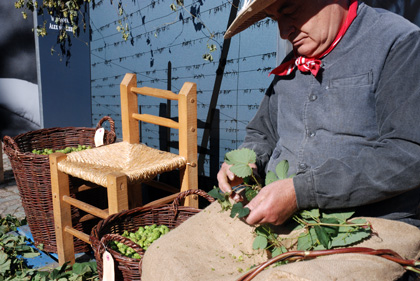
Hop bineI don’t have an answer, but I like the sound of names such as The Grape Hop and Canterbury Jacks.

They were part of the English hop landscape more than 100 years ago, and a curious soul might wonder what beers brewed with them would smell and taste like.

Would they offer “new flavors” or old ones? Would they stir up the same excitement Simcoe, Citra and Sorachi Ace do today simply because they are different?* Probably not, to be honest, because they were mostly variations on a theme. The new generation of hops have been bred from a wider range of ancestors.

*(Quick aside, Sorachi Ace is a great name, but I can’t visualize is growing alongside Golding in the hop gardens of Kent.)

Idle thoughts, really, while reading “English Hops: A History of Cultivation and Preparation for the Market from the Earliest Times.” Some other hop names from the 1919 book: Golden Tips, Pretty Wills’, Cobb’s Hop, Amos’s Early Bird and Old Jones’s Hop.

Old Jones’s Hop was “well-shaped, of good colour, of medium size, and of good flavour. The bine is short and green. it was cultivated under the name of Jones’s hop as early as 1798, but is now little grown, as it bears only a small crop.”

Even then the lesson was plain for a hop plant: Produce or be gone.

Monday morning musing: Big Beer & making money

The rich get richerThe Big Four of Big Beer worldwide — Anheuser-Busch InBev, SABMiller, Carlsberg and Heineken — sell 50 percent of the beer. As recently as the 1990s they had only a 20 share.

But here’s the really interesting number, which Benj Steinman of Craft Beers News/BMI provided during the craft brewery conference: They earn 77 percent of the profit.

He pointed out that the United States “profit pool” is the largest in the world and still expanding, expected to grow $3 billion in the next three years, mostly because of cost savings at A-B InBev and MillerCoors. In contrast, he said that because of the intense fixed costs involved in expansion that “craft breweries” probably earn just 3 percent of the profit pool despite selling 5 percent of the beer.

Some links to take your mind off that curious business reality:

  • Don’t bet against Bud Light. I sort of hate to reward the PR person who sent me six copies of a release to my various email addresses, but it turns out you can bet on what you think will be the best selling beer in the United States between now and Sept. 1. Bud Light is a prohibitive favorite (-5000), given a 98 percent chance of winning. I’d venture it has more like a 100 percent chance.
  • Slicing and Dicing beer by ABV, by Local, by Session, and by Style. The ever-amazing Bryan Kolesar surveys beer menus in the Philadelphia suburbs, produces charts and answers questions like: Does diversity exist within session beers under 5.5%? and Are the locals being served?
  • The Albatross That is Food and Wine Pairing. Because Amazon lists something like 159 books on food and wine pairing, and now . . . here come the phone apps.
  • Just when you thought beer couldn’t get any colder. (eom)
  • On the folly of ‘grading’ what we drink. Wine sage Hugh Johnson talking about wine scores: “. . . they can never reflect a wine accurately. I’ve said to people, ‘I love wine. Wines are my friends. I also love my friends. How would you like scoring your friends?!'”