One link, one paragraph

The link, for all those who curious about tastes from the past, including Ron Pattinson*.

“Olfaction helps shape our cultures, although it often does so unknowingly or without us noticing,” says (Inger) Leemans, who led the Odeuropa project. “When we talk about cultural heritage, we can think about religious rituals, but we can also think about specific scents that we’ve been cherishing and living with for a long time.”

~~~~~~~~~~~~~~~~~~~~~~~~~~~~~

* Something he told be for Brewing Local: “Why do I want to taste extinct styles? On one level it’s purely from curiosity: how did it taste, what did it look like, how did it drink? All the things you can only really learn about a beer by having one in a glass in front of you. That simple need to know could be satisfied by a pint or two.

“But then there’s the cultural aspect. Beer styles—and especially those associated with a specific place—have a wider significance than just being a drink. Because every beer style is a unique cultural item. When one disappears, the culture it came from is diminished.”
Hop object #2

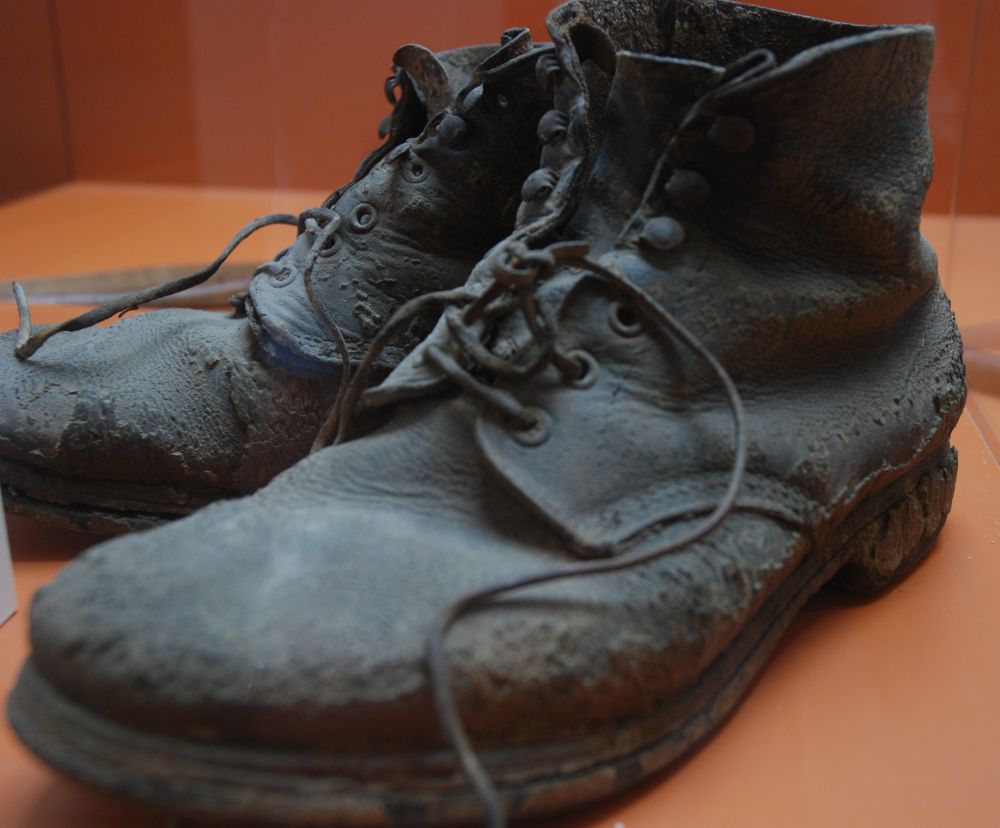
A hop worker's shoes, seen at Deutsches Hopfenmuseum in Wolnzach, Germany

Spotted in Deutsches Hopfenmuseum in Wolnzach, Germany. The shoes were worn by a worker processing hops. When a bag was filled, a worked would jump into it, stomping down the hops to make sure the bag was full. When I dug this out, I wondered if these could have been called Hopfenstopgen boots. That’s because in Hop Queries Vol. 4, No. 6, I wrote about dry hopping in Germany in the 19th century. That was called Hopfenstopfen, which can be translated at hop plug.

Simon Moosleitner, a subscriber in Germany, suggested there is more to think about, writing:

“I would give it a slightly different translation. You’re definitely right with translating Stopfen as plug or bung. However, in this case the word Stopfen is a nominalization of the verb to stopfen (you may notice the difference in capitalization, in German nouns are always written with a capital letter).

“The verb stopfen has a slightly different meaning. It is used when repairing clothes or to be more precise darning socks. But more importantly it’s the same word (potentially even etymologically) as to stuff. Whether you want to say one stuffs a pillow with feathers or food into oneself, the word stopfen can always be applied. Hopfenstopfen is therefore the act of stuffing beer with hops, which I guess is an even more fitting term now with all the hazy beers around.”

One link, one paragraph

Harvest House hotel in Boulder, Colorado. Site of the first Great American Beer Festival.

A 1960s postcard from the Harvest House hotel, a mid-century modern gem

The link.

The paragraph:

“Walking out of the Friday evening session last year I had a sense that I’d be skipping the 2026 [Great American Beer Festival] thanks to a ‘been here, done this’ feeling. Now, with this change and a promise of something new, I’ve already started looking at flights to the Mile High City for mid-October.”

The first GABF was held in the Millennium Harvest House Hotel in Boulder, Colorado. It was demolished recently to be replaced by University of Colorado student housing. Is that relevant to all that was written last week about GABF leaving the Colorado Convention Center?

One link, one paragraph

The link.

The paragraph:

“There were a few early people back in the day who understood Jack (Joyce’s) vision,” says (Floyd) Holcom. “The Rogue Nation was made up of embassies, they didn’t have managers they had ambassadors. That is why Rogue was kicking ass in those days is that felt that they were ambassadors to craft beer. I think that’s why Jack chose us to put a Rogue here.”

Embassies and ambassadors.