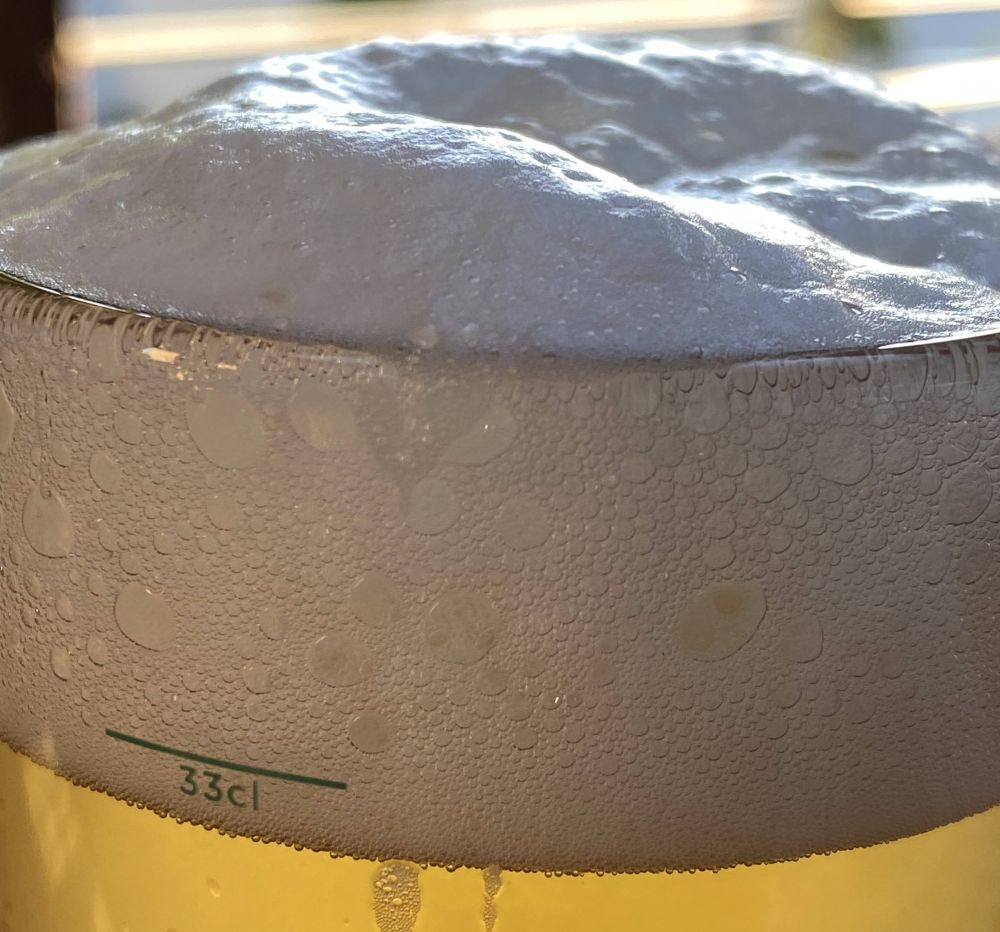
I recently wrote a story about beer foam for Brewing Industry Guide (“Foam Loves Hops (Except When It Doesn’t”). As happens, I had to leave a few darlings on the cutting room floor in order to have room for some key information. Such as, Dry hopping with Cascade pellets resulted in a near-linear decline in foam stability using the Nibem method, a standardized way of measuring foam stability over time.
This was one of those paragraphs:
There is more to monitoring beer foam than counting bubbles, although they are the foundation. They result from nucleation, and as those bubbles climb to first form or then replenish the foam head, proteins and bitter substances are carried into the bubble wall, forming a matrix that holds the skeleton together. In his doctoral thesis, “Beer Foam Physics,” A. D. Ronteltap calculated that a foam 3 centimeters high (a bit less than 2 fingers) in a glass 6 centimeters wide (a bit less than a Willi Becher) made up of bubbles with an initial radius of .2 mm (twice the width of a human hair) would contain 1.5 million bubbles distributed over about 100 layers.