Which speaker is not like the others?

– Sam Calagione, President, Dogfish Head Craft Brewery
– Luiz Edmond, President North America, Anheuser-Busch
– Bill Hackett, President, Crown Imports LLC
– Tom Long, President, MillerCoors LLC
– Dolf van den Brink, President and CEO, HEINEKEN USA

Rhetorical question.

From the press release:

ALEXANDRIA, VA – The National Beer Wholesalers Association’s (NBWA) 75th Annual Convention will be taking place October 14-17 at the Manchester Grand Hyatt San Diego in San Diego, California, where it’s always 75 and sunny!

For the first time ever, NBWA members will hear from leaders of some of the nation’s most prominent brewers and importers together, all on one stage, during the General Session on Tuesday morning, October 16. Participants include:

Sam Calagione, President, Dogfish Head Craft Brewery
Luiz Edmond, President North America, Anheuser-Busch
Bill Hackett, President, Crown Imports LLC
Tom Long, President, MillerCoors LLC
Dolf van den Brink, President and CEO, HEINEKEN USA

One stage. Last man standing? Who you betting on?

Let’s talk goryczka (bitterness)

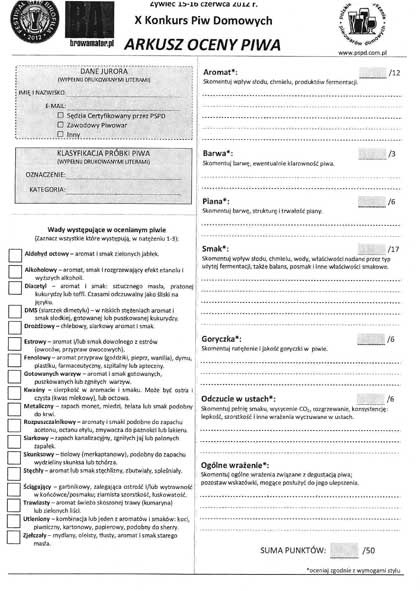
Polish Homebrewers Association Scoresheet

Quick disclaimer: This post won’t be an in-depth discussion about bitterness itself, IBU, quality of bitterness or something similar. I just wanted to use goryczka in a headline. Instead, this is a copy of the beer competition scoresheet used by the Polish Homebrewers Association. It is similar to a Beer Judge Certification Program (BJCP) scoresheet, but the differences are interesting.

Obviously it is in Polish. Because they are good hosts, the Polish homebrewers also provided an English version for English-speaking judges (or German speakers who also spoke English, etc.) last month during the X-th Konkurs Piw Domowych (National Homebrew Competition) held at the Zywiec Brewery.

Should you not want to toggle back and forth between the two, here’s how they compare:

BJCP   Polish
Aroma/Aromat 12 12
Appearance/-   3
Color/Barwa 3
Foam/Plana 6
Flavor/Smak 20 17
Mouthfeel/Odcsucie w ustach   5 6
Bitterness/Goryczka 6
Overall/Ogólne wraženie 10

Both scoresheets list (on the left) possible flaws, but on the BJCP sheet judges simply check the boxes when those are present while in Poland they rate the intensity.

The key additions in Poland are foam (color, structure, quality, meaning volume, stability and cling) and bitterness (the intensity and quality of the bitterness).

For the record, like style guidelines these scoresheets are designed for beer competitions, not real life. Taking them outside that environment can lead to long, meaningless arguments discussions. However the influence of the BJCP sheet on the scoring matrix at RateBeer (Aroma 10, Appearance 5, Taste 10, Palate 5, Overall 20) should be obvious and the cultural impact of beer rating sites internationally cannot be understated.

They’ve got at least a few people talking about beer in a way they weren’t before. Personally, I like foam and I like bitterness. I’d be happy to see them be part of the conversation.

Which hop is not like the others?

Obviously, a variation “Which beer is not like the others?” but with hops. The goal is to identify the outlier and explain why it doesn’t belong on the list. There may be more than one answer. I happen to have a very specific one in mind, but readers may come up with others. Yes, there is such a thing as a wrong answer, but there’s probably more than one right one.

a) Motueka
b) Liberty
c) Spalt Spalter
d) Soranchi Ace
e) Sterling


Take a deep breath, hops lovers

For the Love of HopsThe Boston Beer Company is sharing hops (again)1, this time some of those that many brewers, and drinkers, are absolutely crying for — Citra and Simcoe. And they are selling them at their cost.

You can read about it at the Samuel Adams website, but you need to be an brewery operator to buy the hops.

Three quick thoughts:

– This is quite generous.

– They can do this because the forward contract for hops, something any size brewery can do.

– This does not guarantee there will be “plenty” of Simcoe, Citra and Ahtanum (the other hop for sale, and like Simcoe one of five hops in Latitude 48 IPA) after the 2012 harvest. But it likely means those want to contract for them will be able to.

These are strange hop times. There’s a glut of “alpha” available, meaning those only interested in hops for bittering purposes (even though may be very low, as in less than 8 IBU) can pick it up cheap. But the exotic varieties are in short supply.

For instance, it is nearly impossible to find Riwaka from New Zealand. Doug Donelan, New Zealand Hops spokesman explained when in an email: “Riwaka is a high demand variety with limited volume currently in production we need to rationalise distibution to ensure current users aren’t disadvantaged while trying to expand acreage. The US is only a small market for Riwaka with only one brewer currently using any significant volume. Existing users will continue to be supplied we are just limiting our expansion for the time being.”

He pointed to the importance of planning ahead. Contracting. A brewery doesn’t have to be as big as Boston Beer to do that.

“We grew 90 (metric tons) in 2012 all of which was forward sold so brewers attempting to buy high demand hops on spot markets need to re-think their purchasing strategy. Nelson Sauvin has been in volume growth for the past few years and will continue for the forseeable future,” he wrote. “Hops aren’t something you just turn a tap on with. We grow a wide mix of varieties so expansion needs to managed due to several factors. In time we will increase acreage of several high demand varieties but this also needs to be balanced with other contracaual commitments and release of newer types as well.”

1 Boston Beer also shared hops during the 2008 “hop crisis.” The hops were Hallertau Mittelfrüh and Golding, because Boston Beer used almost exclusively continental and UK hops at the time. BBC founder Jim Koch quite candidly admitted he didn’t care for American hops. He’s come around.