Monday beer links, musing 12.16.13

Single hop beers, an interesting geeky angle on beer. Jamie Goode, one of the most authorative wine writers anywhere, tastes single hop beers. He knows his way around, and appreciates, beer, so worth reading on its own.

I was further struck by the name on and his description of Marks & Spencer Hallertau Brewers Gold Golden Ale Single Variety Hopped Ale. 4% ABV, made by Crouch Vale Brewery, Essex. His notes: “This is a Bavarian hop. Very fruity style with some malty richness, a bit of spice and nice rich texture. Concentrated: an interesting-tasting lager style. 8 (out of 10)”
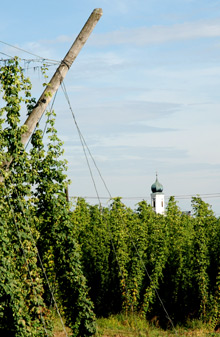
Hops growing in the Hallertau region of GermanyBrewer’s Gold was bred in 1917 at Wye College 60 miles east of London and released for cultivation in 1934. With her, and her sister Bullion, breeder E.S. Salmon took hops in a new direction. He was the first to cross pollinate genetically distinct American hops with European hops. When Salmon began at Wye College, hops contained 4 percent alpha acids on average and 6 percent at the most. Breeders have since released hops with more than 20 percent alpha acids, almost always using cultivars that lead back to Salmon. They not only contain more alpha acids, but different odor compounds. Thus brewers can use “exotic” hop varieties like Citra and Mosaic from the United States, Galaxy from Australia, or Mandarina Bavaria from Germany.

It took 40 years some places and 70 others for distinct “American” aromas (citrus, piney, black currant, ribes) to catch on. I’ve never heard a beer freshly hopped with Old World varities (Saaz, Hersbrucker and friends) described as smelling like a cat’s litter box, but the same single-hopped Citra beers some people embrace for their tropical aromas and flavors others find “catty.”

Not much Brewer’s Gold is grown in the Hallertau region of Bavaria — heck, not much is grown anywhere — but it is interesting to consider how it becomes different when it is a Bavarian hop rather than a Kentish hop or a Yakima hop.

One of the hop farms I visited in Bavaria while researching “For The Love of Hops” was owned by the Bogensbergers, the last farmers in the Hallertau region to grow Nugget, a variety bred in Oregon for its (then high) alpha. “It has a much better aroma than 20 years ago,” Florian Bogensberger said. “All the imported varieties, they are very strong when they arrive, but they change.”

They also grew American-bred Columbus, which is pungent and sometimes catty, for several years. “When it came over it was rough, but it turned into something smooth,” he said.

Nine beers many Americans no longer drink. The list is back, and it is easy to understand why Budweiser, given that its sales have fallen 29 percent between 2007 and 2012, is on it. However nobody drinks? Bud still sold 16.8 million barrels in 2012. That’s 3.5 million more barrels that craft beers sales in 2012 (the official Brewers Association total for the year).

Everything you wanted to know about Devon White Ale but were afraid to ask.

The Session #83 topic announced: “Against The Grain.” “I can find myself wondering sometimes when I’ve had an extremely popular beer, but haven’t been all that ‘wowed’ … is it me? Am I missing something here? Was there too much hype? Could there be such a thing as taste inflation? If we really want to dive further into this, is it really only ‘good” if a large portion of the craft beer community says it is or is our own opinion and taste enough?”

A visit to Donnington Brewery. Ed Wray steps back in time, except as he points out it is fascinating this is a working brewery rather than a museum. Great photos.
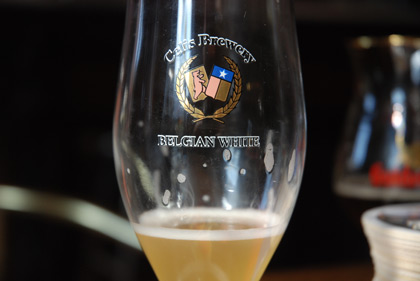
Six degrees of Pierre Celis

Celis White

Total Beverage Solution, a South Carolina-based company known first as an importer, announced Tuesday that it has acquired the Celis beer brand.

So the Celis brand, which originated when Pierre Celis opened the Celis Brewery in Austin, Texas, in 1992, has been owned by Celis, Miller Brewing, Michigan Brewing, a company called CraftBev International, Inc., and now Total Beverage. In the United States.

Before starting his Texas brewery Celis founded the one that revived the defunct white beer style, first calling it Brouwerij Celis, then De Kluis and finally Hoegaarden. He sold that to brewing giant Artois, which was acquired by Interbrew, which merged with AmBev to form InBev, the company which later bought Anheuser-Busch, the result being A-B InBev.

That’s why in “Brewing With Wheat” I asked: “Where would you start looking for the ‘real’ Celis White? In the town of Hoegaarden, where Celis first brewed his Blanche Bier? In Weberville, Michigan, because Michigan Brewing Company bought the Celis brand from Miller Brewing and has won several awards with its Celis White? In Ertvelde. Belgium, where Brouwerij Van Steenberge brews Celis White for sale in the rest of the world? In Watou, where Celis consulted in developing the recipe for Saint Bernardus Wit?”

Nothing like a small family business that is passed down from one generation to the next.

So now we await the next chapter, and based on the past it is bound to be somehow different than we might expect. “We are currently considering a number of options for brewing, and we plan to reintroduce the brand to market by mid-2014,” Total Beverage CEO Dave Pardue said for a press release announcing the deal. Last year Total Beverage acquired the Humboldt/Nectar Ale brands from Firestone Walker. Firestone Walker continues to brew those for Total Beverage, which does not have a brewery. The company will have to find another brewery to make Celis beers.

A little over a year ago, CraftBev International bought the brand when the assets of the Michigan Brewing Company were auctioned off. At the time, founder Sushil Tyagi said: “I have been building a brewery with the Celis family. We’ve already been building the distribution network. We’re making all the plans for marketing and branding. This (brand name repurchase) is just the one missing piece.” Instead CraftBev ended up selling the brand to Total Beverage.

Emails to Tyagi and Christine Celis, Pierre’s daughter, asking what happened have gone unanswered. Expect an update explaining if they are. What is known is that Celis meanwhile rolled out the first of what she says will be a series of “Gypsy Collaboration” beers.

While we await the next press release from Total Beverage Solution, a quick recap:

1957 – The Tomsin Brewery in Hoegaarden closed. At its peak in 1758 the town of Hoegaarden supported 38 breweries.

1965 – Listening to others lament the loss of the brewery and the once ubiquitous white beer style, Celis wrote in his memoir, he started thinking about opening a brewery.

1966 – (March 13, in fact) Pierre Celis brewed his first official batch of Oud Hoegaards Bier.

1978 – Celis he changed the name of his brewery to De Kluis.

1985 – A fire gutted De Kluis, which was disastrous for Celis because he carried little insurance. He sold a majority stake in the company to brewing giant Artois, and in 1990 sold the rest.

1992 – Celis founded the Celis Brewery. That year Celis White won a gold medal at the Great American Beer Festival, and the next three years it won two more golds and a silver.

1995 – Miller Brewing bought a stake in the Celis Brewery.

2000 – Pierre Celis sold the rest of the business to Miller in April. Miller closed the brewery by the end of the year.

2002 – Michigan Brewing Co. in Weberville, Mich., acquired the Celis Brewery equipment from Miller, including the 100-barrel brewhouse, tanks, packaging equipment, office equipment, lab equipment and everything else down to the janitorial supplies.

2012 – The assets of Michigan Brewing were auctioned off, and in 2013 the company filed for bankruptcy.

(The photo at the top was taken at Brouwerij Van Steenberge outside of Ghent. The De Smet brewery originally brewed Celis White for distribution on Belgium, but when Heineken bought the brewery in 1999 Celis went looking for a new partner. “He said, ‘I can’t accept my beer would be produced by Heineken.’ If you can work with Pierre Celis, the godfather of white beer, you must,” Jeff Versele of Van Steenberge said. Celis White amounts to a small portion of what the brewery makes, but it is sold far afield, including places like Japan.)

Monday beer links, musing 12.09.13

Tuesday is National Lager Day. I didn’t know that either, not until I received a press release on behalf of Anheuser-Busch. It included results of a new survey conducted by the brewer and KRC Research that found drinkers prefer lagers to ales by a large margin.

Key findings include: beer drinkers prefer lagers 2-to-1 over pale ales and 3-to-1 over IPAs and stouts; two-thirds of beer drinkers like the crisp flavor [I added the italics] flavor of lager more than beers with bitter, sweet or fruity flavors; and when it comes to serving style, respondents say enjoying beer in a glass bottle is best (38%), followed closely by beer on draught (32%).

For the press release, A-B head brewmaster Pete Kraemer said: “It’s great to see excitement for lagers reaffirmed through the survey results. They are the most challenging beers to brew, but also the most rewarding. There is nothing I enjoy more than the light, refined flavor complexity of an American lager.”

The press release also points out that lagers account for 75 percent of the beer consumed in the U.S. Those are the facts and that’s a lot of beer.

On to other matters:

“The Unbearable Nonsense of Craft Beer – A Rant in 9 Acts.” Max Bahnson and Alan McLeod simulreleased an excerpt from their upcoming book. You can read it at either spot, with McLeod’s commentary here, and Bahnson’s here.

The Session #82 roundup posted. Steve Lamond took no time collecting the “beery yarns” published just Friday.

Why Do I bother? The lunatic idea that Grodziskie/Grätzer was a sour beer has Ron Pattinson appropriately pissed off.

– What if A-B had “spun off” specialty division in the 1990s? An interesting bit of history from Brew Hub founder Tim Schoen, who previously worked at Anheuser-Busch for 28 years:

“In the 1990s, I was in charge of innovations at A-B, or what we called the specialty brewing group. From that point, I knew there was a groundswell of consumer demand. During that period, I proposed that my group secede from (A-B), and I had a whole plan, moving over to a whole separate building. It was going to be the Specialty Brewing Group Beer Co. It was going to be all crafts and micros. Everyone loved it, but we didn’t do it. I still to this day say that if we would have done it, there would be a different landscape out there, at least for my former employer.”

“Rare beer? You can keep it.” He’s mad as hell and he’s not going to take it any more.

Is a Peanut Butter Pop-Tart an Innovation? “Back in 2007, 99 companies in the S&P 500 mentioned innovation…. This year the number was 197.” Perhaps this is relevant to discussions about “innovation” and beer.

Monday beer links, musing 12.02.13

Good Not surprising to see that the chatter about “craft beer” continued unabated while we were on holiday. Although it seems like I just did a roundup, here some are additional thoughts, followed by a link to a bunch of other links to long reads about [insert no confusing adjectives here] beer itself.

THIS is the Definition of Craft Beer. [Via Stephen Beaumont, Blogging at World of Beer]

Another long post about craft beer. Pete Brown follows up on his assertion that “2013 will be remembered as the year craft beer went mainstream.” [Via his blog]

“O que é craft beer”, ou “quem se importa”? (Or: “What is craft beer”, or “who cares”?) [HT to Pivní Filosof]

Look Out! There’s a Craft-Beer Revolution Taking Over France. “He opens a bottle of Ernestine, an IPA enriched with rooibos and cola nuts that he bought at the local open-air market Marché Dejean.” What if an entire country devoted itself to brewing Category 23 beers? [Via The Daily Beast]

And in other beer reading. Boak and Bailey’s Beer Blog invited other bloggers join them in writing “longer than usual” posts last Saturday. Because I’m trying to show some discipline in what and when I post here I jumped the gun a bit, but the timing was otherwise great. I was able to drop them into Pocket and read them during the long trip home. Set aside some time — I figure Ron Pattinson wrote enough alone to occupy travel through at least one time zone.

Where there’s beer there’s IPA

We’ve been on the Hawaiian island of Kauai for most of the past week. Strictly vacation, so no taking of notes, no conversations with brewers, no checking out the brewing equipment when we visited Kauai Beer Company and Kauai Island Brewing.

However, a couple of observations.

Kauai Island Brewing is the “World’s Westernmost Brewery.” Reason enough to visit. Basically, what was Waimea Brewing moved from historic Waimea Plantation to Port Allen and took on another name. The new location seems perfect for the tourist trade. Several charter services (catamarans) are located right across the road. We took an afternoon-into-sunset cruise that included a light meal, and we were surprised that most people left immediately, rather than stopping in the brewpub or a nearby bar. Perhaps early docking boats carry more customers.

Nonetheless, there were plenty of drinkers in the spacious restaurant, which is welcoming in an island way. Strolling past tables and looking at glasses I momentarily felt like I could gave been back in Oregon — cloudy, cloudy, cloudy.

The eleven beers on tap include two IPAs, the second called The Fonz IPaaaaaaaaaaaaaa and brewed with different hop varieties each time. Captain Cook’s IPA, a grapefruit bomb but well balanced, is made with three pounds for hops per barrel. It was tasty enough that I hope this part of the description is tongue in cheek: “Created after the hoppy ales brewed in the 1700’s for the long journey from England to Hawaii.”

Kauaui Beer Company, in contrast, is located in downtown (if that is the right word) Lihue. It is a work in progress, a brewpub that hopes have its restaurant up and running by February, for now keeping limited hours and serving beer only. In fact, this week, lagers only. They hope that Black Limo, a 4.4% ABV Schwarzbier, will be their flagship, or one of them.

It is sessionable and locals friendly, but most intriguing was tasting two helles on tap, both brewed using the same grain bill and with the same yeast, and targeting 17 bittering units. However, one was hopped with German Halltertau (guy pouring the beer wasn’t sure if it was Mittlefrüh or Tradition) and the other with the very New Worldish Eldorado.

The aroma of the former was spicy and floral, playing well with bready, cracker-like aromas and flavors from the pilsner malt. The latter was bold by comparison, the fruity aromas (mostly citrus, but reminding me of the mountain apples we’ve come across on Kauai) of the hops pretty much dominating.

We much preferred the Hallertau version, but I wonder if that is simply because it tasted/smelled familiar. A drinker who considers pale lagers “boring” is going to find the other more interesting. There’s a reason that IPA sales are up something like 40 percent again this year. Drinkers want those bold aromas.

Meanwhile, the guy pouring beer told us the next beer on tap would be an ale. And IPA. But you already knew that.