Because process always matters in beer & brewing

MONDAY BEER LINKS, MUSING 01.05.15

Session 95: Those Unwritten Books And Happy Marriages…
This month’s Session resulted in a feast of links, nicely organized by host Alan McLeod. Excellent commentary included. [Via A Good Beer Blog]

Sierra Nevada’s New Hop Hunter IPA Is Like No Other Beer in Its Class.
Reducing this to very unsexy basics: Sierra Nevada Brewing will soon release an IPA made with concentrated essential oils gathered from unkilned hops using steam distillation. Writing for Esquire, Aaron Goldfarb flushes out the details and offers a tasting note: “Like most wet hop beers, Hop Hunter is extraordinarily floral and aromatic, like sticking your nose into a freshly-picked plant or flower bouquet. It’s not really bitter-tasting either, certainly not as bitter as your typical IPAs.”
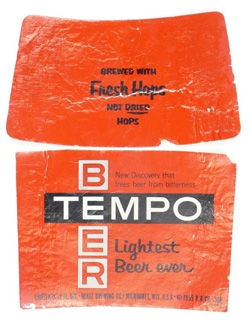
Blatz Tempo I’d like to know more about the process, and if I did I would share it with you. It feels like there are implications beyond if Hop Hunter IPA is a “best of class” beer. I will be in full research mode late this month at the American Hop Convention in San Diego and will report back.

Almost 50 years ago, Blatz Brewing in Milwaukee sold its own version of a “fresh hop” beer called Tempo. At the time, Blatz president Frank Verbest said the brewery spent two years and hundreds of thousands of dollar coming up with the process to brew the beer, partnering with companies outside the brewing industry. He likened it to distilling crude oil into gasoline and other derivatives. (The online version of the Milwaukee Journal can be a little difficult to read — I quoted from it extensively three years ago.)

A few years later, Fortney Stark sued Blatz, claiming they had not honored a 1954 deal in which he turned over his secret process for this extracting process. His patent describes a process that most often uses methanol as an extractive. The extract was then “concentrated to any desired degree by evaporation or distillation to expel the solvent.” So a different process and — given the beer was advertised as “a new discovery that frees beer from bitterness’ — a different intent than Sierra Nevada has for this IPA. [Via Esquire and Jess Kidden]

Process or ingredients?
A couple of days after Christmas I visited Jester King Brewing outside of Austin to talk about, and taste, beers that reflect where they are brewed. One of the first things Jeff Stuffings asked me is if this indigenous-American book beer I’m working on will be focused more on ingredients or process. A fair question, since I wanted to talk about how they integrate locally cultivated ingredients in the beer, about their unique mixed-culture yeast, and about local water, among other things. However, the answer has to be both. It won’t do to simply list ingredients that brewers used 300 years ago or are including now. How they were or are prepared, when they were or are added, those things matter. Eight days later, quite interesting to read what Lars Marius Garshol has to write about the same situation in Norway. [Via Larsblog]

In Belgium, Battle Builds Between Brewers and ‘Beer Architects’.
The Wall Street Journal catches up with something Joe Stange wrote for Belgian Beer & Food last spring, but that one is not online. Imagine the conversations we’ve been having here for a very long time in the U.S. taking place in Flemish and French. [Via Wall Street Journal]

Breweries that Closed.
Even in Beervana, breweries fail. From Bryan Yaeger: “Ostensibly this is a story about breweries you’ve likely never tasted beer from or possibly heard of–such as Bull Ridge or Blue House–but what good is reading an obit for someone you’ve never met or read about unless you can put their life in context? So before we start to eulogize the not-really-dearly departed, let’s consider this a living wake.” [Via The New School]

Guide to opening a hipster cafe.
h/T to Max Bahnson for pointing to this and suggesting, via Twitter, “Replace a few words with “Craft Beer” and you’ve got the perfect guide to opening a Beer Bar.” [Via Imbur]

Closing Time – 2014

The aftermash

So stack those chairs upon those tables
And stack those empties upon that bar
And count your money
And count my money
And hear those bottles ringing
You know where you are

Closing time
Unplug them people
And send them home
It’s closing time

As sung by Lyle Lovett.
Written by Christopher T. Feinstein, Lyle Pearce Lovett, L. Lovett, Jay Joyce.

You can listen to the song on YouTube, from a 1988 concert and worth a look if only for the hair. Or go further back in time (less hair) and hear Nanci Griffith chime in.

Whither Anheuser-Busch Faust v3.0?

MONDAY BEER LINKS, MUSING 12.29.14

The 4 American Originals: Beers From My Past. Chapter 2.
Mitch Steele of Stone Brewing continues his stroll down memory lane with details about the Anheuser-Busch American Originals series he helped create in 1995. Best understatement in the post is about American Hop Ale: “The beer was what I envisioned at the time as kind of an English IPA. I’ve learned a lot about English IPAs since then, but back then this beer fit my understanding of the style.” Probably more than a lot. The American Hop Ale was basically his recipe and it worked its way up the corporate ladder basically unchanged. That was the good news. The bad news was it obviously didn’t capture the imagination of the folks in marketing.

Steele doesn’t have old recipes or specifications, but as he recalls Faust would have had about 28 international bitterness units (IBU). There is a new version of Faust on tap now in St. Louis (at A-B’s Biergarten and the Budweiser Brewhouse at BallPark Village). It might have popped up on your radar a few weeks ago, here or with more details here. It has 35 IBU, so it is more bitter and has more overall hop impact. The recipe includes Saphir, a German hop variety not available in the 90s. (Quick aside: Saphir is an important component in the unique aroma/flavor of Firestone Walker Pivo Pils). It’s a different beer than the Faust of the nineteenth century for the 1990s.

In the first part of his series about beers from his past, Steele wrote, “Lager beers like Faust or Muenchener had little hope of making a dent in those markets (Denver and Seattle). I question why we didn’t focus these beers in the Midwest, they weren’t even available in St. Louis for quite a while after the first release, which made absolutely zero sense to me.”

Your guess is probably better than mine what might happen with Faust v3.0 here in St. Louis, in the Midwest, or elsewhere. It was excellent to be able to have one after Davo McWilliams made the last hop edition in his IPA in the works at the pilot brewery (even nice because he was buying). It certainly will be nice if it is available next summer at Busch Stadium (it was on tap last May at Ballpark Village just north of Busch Stadium). There are already plenty of good choices at the stadium, but you almost always have to walk farther than the nearest Bud Light to find them and not one is a hoppy lager quite like Faust. [Via The Hop Tripper]

Beer Giants Cultivate Their Crafty Side.
You’ve probably read much that is in this story more than once, but it provides this context: “Overall, packaged food manufacturers with less than $1 billion in sales grew 6.2% annually between 2009 and 2012, four times faster than those with more than $3 billion in sales, according to PricewaterhouseCoopers, a professional-services firm.” Large brewing companies are the only industrial giants facing a challenge. [Via Wall Street Journal]

James mcMurtry, billboard, Austin, Texas

Brooks on Beer: Music and beer pairings.
Jay Brooks taps into some of the things Pete Brown has written about pairing beer and music. He also points to a website, Drinkify, that suggests drinks to pair with particular musicians. Just enter in a name and hit the “What should I drink?” button. First thing off, I typed in “James McMurtry.” It returned “One bottle organic red wine. Serve at room temperature.” Not a good start. McMurtry was drinking wine one of the first times we ever saw him, and at a brewery to boot. But since then he’s developed a serious connection with Lagunitas Brewing, as this billboard that went up in Austin earlier this year suggests. (It promotes an album that was to be released in the fall, although we’ll have to wait until February). Notice the bottle. In addition, he’s the producer for a recording Lagunitas founder Tony Magee has in the works. Always the optimist, I gave the app another whirl with Robert Earl Keen (after discovering “Robert Keen” throws it into a loop). It suggested, “THE ROBERT EARL KEEN. 1 bottle Maker’s Mark Bourbon. 1 bottle Egg whites. 8 oz. Tequila Añejo. Combine in shaker and strain into cocktail glass. Serve. Stir quickly.” That was enough. The man has served as an unpaid (as far as I know) spokesman for Lone Star beer, been sponsored by Shiner, and now his own beer. Any of those would have been a better pairing. [Via San Jose Mercury News]

Stretching Your Dollar: Is Elasticity Craft Beer’s Biggest Threat?.
This is the second of two posts (the first is here) tackling price and the role of price in deciding whether to buy local. Bryan Roth points out he’s not an economist, and the notion of “intercraft elasticity” is a pretty daunting concept. But one worth thinking about. [Via This Is Why I’m Drunk]

The Session: The beer book not written.
It is not always obvious what the monthly host has in mind when posting a topic for The Session, but host Alan McLeod made it delightfully clear this month: “What is the book you would want to write about good beer? What book would you want to read? Is there a dream team of authors you would want to see gathered to make that ‘World Encyclopedia of Beer and Brewing’? Or is there one person you would like to see on a life long generous pension to assure that the volumes flow from his or her pen?” And speaking of his blog, McLeod has chosen the winners in his annual Christmas photos competition. [Via A Good Beer Blog]

Beer, agriculture & lifestyles

MONDAY BEER LINKS, MUSING 12.22.14

Random fact not worth a blog post (and that felt too irrelevant to tweet): A comment attempt that ended up in the spam folder (bless Akismet) last week was 33,501 words long. Should have saved it for 28 February.

5 Reasons NOT to Become a Hop Farmer in 2015.
@47Hops has tweeted this link relentlessly and several other tweeters have picked up on it. In the comments (where there’s some excellent reading) blog author Douglas MacKinnon says that on Facebook he received “negative comments about this article saying I’m a greedy dealer trying to keep the market to myself” and based on the tone alone you can see why. It portrays the hundreds of farmers in the country newly interested in growing hops in a rather singular way. I have not been shy here or on Twitter or on Facebook about suggesting people giving hops a whirl should know what they are up against. But many of them do have a clue. Recently and in the coming months there have been or will be educational conferences about everything releated to growing hops in several different states east of the Mississippi. Maybe as important, I remember that less than 40 years ago it was idiotic to start a new, obviously small, brewery. [Via 47 Hops]

Are You Ready for Lifestyle Beer?
All’s Fair.
– Jeff Alworth writes “The rise of lifestyle brewing — less a new thing than the end state of a very old trend — is yet the latest development in that constant tension between hype and authenticity.”
– Dave Bailey writes “at a time when there seems to be many people claiming that we should all shout universally that all beer is good, it seems to me that at least one brewery is ready to fight gloves off. I for one welcome this.”
[Via All About Beer and HardKnott Dave’s]

Why J D Wetherspoon’s is fast becoming my favourite craft beer bar.
“I never thought I’d see the day.” [Via Pete Brown]

Heineken’s Charlene de Carvalho: A self-made heiress.
The mysterious banker behind the world’s best-known beer.
What happens when you are 47 years old and inherit the Heineken fortune and control of a brewing empire that you had almost nothing to do with up until your father died? (The article includes the story about when Freddy Heineken was kidnapped. He said he captors tortured him. “They made me drink Carlsberg.” [Via Fortune ]

Baderbrau rebirth culminates with South Loop brewery.
So what’s next, somebody opens a brewery called Cartwright Brewing in Oregon? How about a Newman Brewing in New York? Nostalgia for failed startups of the 1980s feels a bit strange. [Via Chicago Tribune]

Lo Hai Qu on Wine Magazines.
Per usual, the HoseMaster takes no prisoners. Would I find somebody skewering beer magazines as amusing (given that I work for several of them)? Would you? Because “when it comes down to it, wine magazines are just like the men that read them—fun for a night, but then easily disposable.” [Via HoseMaster of Wine]

The taste of downtown Grand Rapids

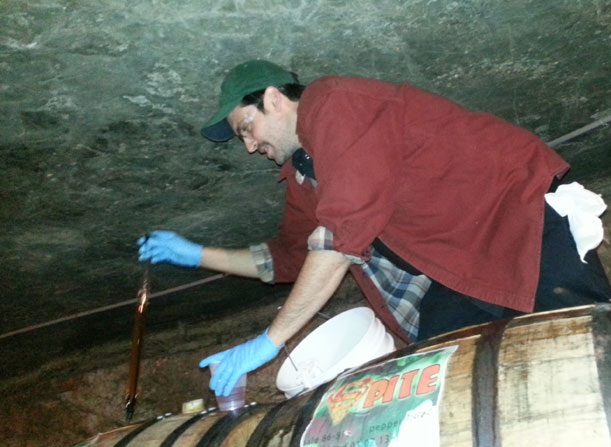
Jason Heystek pulls a barrel sample at Founders Brewing

Meet Jason Heystek. His business card identifies him as head cellarman and lead guitar at Founders Brewing.

He’s also the guy in charge of barrels at Founders, the Michigan brewery that stirred up the Internet this week by announcing a it would sell a 30 percent of its company to a Spanish brewery.

In a follow up story, Founders CEO Mike Stevens said, “We were looking for someone who truly understood the soul (of) this brand.”

Which implies they damn well want to retain that soul. How will that work out? I’m making no predictions. I’m not very good at them. Remember Session #67 (the one in which we predicted how many breweries would be operating in 2017)? I typed 2,620, a number far too distant to see in the rear view mirror to see any more.

A bigger deal than who in what country owns what percentage of the brewery — it matters to some people, and in a perfectly valid way, but that is a different discussion — are the plans to make a lot more beer. Three years ago Founders brewed 41,000 barrels and soon the brewery will have the capacity to make 900,000 barrels. There’s no guarantee they’ll reach that target, but they’ve shoved a lot of chips on the table. And they did that before striking the deal with Mahou San Miguel.

It’s a whole different scale. It took some doing, but they figured out a way to scale up production of Breakfast Stout, and All Day IPA is a powerful endorsement for investing a million dollars in a Krones canning line. Quality isn’t easy, but maybe it is the easy part. We start talking about soul when we starting considering the connection Founders has established with its customers.

Stevens understands this. When they announced this expansion that will cost $40 million just earlier this month Stevens said it would have been easier to build a new brewery in the suburbs than shoehorn an expansion onto its crowded downtown site. “It’s important to us ultimately to stay downtown, to stay in Grand Rapids,” he said. “Grand Rapids is where we started our business. We’ve been growing in Grand Rapids. My partner and me were born and raised in Grand Rapids.”

Barrel aged beers are part of that connection. They aren’t as easy to scale up. Sure, there’s plenty of room for barrels at Michigan Natural Storage, a former gypsum mine with six miles of tunnels. And, sure, Goose Island Beer Co. has done a pretty astonishing job of scaling up production of Bourbon County Stout, and its variations. Once again, sure, almost nobody who drinks the barrel aged beers from Founders knows that Heystek climbs around on top of the barrels, checking the progress of the wide variety of beers he puts in them. And, by golly, they pass the place test — brewed downtown and hauled three miles to the same place as always to age.

But there’s something different. Maybe not something you’d taste “blind.” Maybe you need to have met Jason Heystek — a constantly funny guy who is flat out serious about Founders beer. I’m pretty sure a lot of people in Grand Rapids have.

When you’re alone and life is making you lonely
You can always go downtown
When you’ve got worries, all the noise and the hurry
Seems to help, I know, downtown

– From “Downtown” (Written by Tony Hatch, sung by Petula Clark)