Beer, agriculture & lifestyles

MONDAY BEER LINKS, MUSING 12.22.14

Random fact not worth a blog post (and that felt too irrelevant to tweet): A comment attempt that ended up in the spam folder (bless Akismet) last week was 33,501 words long. Should have saved it for 28 February.

5 Reasons NOT to Become a Hop Farmer in 2015.
@47Hops has tweeted this link relentlessly and several other tweeters have picked up on it. In the comments (where there’s some excellent reading) blog author Douglas MacKinnon says that on Facebook he received “negative comments about this article saying I’m a greedy dealer trying to keep the market to myself” and based on the tone alone you can see why. It portrays the hundreds of farmers in the country newly interested in growing hops in a rather singular way. I have not been shy here or on Twitter or on Facebook about suggesting people giving hops a whirl should know what they are up against. But many of them do have a clue. Recently and in the coming months there have been or will be educational conferences about everything releated to growing hops in several different states east of the Mississippi. Maybe as important, I remember that less than 40 years ago it was idiotic to start a new, obviously small, brewery. [Via 47 Hops]

Are You Ready for Lifestyle Beer?
All’s Fair.
– Jeff Alworth writes “The rise of lifestyle brewing — less a new thing than the end state of a very old trend — is yet the latest development in that constant tension between hype and authenticity.”
– Dave Bailey writes “at a time when there seems to be many people claiming that we should all shout universally that all beer is good, it seems to me that at least one brewery is ready to fight gloves off. I for one welcome this.”
[Via All About Beer and HardKnott Dave’s]

Why J D Wetherspoon’s is fast becoming my favourite craft beer bar.
“I never thought I’d see the day.” [Via Pete Brown]

Heineken’s Charlene de Carvalho: A self-made heiress.
The mysterious banker behind the world’s best-known beer.
What happens when you are 47 years old and inherit the Heineken fortune and control of a brewing empire that you had almost nothing to do with up until your father died? (The article includes the story about when Freddy Heineken was kidnapped. He said he captors tortured him. “They made me drink Carlsberg.” [Via Fortune ]

Baderbrau rebirth culminates with South Loop brewery.
So what’s next, somebody opens a brewery called Cartwright Brewing in Oregon? How about a Newman Brewing in New York? Nostalgia for failed startups of the 1980s feels a bit strange. [Via Chicago Tribune]

Lo Hai Qu on Wine Magazines.
Per usual, the HoseMaster takes no prisoners. Would I find somebody skewering beer magazines as amusing (given that I work for several of them)? Would you? Because “when it comes down to it, wine magazines are just like the men that read them—fun for a night, but then easily disposable.” [Via HoseMaster of Wine]
The taste of downtown Grand Rapids

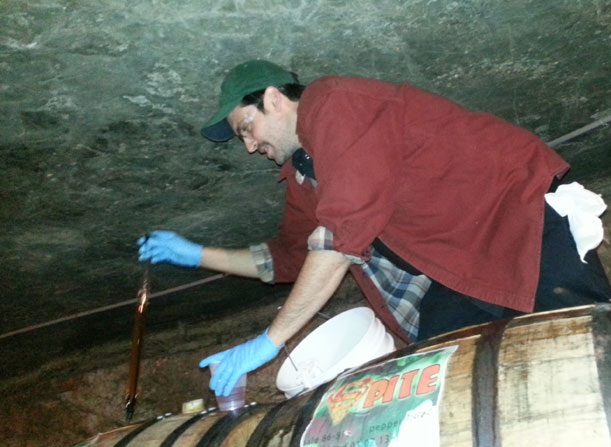
Jason Heystek pulls a barrel sample at Founders Brewing

Meet Jason Heystek. His business card identifies him as head cellarman and lead guitar at Founders Brewing.

He’s also the guy in charge of barrels at Founders, the Michigan brewery that stirred up the Internet this week by announcing a it would sell a 30 percent of its company to a Spanish brewery.

In a follow up story, Founders CEO Mike Stevens said, “We were looking for someone who truly understood the soul (of) this brand.”

Which implies they damn well want to retain that soul. How will that work out? I’m making no predictions. I’m not very good at them. Remember Session #67 (the one in which we predicted how many breweries would be operating in 2017)? I typed 2,620, a number far too distant to see in the rear view mirror to see any more.

A bigger deal than who in what country owns what percentage of the brewery — it matters to some people, and in a perfectly valid way, but that is a different discussion — are the plans to make a lot more beer. Three years ago Founders brewed 41,000 barrels and soon the brewery will have the capacity to make 900,000 barrels. There’s no guarantee they’ll reach that target, but they’ve shoved a lot of chips on the table. And they did that before striking the deal with Mahou San Miguel.

It’s a whole different scale. It took some doing, but they figured out a way to scale up production of Breakfast Stout, and All Day IPA is a powerful endorsement for investing a million dollars in a Krones canning line. Quality isn’t easy, but maybe it is the easy part. We start talking about soul when we starting considering the connection Founders has established with its customers.

Stevens understands this. When they announced this expansion that will cost $40 million just earlier this month Stevens said it would have been easier to build a new brewery in the suburbs than shoehorn an expansion onto its crowded downtown site. “It’s important to us ultimately to stay downtown, to stay in Grand Rapids,” he said. “Grand Rapids is where we started our business. We’ve been growing in Grand Rapids. My partner and me were born and raised in Grand Rapids.”

Barrel aged beers are part of that connection. They aren’t as easy to scale up. Sure, there’s plenty of room for barrels at Michigan Natural Storage, a former gypsum mine with six miles of tunnels. And, sure, Goose Island Beer Co. has done a pretty astonishing job of scaling up production of Bourbon County Stout, and its variations. Once again, sure, almost nobody who drinks the barrel aged beers from Founders knows that Heystek climbs around on top of the barrels, checking the progress of the wide variety of beers he puts in them. And, by golly, they pass the place test — brewed downtown and hauled three miles to the same place as always to age.

But there’s something different. Maybe not something you’d taste “blind.” Maybe you need to have met Jason Heystek — a constantly funny guy who is flat out serious about Founders beer. I’m pretty sure a lot of people in Grand Rapids have.

When you’re alone and life is making you lonely
You can always go downtown
When you’ve got worries, all the noise and the hurry
Seems to help, I know, downtown

– From “Downtown” (Written by Tony Hatch, sung by Petula Clark)

Did people really smoke while brewing in the 1950s?

MONDAY BEER LINKS, MUSING 12.15.14

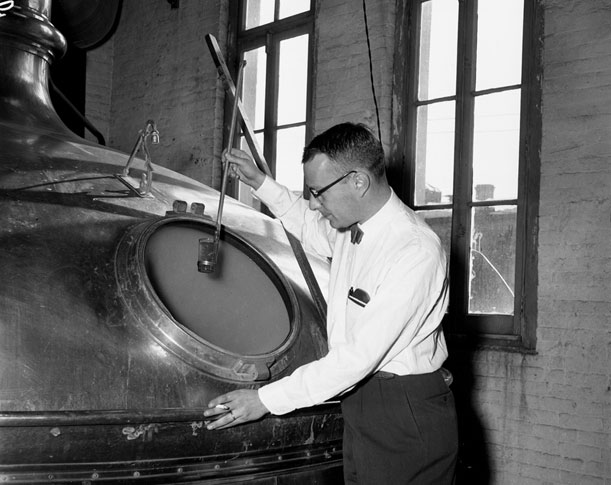
Ed Reisch of Reisch Brewing in Springfield, Illinois

A ‘good mixer.’
The State Journal-Register in Springfield, Illinois, occasionally hauls out photos from its archives. This one is from December 1953. It shows Ed Reisch, the fourth generation of his family to run Reisch Brewing, at a brew kettle. The brewery closed in 1966 and Reisch went to work at Pabst Brewing in Milwaukee. His son, George (his tweet led me to this photo), became a corporate brewmaster at Anheuser-Busch (now AB InBev). His grandson, Patrick, is a brewer at Goose Island Beer Co. in Chicago. I’m pretty sure Reisch was not manning the kettles that day. The shirt and bow-tie are one giveaway; the cigarette in his left hand another. And on a historic note, it seems that Reisch Brewing still had oak fermentation vessels in the 1950s. [Via The State Journal-Register]

Beers from my past-Pt 1: The Anheuser-Busch American Originals.
Mitch Steele — you know, the guy who once brewed at Anheuser-Busch, now oversees brewing at Stone, and who wrote a book about IPA — digs into his garage and his memory to start a series about when he worked in new products at A-B (mid- to late-90s). He plans to include details about Faust, which has been getting new attention recently, in the next one. [Via The Hop Tripper]

Black-Market Brews: Inside the Super-Secret World of Beer Muling.
Who needs lions and tiger and bears when you’ve got whales and mules, oh my? Just when you thought the New Beer World couldn’t get any stranger there’s a story like this. It would have broken my spirit to spend any time reading discussions that followed at Rate Beer and Beer Advocate, but I particularly like this comment on the STL Hops forum: “I feel that actual mules would think that this term is derogatory to them and possibly to farmers and whatnot who actually use mules.” [Via First We Feast]

The King has left the building.
h/T to Roger Baylor for pointing to this. He put it better than I can (not the first time I’ve written those words about his blog): “Writing well is very, very hard, and the best way to approach it is to tell the truth and write what you know. Sometimes, what you know is awfully hard to write with honesty.” [Via Louisville Beer]

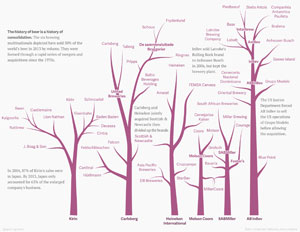
Big Beer: Is Consolidation Limiting Your Drink Selection?
Beer family treesSkip to the end for the dire warning: “If the consolidation trend continues to absorb more and more of the world’s brewing market, we could see the same product sold under different brand names in an attempt to give consumers the illusion of choice.” Obviously not happening in our small world. But the real reason I’m pointing to this is it uses a great graphic first posted at Quartz at the beginning of October and until Saturday overlooked by me. Of course, it is already out of date. There’s a Blue Point branch on the AB InBev tree but no 10-Barrel. [Via Business CheatSheet]

Fear Beer? Sometimes the Best Wine is a Beer (or a Cider).
Mike Veseth writes, “I spoke about the trends I have observed traveling the world in the past year and one of them is the rise of craft beer and cider and their growing incursion into the wine space. I see it everywhere and the people I meet are often surprised that it is a widespread phenomenon. I thought it was just something that’s happening here is a common response.” Read that last sentence again. [Via The Wine Economist]

Urban spelunking: Leinenkugel’s 10th Street Brewery.
A reminder that an “ultramodern” and “highly automated” brewery meant something different in 1985, when G. Heileman Brewing built this facility. Today? “At best I would call 10th Street a partially automated brewhouse, some of the temperature controls of the mash and some of the brews vessel to vessel movements are automated – with the brewer pressing a button to start and stop the processes – but that would be it.” [Via OnMilwaukee.com]

New brewery in Thibodaux to offer King Cake Ale.
Cinnamon, vanilla and lactose aren’t ingredients that constitute something specifically local to south Louisiana, so it’s probably a stretch to call King Cake Ale a place-based beer, but it’s probably worth a trip to Thibodaux just to make sure. [Via WWLTV.com]

On the demise of beer, & your weekly ‘place’ updates

MONDAY BEER LINKS, MUSING 12.08.14

The great beer abandonment: America’s young drinkers are increasingly drinking wine and hard alcohol instead.
“Even the beer world’s coveted corner, craft beers, which has been gaining market share for many years now, might be on the verge of hitting their peak. ‘While we’re not there yet, we’re definitely approaching bubble territory,’ Spiros Malandrakis, an industry analyst at Euromonitor, said this past summer.”
[Via Washington Post]

Craft Beer Report Card: Have We ‘Failed Our Female Fan Base’?
Enough.
The Sexist Nightmare That is Being a ‘Barmaid.
Jessica Miller, who was one of the one of the women surveyed for the “How Craft Beer Fails Its Female Fan Base” story in the 11.24.14 links, offers indepth perspective on the issue. The next two links provide a different sort of persective.
[Via Hey, Brewtiful; Hipster Brewfus; The Vagenda’; h/T Boak & Bailey’s Beer Blog]

Learning to love constraint in brewing, or, Globalization and the terroirs of music, soccer formations, and local beer.
Truly local beer requires a beer culture.
The first was written for Boak & Bailey’s call to “go long” but I didn’t spot it until Monday. It begins with a series of digressions (“I swear this eventually has to with beer”) but they turn into a fine way to introduce the idea of “commitment to restraint.” And it ties directly into what Lars Marius Garshol has to say in the second. You know you should take the time to read something that includes this thought: “Strong forces are pulling the other way, toward drowning everything in the soup of sameness.”
[Via The Brewolero and Larsblog]

Persimmons.
Indigenous ingredient of the week.
[Via Richmond-Times Dispatch]

Fourteen rules concerning wine blogging.
They work just as well for beer.
[Via Via Steve Heimoff]

How to avoid ‘the sameness of craft beer’

MONDAY BEER LINKS, MUSING 12.01.14

The sameness of craft beer. SPOILER ALERT, it is better to start at the beginning, but I’m cutting directly to the conclusion: “So are we necessarily headed for a world where beers taste the same everywhere? Probably we are, at least to some degree, because I don’t really see how anyone today can develop a genuinely local beer culture.”

To “some degree” leaves wiggle room, so I can’t say I simply disagree with this. There is much truth in it, but I see something else happening as well. Friday we were in a newish place in western New Jersey located in a building in which more than one restaurant venture has failed, the last being an “Asian fusion” concept. It was packed. Presumably because it has 40 beers on tap, most of which would be labeled craft, and about as many televisions, all of which were showing various football games. The draft menu included cultish San Diego-style hop-centric beers such as Ballast Point Sculpin IPA and Port Brewing Wipeout IPA (so from 2,700 miles away). There was a handle for Coors Light, a beer I saw plenty of people in their mid-20s drinking. If you wanted a Budweiser you had to buy it by the bottle (and people did). There were also, thank goodness, plenty of regional choices, although none from tiny breweries or beers you’d label “place based.”

So I don’t see beers tasting the same everywhere. Brewers in the Midwest who like hop-centric beers similar to those found on the West Coast are making beers that taste much the same, but there is a difference between exactly the same and broadly the same. The former has a better chance of being boring. One things that struck me at the Beers Made by Walking Festival last October in Denver was the connection attendees seem to make immediately with the beers being served. Granted, people who paid to attend were already predisposed to appreciate these beers. Some were from small breweries, but some were from larger ones. They were delightfully not the same, and most were not scalable. Granted, I’m a cockeyed optimist, but it sure looks like this not-scalable trend has legs.
[Via Larsblog]

Whatever People Say I Am, That’s What I’m Not. Read it for a measured report on The Brewers Project at Guinness. Or read it for sentences like this: “St. James’s Gate is a totally sterile plant, no beer leaves alive, not even the made-for-destruction test batches.”
[Via The Beer Nut]

What do beer writers think of beer certifications? Chad Polenz polled people who write about beer about the “expect their brethren to have a certification in order to have credibility.” He also posted a link on his own Facebook page and one on the Beer Judge Certification Program page, and between the two there are almost 200 comments. Exhausting reading.
[Via Times Union and Facebook]

Photo Contest 2014: The What, The How And The Why. Here’s another two-for-one set of links. Alan McLeod rambles a bit about Photo Contest 2014 and blogging in general, with enough length to qualify as a #BeerLongRead — the occasional gathering of bloggers hosted by Boak & Bailey. Lots there to add to Pocket.
[Via A Good Beer Blog and Boak & Bailey’s Beer Blog]

Rethinking the tasting note. If it is time to change the way “we” talk about wine, as is suggested here, then maybe it makes sense to reconsider how “we” describe the aromas and flavors in beer.
[Via Grape Collective]