Diversity, local, imagination; maybe they are related

MONDAY BEER AND WINE LINKS, MUSING, 05.29.17

It’s Memorial Day in America, so time to crank up James McMurtry and choose you beer wisely.

Local Brewers Defy the Lily-White Craft Beer Scene.
Cultivating Black Brew Culture Through Hip-Hop.
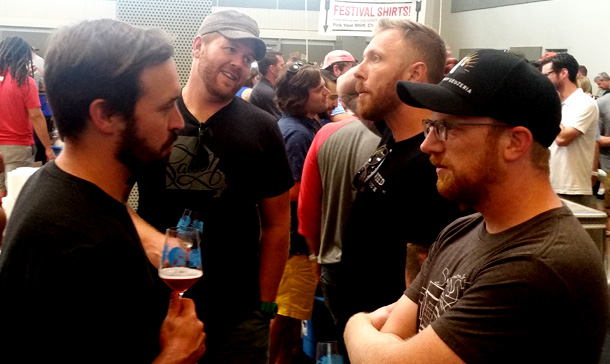
– This, “On May 12, a diverse crowd of around 100 people gather in Goodyear Arts for an exhibit called Mood: BLACK featuring visual art, live music and free drinks. In a back corner, folks gather around a table to try cups of Dat Dere or the Stokely Stout, two beers from Black Star Line Brewing, a black-owned brewing company based in Hendersonville.
     “Cut ahead by a few hours, on the afternoon of May 13, as people pour into a block on Louise Avenue for the opening of a new Catawba Brewing Co. location in the Belmont neighborhood between Plaza Midwood and NoDa. . . . While everyone seems to be enjoying themselves at each scene, there’s one striking difference between the two: despite Catawba’s location in a historically black neighborhood, there’s not a single black person to be seen among the hundreds of people there at around 5 p.m.”
– And this, “So what can Charlotte’s current brewery owners and regular patrons do to help change these preconceived cultural notions attached to Charlotte’s brewery culture? How can they help both budding and long-time black beer enthusiasts see breweries as a space of true leisure and relaxation for all?”
Read more

Weekly beer links: International edition

MONDAY BEER AND WINE LINKS, MUSING, 05.22.17

Pay no attention to that elephant in the room. More long (and I dare I suggest passionate?) screeds this past week related to AB InBev and buyouts in general. But there is a whole world of beer out there . . .

RUSSIA

Burnt by the sun.
This is from last summer, but it just hit my radar. “Defying centuries of Christianisation, the Chuvash are still largely a pagan people with colourful rituals and a pantheon of gods that make ancient Greece look like a spiritual backwater.” And they grow hops. Not like in the 1980s, but there is a plan. [Via Calvert Journal]

SOUTH AFRICA

The true import of South African hops.
Yes, that is the elephant over there, but last week I suggested a conversation about South African hops should include South Africa and now somebody has. [Via All About Beer]

Read more

Beer links 05.15.17: ABI & ABI-free

There’s enough op-ed in several of these posts I’ll mostly forego musing this week.

EVIL EMPIRE (UNLESS IT’S NOT) RELATED

Killing Craft? AB InBev Blocks Sale of South African Hops to American Craft Brewers.
[Via Craft Beer & Brewing]
AB InBev is Coming for All Your Hops, Unless They Aren’t.
[Via This is Why I’m Drunk]
I will be in South Africa in July. Although we won’t be near the hop growing region I hope to talk to some farmers, because I haven’t seen a report in which somebody does. After all, they are central to the story. (Added May 16: Lucy Corne reports from South Africa for All About Beer.)

Read more

Beer links, musing 05.08.17: It’s different this time

Sour beer summit in St. Louis

On the Wicked Weed Brewing Purchase.
[Via Jester King Brewery]
What it’s like to work for a brewery that “sold out”
[Via DRAFT]
Watch the Hands, Not the Cards — The Magic of Megabrew.
[Via Good Beer Hunting]
If you somehow missed the news last week that AB InBev acquired Wicked Weed Brewing take a moment to google a few of those words. It happened. The reaction was swift, much of it like when AB InBev bought 10 Barrel Brewing, like when AB InBev bought Elysian Brewing, like . . . you know the drill. It’s happened enough that several bars were quicker to announce they’d no longer be serving Wicked Weed beer. At the same time, drinkers across the country asked if it was OK to be excited to think about Wicked Weed’s highly rated beers showing up in their hometowns — just as 10 Barrel and Elysian already have. In addition, DRAFT magazine and Good Beer Hunting posted insider written stories that told us something new. They both come from a point of view.

Read more

It’s not easy being big

The challenges Big Craft™ faces are not unique to beer.

Yesterday the Wall Street Journal published a story headlined “Big-Name Food Brands Lose Battle of the Grocery Aisle.” Pretty straightforward premise.

America’s packaged-food giants are losing the battle for retailers’ shelf space, complicating their efforts to break out of a yearslong slump.

Instead of promoting canned soup, cereal and cookies from companies like Kraft Heinz Co., Kellogg Co. and Mondelez International Inc., grocery stores are choosing to give better play to fresh food, prepared hot meals, and items from local upstarts more in favor with increasingly health-conscious consumers.

“We’ve got to maximize return on our shelf space,” said Don Fitzgerald, vice president of merchandising at Mariano’s, a Chicago grocery chain bought by Kroger Co. in 2015. Shoppers, he said, are drawn to steamy pasta at the store’s deli counter, rather than a box of dried macaroni with powdered cheese sitting on the shelf for weeks.

This follows a report last February about how larger companies are looking to smaller ones for, as the headline (“Big Food Looks to Startups for Ideas, Innovation”) suggests, news ideas.

Food giants are starting venture-capital funds to invest in startups focused on healthier and less-processed foods, betting the younger companies can teach them to be more entrepreneurial and innovative. Slow to recognize consumers’ shift toward those products, global titans have found themselves stuck in a rut. This week, Nestlé SA, the world’s largest packaged-food company, dropped its long-running sales-growth target for the next three years, saying it needs time to adapt to these fundamental changes in the industry.

“It’s hard for consumer companies to step out of what they’ve been locked into for 60 or 80 years,” said Ryan Caldbeck, founder and chief executive of CircleUp, a business that connects private-equity firms with food startups. CircleUp says large consumer-goods companies lost $18 billion in market share to smaller competitors between 2011 and 2015.

This might belong in the mix as well: “Hard times for Whole Foods: ‘People say it’s for pretentious people. I can see why'” It seems that eventually price matters even for authentic, or great, or “exquisitely selected” products.

*****

ENDNOTE: When using the term Big Craft™ be sure to honor the the trademark — at least as long as Big Craft™ is relevant.