Germany and Rate Beer 2010

German beer sales were down again in 2009, continuing a 20-year trend.

I think I finally figured out why. They brew shit beer.

There you have it. Pretty simple.

The Rate Beer Best 2010 list is out and not a German beer made only one German beer in the top 100.

Pardon my flipness. That German beer consumption has declined 30 percent in the last 20 years is not something to laugh about, and I’ve rambled on enough about lists like Rate Beer’s. (That said, it might take some restraint to resist commenting on Beer Advocate’s Beer in Review.)

British blogger Mark Dredge, a Rate Beer contributor, provides an excellent perspective on the Rate Beer Best:

For me, as it’s a collective opinion, it’s largely a guide as to what geeky beer drinkers (you need to be a geek to want to rate – rating is hard work and takes real dedication!) like to find in their pint glass. It’s not a list of the best beers to drink in a pub on a Sunday afternoon, it’s a list of some of the most esoteric flavour experiences possible, dominated by imperial stouts, barrel aging, IPAs and sours.

A couple of years ago Sylvia Kopp wrote a fine article in All About Beer magazine about the challenges German brewers face. Go read it.

Georg Schneider, owner of the Private Weissbierbrauerei G. Schneider & Sohn in Kelheim, doesn’t mince words: “The German beer market is deadly boring,” he says. “It is all very much the same. The tendency towards sameness is encouraged, for example, by our domestic beer tests rating beer only by its typicality and flawlessness. Creativity is only acted on in the beer mix category.”

Since then a group called Bier-Quer-Denker, selected by the brewing publication Brauwelt and the Association of Small Private Breweries, has presented beers beyond the usual in Germany at a couple of seminars. One was a “Reinheitsbegot tripel” (passing on sugar commonly used by Belgian brewers), using two hop varieties from New Zealand and yeast sourced from the Westmalle Trappist monastery brewery.

Of course they’re probably going to have to brew an imperial stout if they want to make the Rate Beer 2011 list.


Watching breweries grow

Last week I mentioned that when Ken Grossman and Paul Camusi wrote the business plan for Sierra Nevada Brewing their goal was to sell 3,000 barrels of beer annually. They produced 1,500 barrels the first year (1980) and the brewery passed 3,000 in its fifth year of operation.

The Brewers Association classifies breweries that make fewer than 15,000 barrels (31 gallons in a barrel, you’ll recall) “microbreweries” and those larger “regional breweries.” Quite honestly, 60,000 is a more important number to breweries because all barrels produced after that are taxed at a higher rate.

Anyway, it took Sierra Nevada 10 years to grow beyond “micro,” and five years later the brewery produced 150,000 barrels. Growth isn’t always linear. But just for the heck of it here’s a look at 10 breweries you’ve likely heard of and how long it took them to grow from “micro” to “regional.”

How are they doing now? Rather than use 2008 sales figures, which are more than a year old, I’ll update the chart in a few months, after the Brewers Association compiles the 2009 data.

Brewery   Year   Barrels     Barrels
  (Yr of operation)   That Yr     Previous yr
Sierra Nevada Brewing   1989 (10th)   20,884     14,000
Widmer Brothers   1991 (7th)   27,500     12,000
Deschutes Brewery   1994 (7th)   19,719     8,564
New Belgium Brewing   1994 (4th)   18,951     5,837
Harpoon Brewery   1994 (8th)   24,000     12,950
Boulevard Brewing   1995 (7th)   21,000     14,748
Bell’s Brewing   1996 (12th)   15,631     10,250
Stone Brewing   2002 (7th)   18,450     12,779
New Glarus Brewing   2003 (11th)   18,700     13,700
Dogfish Head Brewery   2004 (10th)   20,200     13,600


Under the radar, all things are relative

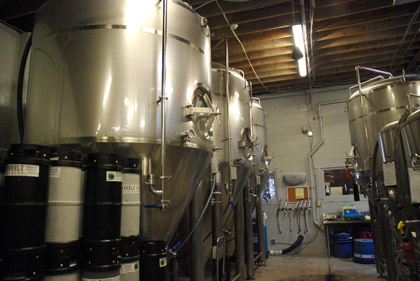
Marble Brewery in Albuquerque recently installed three more fermenters (above, on the left), each holding 45 barrels (almost 1,400 gallons). Marble brews mostly ales, so running 26 batches through each fermenter over the course of a year would constitute a leisurely pace and still yield more than 3,500 barrels.

Now consider this. When Ken Grossman and Paul Camusi founded Sierra Nevada thirty years ago the business plan called for production to max out at 3,000 barrels. “We figured we could make money at that, we wouldn’t get rich but we’d get by,” said Grossman, now the company president. Sierra Nevada produced 1,500 barrels the first year (1980) and passed 3,000 in its fifth. It now brews nearly 700,000 annually.

All things are relative. Yesterday Stephen Beaumont pointed to a Wall Street Journal story about U.S. beer sales volume falling. He suggests this is a victory for boire moins, boire mieux (drink less, drink better). I’m certainly on board with the drink better part.

He writes that the WSJ “doesn’t see this because they’re used to looking only at the large, public corporation side of things.” Indeed, 3,000 barrels here, 3,000 barrels there . . . nothing to the global beer powers. But 3,000 barrels equals close to one million 12-ounce bottles. To those of us buying niche beers that’s a lot of bottles.

Before 2009 no New Mexico brewery since Prohibition (and we don’t have numbers from before) had brewed 5,000 barrels. Marble made 5,200 last year, an increase from 1,950 in 2008 (the brewery began selling beer in April that year). The increase was a ridiculous 267 percent, the actual growth 3,250 barrels.

OK, you never heard of Marble. That’s part of the point. Also Great Divide Brewing in Colorado grew a little over 3,000 barrels (34 percent) in 2009 to about 12,000 barrels. And sales at Saint Arnold Brewing in Texas increased 13 percent (production rising not quite 3,000 barrels) to nearly 26,000 barrels.

We’ll never know how much Bud Light Lime A-B InBev sold in the Albuquerque area in 2009. Maybe it was more than 3,000 barrels, but it’s still just another brand passing through. Before that it was Miller Chill. Nothing changes.

But things have changed in the cooler at the only market in the village where I live. Corrales is an anomaly, long and narrow with about 8,000 people and no stop lights. Albuquerque and Rio Rancho are hard by and that’s where most people shop. Drive two miles past Frontier Mart and there’s a full-size grocery store with cheaper milk and a fully stocked liquor store.

Still, Frontier always had a solid, if limited, wine selection and the usual “craft” beer suspects. Then this fall they squeezed soft drinks into one cooler facing, making room for many more beers. Instead of just offering Sierra Nevada Pale Ale they have Torpedo. Always something from Deschutes and Full Sail. More than Fat Tire from New Belgium. And at least four New Mexico beers.

A-B InBev still owns the floor display, including its lineup of beers brewed in Belgium, but this is real change. Change not so easily measured by numbers.

***************

Of course we’re headed back to number season, and there’s every chance figures for 2009 may not look as glossy as recent years. We know Boston Beer production was up 1.6 percent in 2009, and Samuel Adams sales seldom stray far from the rest of craft (in no small part because they account for more than one bottles sold out of every five). In 2008 the category was up six percent, Sam Adams six percent. In 2007, Sam Adams 14 percent and “craft” 12 percent. You get the idea.


How will Fiji do in the World Beer Cup?

Although a few more entries may show up it seems that 183 judges at the World Beer Cup, held in Chicago in April just before the Craft Brewers Conference begins, will have more than 3,400 beers to judge over the course of two days.

Does that sound like work or like fun to you?

The 2010 WBC will be the largest commercial competition ever, eclipsing the 3,331 beer entries set at the 2009 Great American Beer Festival.

The judges come from 27 countries including the United States, with 63 percent of them from outside the U.S. Several countries not represented in 2008 will be this year: Benin, Cambodia, Fiji, Greece, Haiti, Ireland, Mongolia and Namibia.

Before you haul out the calculator, 3,500 beers for 183 judges works out to less than 20 beers each. Oh, were it that simple. Each beer is judged by by six judges in each round, and multiple times if it advances (the more popular categories require three rounds).

Now does it sound like work?

*******************

More about the judging process (from the 2006 competition in Seattle).