Under the radar, all things are relative

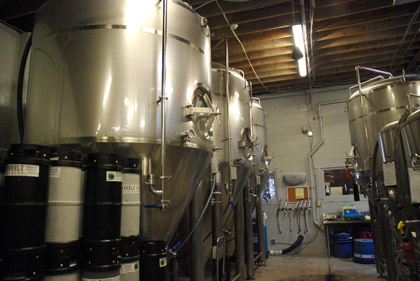
Marble Brewery in Albuquerque recently installed three more fermenters (above, on the left), each holding 45 barrels (almost 1,400 gallons). Marble brews mostly ales, so running 26 batches through each fermenter over the course of a year would constitute a leisurely pace and still yield more than 3,500 barrels.

Now consider this. When Ken Grossman and Paul Camusi founded Sierra Nevada thirty years ago the business plan called for production to max out at 3,000 barrels. “We figured we could make money at that, we wouldn’t get rich but we’d get by,” said Grossman, now the company president. Sierra Nevada produced 1,500 barrels the first year (1980) and passed 3,000 in its fifth. It now brews nearly 700,000 annually.

All things are relative. Yesterday Stephen Beaumont pointed to a Wall Street Journal story about U.S. beer sales volume falling. He suggests this is a victory for boire moins, boire mieux (drink less, drink better). I’m certainly on board with the drink better part.

He writes that the WSJ “doesn’t see this because they’re used to looking only at the large, public corporation side of things.” Indeed, 3,000 barrels here, 3,000 barrels there . . . nothing to the global beer powers. But 3,000 barrels equals close to one million 12-ounce bottles. To those of us buying niche beers that’s a lot of bottles.

Before 2009 no New Mexico brewery since Prohibition (and we don’t have numbers from before) had brewed 5,000 barrels. Marble made 5,200 last year, an increase from 1,950 in 2008 (the brewery began selling beer in April that year). The increase was a ridiculous 267 percent, the actual growth 3,250 barrels.

OK, you never heard of Marble. That’s part of the point. Also Great Divide Brewing in Colorado grew a little over 3,000 barrels (34 percent) in 2009 to about 12,000 barrels. And sales at Saint Arnold Brewing in Texas increased 13 percent (production rising not quite 3,000 barrels) to nearly 26,000 barrels.

We’ll never know how much Bud Light Lime A-B InBev sold in the Albuquerque area in 2009. Maybe it was more than 3,000 barrels, but it’s still just another brand passing through. Before that it was Miller Chill. Nothing changes.

But things have changed in the cooler at the only market in the village where I live. Corrales is an anomaly, long and narrow with about 8,000 people and no stop lights. Albuquerque and Rio Rancho are hard by and that’s where most people shop. Drive two miles past Frontier Mart and there’s a full-size grocery store with cheaper milk and a fully stocked liquor store.

Still, Frontier always had a solid, if limited, wine selection and the usual “craft” beer suspects. Then this fall they squeezed soft drinks into one cooler facing, making room for many more beers. Instead of just offering Sierra Nevada Pale Ale they have Torpedo. Always something from Deschutes and Full Sail. More than Fat Tire from New Belgium. And at least four New Mexico beers.

A-B InBev still owns the floor display, including its lineup of beers brewed in Belgium, but this is real change. Change not so easily measured by numbers.

***************

Of course we’re headed back to number season, and there’s every chance figures for 2009 may not look as glossy as recent years. We know Boston Beer production was up 1.6 percent in 2009, and Samuel Adams sales seldom stray far from the rest of craft (in no small part because they account for more than one bottles sold out of every five). In 2008 the category was up six percent, Sam Adams six percent. In 2007, Sam Adams 14 percent and “craft” 12 percent. You get the idea.
 

How will Fiji do in the World Beer Cup?

Although a few more entries may show up it seems that 183 judges at the World Beer Cup, held in Chicago in April just before the Craft Brewers Conference begins, will have more than 3,400 beers to judge over the course of two days.

Does that sound like work or like fun to you?

The 2010 WBC will be the largest commercial competition ever, eclipsing the 3,331 beer entries set at the 2009 Great American Beer Festival.

The judges come from 27 countries including the United States, with 63 percent of them from outside the U.S. Several countries not represented in 2008 will be this year: Benin, Cambodia, Fiji, Greece, Haiti, Ireland, Mongolia and Namibia.

Before you haul out the calculator, 3,500 beers for 183 judges works out to less than 20 beers each. Oh, were it that simple. Each beer is judged by by six judges in each round, and multiple times if it advances (the more popular categories require three rounds).

Now does it sound like work?

*******************

More about the judging process (from the 2006 competition in Seattle).


How do you learn Czech in Shiner, Texas?

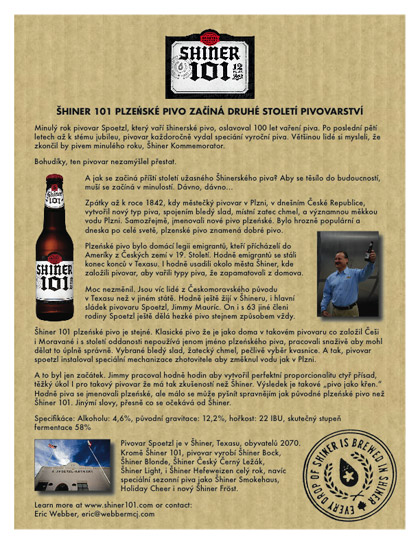
This is the press release the Spoetzl Brewery sent out to announce the release of Shiner 101, its newest beer:

The release suggests heading here for more information, mostly a video of Spoetzl brewmaster Jimmy Mauric talking about beer in Czech. At least I think it’s beer. He could be describing his pet poodle for all I know.

Is that really Jimmy Mauric talking? If you look closely you’ll likely conclude not, but that doesn’t matter. How closely might Shiner 101 replicate a “Czech-style” beer? I’m looking forward to finding out, but again that won’t be the point of the beer.

You can be darn sure it will be a beer of the region. Shiner’s Czech heritage is real. From the Czech Heritage Society of Texas:

The town was originally called New Half Moon but changed to Shiner in 1888. Czech and German immigrants were induced to settle in the area in the 1870s by Henry B. Shiner through his sale of cheap farmland. The prairie around Shiner was fertile and ideal for growing cotton. The Shiner Brethren Church was organized November 8, 1881. A cemetery is located adjacent to the Church. SS. Cyril & Methodius Catholic Church was built in 1891. St. Ludmila’s Academy Catholic School was opened in 1897. The Spoetzl Brewery, which still operates today, was originally built in the early 1900s by the Shiner Brewing Association, a stock company of local men.

Mauric grew up in Shiner, playing on the brewery grounds when he was a kid. He started working in the bottle shop when he was 17, walking a mile and a half to work. He since bought the homestead where he grew up. When the wind blows from the south he sits on his porch and smells fresh wort (usually destined to become Shiner Bock, which accounts for 87 percent of production).

He was always good at fixing things and worked his way up at Spoetzl, becoming assistant brewmaster in 1991 and brewmaster in 2005. Spoetzel sent him to the Siebel Institute of Technology to master brewing. When he was in his 30s he attended an area junior college to learn more about computers and technology. This June he will have worked at the brewery for 32 years.

These days Shiner advertising makes a big deal out of the fact that “Every drop of Shiner is brewed in Shiner.” Mauric certainly believes where is in ingredient in the beer.

“You can duplicate the water chemically, but it’s like a seasoned pot: Most people have a favorite frying pan that just makes everything taste better,” he says. “I don’t think you could copy the flavor from our brewing kettles.”

And there’s the town itself, with a population of little more than 2,000, a place you’d likely never know about were it not for beer. Gonzalez, 20 miles to the west, is five times larger. Have you ever heard of it? In that case you are probably a barbecue savant and answered, “Sure, Gonzalez Food Market.”

“The pride in the beer has always been here,” Mauric says. “Good times. Bad times. How people related to Shiner was the beer.”

You know you’re a beer geek when . . .

I type Andy Tveekrem is headed home and you know the city.

Drum roll, please. The link to the news that includes the answer. It’ll be a new brewery. One of the owners was backpacking in Thailand when he learned Tveekrem would be available and immediately e-mailed his partners. Amazing what happens when you can get wi-fi in Bangkok.

Bonus points if know where Bill Morgan (formerly brewer at the former Diamondback Brewing in the same city) might be.


What if Conan O’Brien were a beer?

If you don’t already think that Conan O’Brien can be brilliant go back and watch Season 4 of The Simpsons. He was the producer for some of the very best episodes. But perhaps the Simpsons aren’t for you . . . and perhaps you’re still pissed off at O’Brien because he twice seemed less than cordial to Michael Jackson when Jackson appeared on his show (here’s Jackson’s account of the first).

But let’s agree that O’Brien is a popular niche product. So are Jon Stewart and Stephen Colbert, but they’ve earned a spot in our culture at least equal to “microbrews.” I didn’t have a beer in hand the other day read David Carr’s analysis in The New York Times the mess NBC has made of “The Tonight Show” franchise, but I might have had my beer goggles on.

In the old paradigm, networks operated from Olympian heights, but with cable outlets multiplying, a network’s size and mass audience are not always an advantage. While cable networks can pick and choose their spots, building discrete successes while living off a combination of fees and advertising, broadcast networks are at the top of a huge ecosystem where their every move lands forcefully on affiliated locals.

In a country this size a niche can be pretty big. Big enough that large companies, some of them breweries, will start to covet that share. They need to be careful how they go after it.

The message to the younger talent is one thing — wait for a turn that may never come or may be taken back at any second — but the message to younger audiences is even clearer: a legacy industry will default to legacy assets and ride them down to the bitter end . . . .

Twitter nation was livid, of course. “Nice work NBC. Take out the only late night host my age range and younger will even consider watching,” said @MatthewJBrown, Tweeting the sentiments of many.

Based on the times Jackson appeared on O’Brien’s show it seems he might not understand this analogy:

He clearly isn’t Miller Lite. He might not be Blue Moon White or Samuel Adams Boston Lager. But he’s bigger and more real than Duff.