
Monday beer links: Inside Trillium and Doom Bar, lots of history & even a listicle

BEER AND RELATED LINKS, MUSING 12.17.18

Case Study: How Trillium (Temporarily?) Lost the Plot.
Jeff Alworth writes, “An industry insider texted me as all this was playing out and joked snarkily that Trillium had ‘been sideswiped by finding that craft beer fans drink the ‘craft beer movement’ Kool-Aid!’ If a brewery preaches an ethos that craft beer is different, that it is about community and connection, then it will be held to that standard.”

That’s one bottom line here. Another, outlined in detail, is that growth is intoxicating but new owners often are not prepared for the challenges. That’s why I’m surprised that none of the stories linked to why Massachusetts officials shut down the brewery for a month in 2014 when it was discovered Trilliam was operating without a license. At that time, fans were clearly on the side of the brewery.

Read more

The Session #140: Czech hops

Hop picking in BohemiaThe SessionThe topic for The Session #140 is Czech beer, but I’m going to write about Czech hops. The advertisement at the top may not be as old as it looks, but it suggests an unbroken link to the past.

A massive fire in the town of Žatek (Saaz in German) in 1768 destroyed historic documents that might provide more information about early cultivation, which apparently began in the first millennium. Few references to Bohemian hops exist before the fourteenth century, but from the time Charles IV actively promoted the product it flourished. In 1553 the Bohemian town of Plattau became the first outside of Spalt to receive its own hop seal, issued because dishonest merchants packaged inferior hops and sold them as “genuine Saaz.”

The original Saazer variety had, and still has, a red bine. It was called “Saazer Red” or “Asucha Red” to distinguish from the “Green Hop” that also grew in the area. In 1869 brewers paid 50 gulden per zentner for “Asuscha Red,” compared to 28 gulden per zentner for the “Green Hop.” More than a half century later, when hop breeding pioneer Karel Osvald began making clonal selections to improve the agronomic qualities of Saaz, he made it clear the hop would have evolved.

“Current hop cultures are a mix of vegetative posterity of various genetic origins. Issue of varieties is absolutely unclear, and we can talk neither of Czech old-Saaz red-bine hops nor of Semš hops. Semš hops originate from old-Auscha hops, which comes from old-Saaz hops,” he wrote. “Today the cultures of hops are thoroughly mixed, even though there are no great differences between neighboring plants in a hop yard. Hops are plants that can adapt to growing conditions, since the soil and the climate lend them a certain character.”

Read more
You know you’re a hop geek

When I tell you a hop named Ernest is back in production in England.

And you think, “I sure hope it was named after Ernest S. Salmon.”

It is. Details in the next Hop Queries, the free newsletter going out Monday.

A few disjointed thoughts inspired by the latest hop acreage report

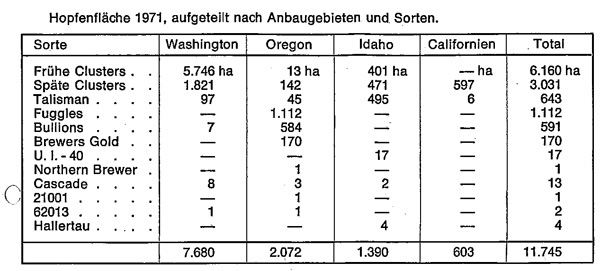
US hop production 1971

Let’s call this the state of U.S. hops 0 BC (Before Cascade).

The chart is taken from The Barth Report 1970/71. The measure is hectares, one equaling 2.47 acres. U.S. hop farmers harvested almost 46 million pounds of hops in 1970 (compared to more than 106 million in 2017) and exported about 10 million. Between September of 1970 and April of 1971 U.S. brewers imported 13.6 million pounds of hops, 88% of them from Germany and Yugoslavia (since dissolved – about one third of the hop production was in what is now Slovenia). They used imported hops for traditional, classic, some say noble, aroma and flavor. They briefly thought Cascade might serve as a substitute.

The story about the birth Cascade has been told many times (by Mitch Steele in IPA: Brewing Techniques, Recipes and the Evolution of India Pale Ale and here). After verticillium wilt devastated the Hallertau aroma crop in the early 1970s, Coors Brewing offered contracts at then-lucrative prices to support growing Cascade. By 1975 farmers in the Northwest had planted more than 4,300 acres of Cascade, or 13% of the total crop. But brewers — let’s call them pre-craft brewers — soon discovered a) the aroma wasn’t quite why they expected or wanted, and b) Cascade does not store well. “The beer tasted OK, except when the beer drinker would have another bottle of beer . . . something would come up through the nose he wasn’t familiar with,” said Al Haunold, the USDA hop geneticist at the time. “We know now that it is geraniol.”

Read more

Monday beer links: Diversity, mental health and Fynbos flavors

BEER AND WINE LINKS, MUSING 06.11.18

Portland brewer Lee Hedgmon defies stereotypes about beer and race.
No shit. h/T to @brewingarchives, who also collected this terrific oral history from Lee Hedgmon. Set aside a couple of hours.

Scott Sullivan from Greenbush – Describes Mental Health Issue in Craft Beer Industry as a Cancer.
Not a fun topic, but a serious topic. Take time for the comments.

Read more