Rogue Ales: What the numbers show us

The New Brewer magazine Industry Review issues

You may have heard that all the doors at Rogue Ales turned up shut last week. Jeff Alworth wrote an obituary, and reminded us how influential Rogue was. I agree. We first met Jack Joyce during the Oregon Brewers Festival in 1995. And I remember XS Russian Imperial Stout vividly. It paved the way for other intense beers.

Alworth mentioned that Rogue remained one of the largest craft brewers (50th in 2024) in the United States, which made me wonder when Rogue first made the list and how it had moved up and down through the years. As I was looking through the numbers, my goal changed. At one point, I thought about comparing Rogue and Anchor through the years, but that turn out to be particularly interesting. Instead, I charted Rogue and New Glarus Brewing, and added in Brewers Association defined Craft as well.

Two thoughts before I leave you to consider the numbers. First, comparing almost any brewery to New Glarus is not fair. Too bad. Also, the Craft numbers underwent some adjustments through the years for a variety of reasons (most notably to account for breweries that were once consider Craft and then were not). So there is a chance that I grabbed the 2017 number in 2018 and it has since been revised.

YearRogue AlesDomestic CraftNew Glarus Brewing
200025,000 barrels5,307,057 barrels9,406 barrels
200127,4585,352,58010,478
202229,8175,460,74213,700
200328,5035,532,03118,700
200438,0845,922,27226,113
200543,1506,409,29039,622
200651,9857,172,53654,261
200767,7378,018,23764,953
200869,6428,483,65975,137
200976,3429,064,62978,733
201081,95810,133,97791,937
201192,11011,467,337108,690
2012113,20913,246,390126,727
2013104,00015,504,850146,310
2014117,00022,133,379162,287
2015105,96124,335,413194,894
2016105,00024,302,549214,006
201798,00024,958,560226,328
201888,00025,457,429231,875
201989,00026,320,151236,161
202075,00022,842,008206,302
202188,00024,746,826232,539
202267,00024,179,853231,395
202355,88124,048,217228,132
202445,60223,103,985232,171

Counting bubbles

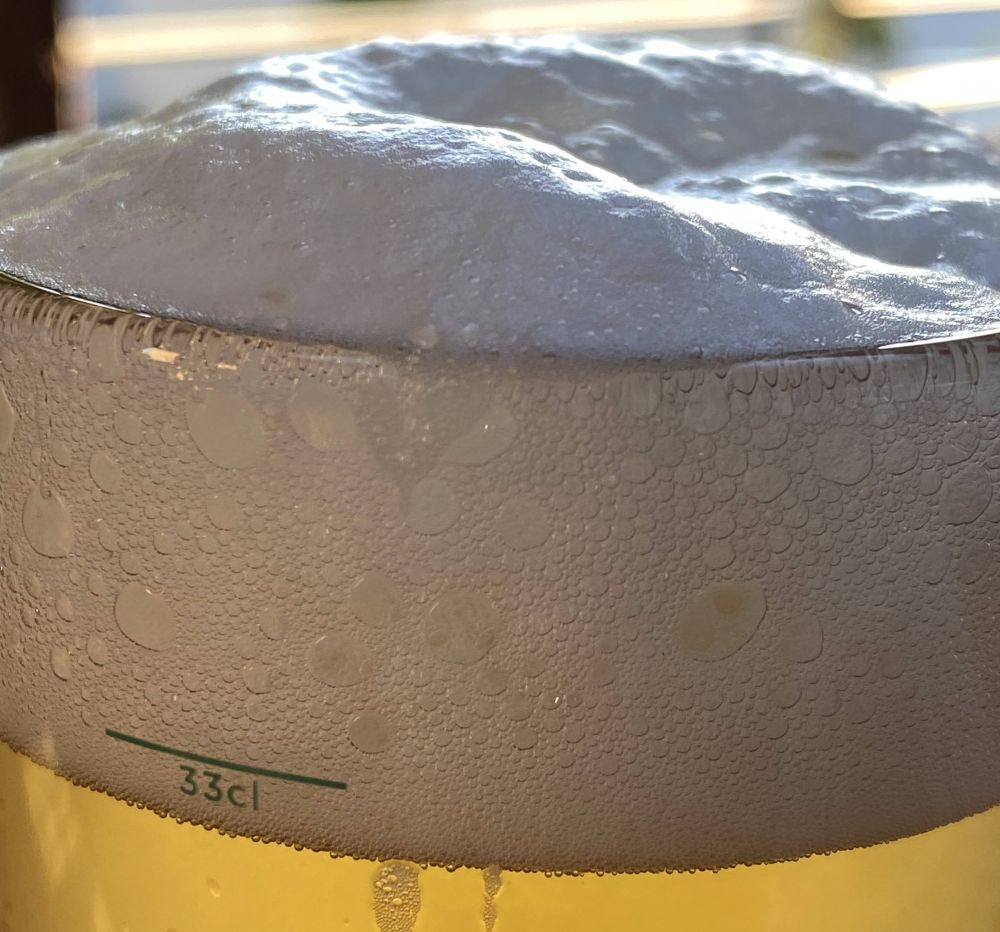
How many bubbles in this beer foam?

I recently wrote a story about beer foam for Brewing Industry Guide (“Foam Loves Hops (Except When It Doesn’t”). As happens, I had to leave a few darlings on the cutting room floor in order to have room for some key information. Such as, Dry hopping with Cascade pellets resulted in a near-linear decline in foam stability using the Nibem method, a standardized way of measuring foam stability over time.

This was one of those paragraphs:

There is more to monitoring beer foam than counting bubbles, although they are the foundation. They result from nucleation, and as those bubbles climb to first form or then replenish the foam head, proteins and bitter substances are carried into the bubble wall, forming a matrix that holds the skeleton together. In his doctoral thesis, “Beer Foam Physics,” A. D. Ronteltap calculated that a foam 3 centimeters high (a bit less than 2 fingers) in a glass 6 centimeters wide (a bit less than a Willi Becher) made up of bubbles with an initial radius of .2 mm (twice the width of a human hair) would contain 1.5 million bubbles distributed over about 100 layers.

What does it mean to grow ‘more’ hops?

Roadkill -- as seen during hop harvest in Oregon

Hop harvest has begun in Oregon (where I’ll be in two weeks). This is roadkill from a previous harvest.

Perhaps I will try to make “fun with numbers” a semi-regular Friday feature. We’ll see.

When I received an email last week declaring “Oregon Retakes No. 2 Spot for U.S. Hop Crop” I was en route to Argentina, so wasn’t inclined to do some necessary math. Several sites have since posted the information.

It is a fact that Oregon farmers strung 5,421 acres for harvest and Idaho 5,109. But . . .

Last year, average yield per acre was 1,732 in Oregon and 2,273 in Idaho. If yields are identical this year (they won’t be) then Oregon farmers will harvest 9,389,172 pounds of hops and Idaho farmers 11,612,757. In my mind, more pounds of hops trumps more acres.

This is not to say that the difference in yield will be as large this year. Idaho farmers will harvest far fewer acres of Helios this year (the USDA has withheld the numbers to avoid disclosing data for individual operations) and last year the average yield for Helios was 3,092.

Expect ad update in December, when the USDA posts final results of harvest.

‘Median’ German drinks 20% less beer than 2005

The story is behind a paywall, but you can get a look if you share your email address.

“In 2005 the median German quaffed 112 litres of the stuff. The figure is now less than 90. Germany remains the sixth-biggest beer market in the world. But whereas Germans once downed more than anyone bar the insatiable Czechs, they are now eighth in the per-person league table. Worse, the decline is gathering pace. ‘Panic’ has gripped some breweries, says Gerrit Blümelhuber, a consultant.”