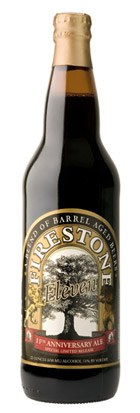
 I’ve already ragged on Firestone Walker for the Plane Jane names attached to spectacular anniversary beers. So to be constructive I should suggest a sexy alternative to “Firestone 11,” the beer they’ll be lining up to buy today at the Firestone Walker taproom in Paso Robles, Calif.
With apologies to Dickens let’s call it a “Tale of Two Matts.” And quote a bit from the opening of his similarly named novel: “it was the age of wisdom, it was the age of foolishness.”
The Matts are Matt Brynildson and Matt Trevisan, the brewmaster at Firestone and winemaker at Linne Calodo Winery respectively. The former had everything to do with brewing, aging and assembling the beer. The latter sat in on sessions that determined the blends for “10” and “11.” As important to me is how generous Trevisan was with his time in a long conversation that helped me understand what makes this beer different.
The foolishness? The labor and time involved compared to what income the sale of 500 cases will bring. The wisdom? It’s in the glass.
Coconut. Vanilla. Oak tannins. Texture. Bourbon. Brown. Chocolate. Dark cherries. Smoke. Earthy/herbal.
That’s how my notes begin. Then, Do we really need to deconstruct this beer?
My thoughts turned to a conversation with Trevisan about blending “10.” “I told them they didn’t have to sit there and pick it apart to find the best one,” he said. “You didn’t necessarily want the one you had the most to say about. Ultimately it’s a beverage to enjoy.”
So Daria and I were pretty much done chatting about our impressions of the beer, even if they did keep coming. For instance, when I poured out the last of the 22-ounce bottle and kicked up the head anew a sudden whiff of rose perfume appeared, recalling Rochefort’s beers. Where the hell did that come from?
We enjoyed the beer but we talked about how much we like the Christmas tree we cut Friday, how many days we should appropriate for the Canadian Rockies next summer, and more stuff you don’t give a hoot about.
Instead, you’re here to find out what makes this beer different, perhaps special. Could there be a one word tasting note?
OK. Texture. It’s rich and velvety on the tongue, but finishes with enough leathery coarseness that it doesn’t leave a sweet impression. I suspect that’s one of the reasons such a wide array of flavors come together so well.
Class dismissed.
The rest of a “Tale of Two Matts” is optional reading.
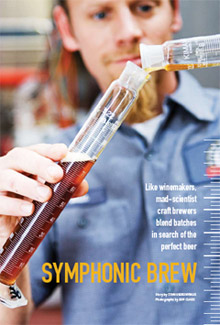 Firestone 11 is a compelling beer with a captivating back story. I wrote about the blending of Firestone 10 in the current Imbibe magazine.
Also, check out Sean Paxton’s recently posted Blending Firestone Walker 11 with Matt Brynildson for photos far more illustrative than my words. Don’t miss the “Bourbon Dot.”
Before we get to the nitty gritty geeky details comparing “10” and “11” let’s back up a bit. When Brynildson hit upon having area winemakers help with the blend, Trevisan — who stocks up on a variety of Firestone Walker beers to serve winery workers during harvest — was one of of the first he called. Wine Spectator has characterized him as one of the “Young Turks” of the Central Coast.
Handed a glass of Abacus, a barley wine, that was a composite taken from several barrels Trevisan asked instead for samples from individual barrels. A conversation with him about wood makes the reason why obvious.
French Oak versus American Oak is just the beginning, because he’ll tell you about different forests around the world. He described two oak trees, each one on a slightly different part of his property, each developing differently in its own microclimate.
“It starts with how the cooper chooses his trees,” he says. Where the wood is dried (think Oregon Coast versus Mojave Desert) and otherwise how the cooper treats it make as much difference as variables that are more easily quoted, like the level of “toast” (when a partially assembled barrel is placed over a fire and charred). For instance, when a winemaker or brewer buys a new barrel it will be described along these lines: American Oak, Medium Aroma Toast, 24 months (the time spent seasoning).
Trevisan says too many winemakers want barrels with the same specs to produce the same flavors. “That takes the human element out of it,” he says. “If I have two barrels I like the idea of the left one and the right one tasting different.”
Assembling those flavors, of course, is why Matt consulted with Matt. “I always work off what I call liquidity. What’s the weight in the mouth? How to you want the wine perceived?” Trevisan says. He returns often to the word “viscosity,” and the importance of flavor at mid-palate.
That may mean something a little different in wine than beer but relates directly to the impressive texture of Firestone 11. A fair complaint about some high alcohol “extreme beers” is that they start with an intense blast of aromas and flavors, but there’s little depth by mid-palate. That’s not the case here.
Make no mistake, Firestone 10 and Firestone 11 taste quite different. We’re not talking about the difference between the 2006 and 2007 vintages of Pinot Noir from a winery. We’re talking the difference between a barley wine and a really big brown ale. The geeky details:
Firestone 11
– 82% Bravo (an Imperial Brown Ale brewed in August 2006)
– 16 bourbon barrels, 5 brandy barrels, 2 retired Firestone Union barrels (new American oak)
7% Rufus (a Continental Styles Imperial Amber brewed August 2007)
– 1 bourbon barrel, 1 rye barrel
7% Velvet Merkin (a regular strength Oatmeal Stout brewed October 2007)
– 2 bourbon barrels
3.5% Parabola (Russian Imperial Stout brewed February 2006)
– 1 bourbon barrel
Firestone 10
– Abacus (Barley Wine) 46%
– Bravo 16%
– Parabola 11%
– Ruby (Double IPA) 8%
– Walker’s Reserve (Oak fermented Robust Porter) 6%
– Hemp Ale (American Brown) 6%
– Double Barrel Ale (oak fermented English Pale) 6%
A 22-ounce of Firestone 10 sold for $9.99 when it was released last year. The suggested retail price on “11” is $16.99.

 We’ve got