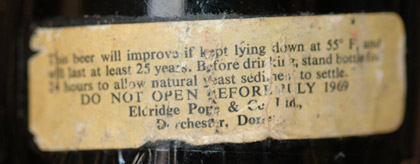
Time to open the 1968 Hardy’s Ale

Thomas Hardy's ale

Doesn’t look the message to wait until July of 1969 is going to be a problem . . .
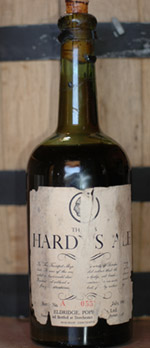
Thomas Hardy's aleThe time has come to open the 1968 bottle of Thomas Hardy’s Ale.

Daria gave me this bottle for Christmas more than six years ago, and the immediate question was what to do with it. It’s not like there was any reason to expect to be anything other than an experience. Check out Tomme Arthur’s notes from a 2004 tasting:

1968- Was the first year that they bottled Hardy’s. There were three separate bottlings and the series begins with the A Bottle.

1968 A (The Pint Bottle)- A cork finished bottle with noticeable signs of evaporation. Perhaps they trapped a few thirsty angel’s in the bottle when it was packaged? The beer reveals a large Soy Sauce nose with Cidery, Vinegar and Lactic qualities all duking it out in a battle Royale. It finishes smokier than a bar in Chicago with flacid carbonation at best. Color wise, this one leans towards the dark to medium dark spectrum.

1968 “B” Bottling- Upon inspection, this one holds little promise. An incredible (ridiculous) amount of beer is missing. The cork crumbles upon insertion of the cork screw. Not a good sign! The beer embraces this cork situation to the max and I’m soon wondering if can send back a beer I haven’t even paid for? For some reason, this vintage has a Tobasco(tm) like flavors. It’s beyond bizarre. How do you do that in beer? Without a doubt not as good as the “A” bottle.

1968 “C” Bottling Capped Bottle- Now this is classic Hardy’s! We’re greeted by Vinegar, Oxidation and winey notes that wreak of musty cellars in wine country. It’s quite dry and light bodied. Tawny and Orangey in a way that the other two 68’s aren’t. The beer finishes with a clarity of purpose that exudes world class and demands that we hand the tag of red headed step child to its lesser brother- bottling “B.” The 1968 Hardy’s Capped bottle was an all timer for me this afternoon.
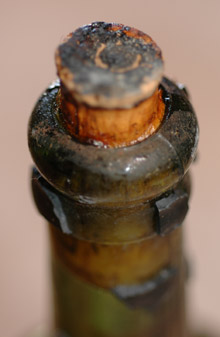
Thomas Hardy's aleAnd when Daria bought it in an eBay auction the chap in the UK stated up front that he hadn’t treated the beer with the care stated on the back label (which sits on the bottle just as crooked as it looks in the photo above). But it didn’t seem right to set it out on shelf — because I want to look at it, that’s why — with the beer still inside. You’ll notice up top that the beer no longer reaches into the neck.

So I stored it on its side at about 55 F and we talked about what to do next. Daria hit on the idea it would be good to open in 2008, since the beer turns 40 and I turn 60. That was before we planned to be in Belgium on my birthday. And hauling a 40-year-old bottle of beer that’s likely going to suck didn’t seem so appealing.

Thus we’re planning on opening it tomorrow along with six other vintages (we’re expecting help drinking these). Just a few questions to answer first. What order should we drink the beers in? One possibility is to start with the 1968 (figuring it’s beyond hope), then drink the youngest and work our way toward the oldest (1992, and the previous one was excellent).

And how the heck do we safely get the cork out of the bottle?
The Session #15: Beer and epiphanies

The SessionWriting about beer certainly changed my relationship with beer, and made what might look like a simple question next to impossible to answer.
I got to thinking about this because for The Session #15 Boak and Bailey asked those of us in the beer blogosphere to answer this question: How did it all start for you? And going further, “We’d like you to write about the moment when you saw the light.”

Looking over the early posts I’ve been startled that people can single out a beer or a where, because there is no single moment or beer I can point to. From the time going on 40 (gulp) years ago I thought “Hey, there’s something different about this Stroh’s from the the basic what’s-in-the-pitcher beer we’ve been drinking in campus bars” my relationship beer has been evolving. Still is. So across a few decades . . .

1980s, Central Illinois. Schlösser Alt. German bars in the Midwest moved enough beer that we told ourselves it was probably fresh. Dortmunder Union sure had more flavor than American lagers, but then we discovered this alt and bitterness.

1993, a lookout tower north of Mancos, Colorado. New Belgium Abbey Grand Cru. We were still Illinois flatlanders, enjoying a view of four states at 10,000 feet. The beer was brewed with yeast acquired from a Chimay bottle, but it was made nearby.

1994, Lyme Regis (south of England). Five days before a pint of Royal Oak (Eldridge Pope) in Sherbourne had been simply spectacular. This totally living Bass buried it. Bass. A lifeless beer not worth drinking in the States.

All of those experiences occurred separately from writing about beer. But we’ve also trooped into hundreds of brewpubs in the last 20 years, I’ve visited monastery breweries, only scratched the surface with American small-batch brewers and then there are hops . . .

Anyway, I also wouldn’t have been at the last 15 Great American Beer Festivals if I didn’t write about beer. So in October I wouldn’t have had either Cable Car or Toronado 20th Anniversary, brewed and blended by Lost Abbey and Russian River respectively to celebrate Toronado’s anniversary. (Yes, an option would have been to go to Toronado’s party.) One-offs that proved for the hundreth (or is that thousandth?) time that a beer can reveal something no other beer has before.

And no, it doesn’t have to be a new-fangled creation — later this year we’ll be sampling beers in the south of Germany and not much later in the north of Italy, which should be a pretty fun compare and contrast. And no, a beer doesn’t have do that to be great. And yes, perhaps I’m a little dense, but that beer can still surprise me is a joy.

For more Session posts, and perhaps even epiphanies, be sure to see Boak and Bailey’s roundup.

‘Extreme beers’ still sell newspapers

And now we step outside the beer blogosphere — where it might seem there is nothing new to say about “extreme beers” — to recognize that to normal people they are still a topic of discussion.

Peter Rowe, whose work in the San Diego Union-Tribune I’ve pointed to many times, used the occasion of the Craft Brewers Conference to revisit the subject: The art of crafts: Extreme or balanced? The great beer debate continues.

Much from the the usual suspects, such as Garrett Oliver of Brooklyn Brewery saying, “If a chef tells you this is the saltiest stew you’ve ever tasted, that’s not what I want to hear. Anybody can put more hops in a brew kettle. That’s not a skill.”

And Greg Koch of Stone Brewing countering: “There may be a brewer somewhere that is just shoving more hops in. But the ones that really shine are the big beers that are artfully made.”

Certainly worth your time.

Rowe also has a six-pack of beer trends.

Dark Lord Day: Passion on display

The Hoosier Beer Geek has pictures. Check out the line. Let’s just say showing up as late at 1:30 was not such a good idea.

Passion on display. Mostly. Unfortunately a little cold-hearted greediness. From a thread at Beer Advocate:

I drove from Minneapolis with a trunk full of Surly to enjoy and trade. Instead, I stood next to frat boys from Chicago who couldn’t stop talking about selling their Dark Lord on Ebay. I waited 5 hours in a line. The Dark Lord sold out 50 people in front of me. My girlfriend was upset because of the cold and I am leaving empty handed

Later in the thread: “It was frat boy hell. There goes the neighborhood…”

Also read the discussion at The Beer Mapping Project.

And at Rate Beer.

Let’s hear it for the Hoegaarden appellation

Hoegaarden breweryInBev has given up moving Hoegaarden out of the city of the same name, the place that it originated.

As of June 1 all the Hoegaarden beer will be brewed there. Much different than in 2006, when InBev announced it would move production to Jupille.

Seems that didn’t work out so well. By 2007 production was a problem. Part of that was because of increased demand, but a union official claimed, “The beer they produce there often has to be thrown out because it is not at all fit for consumption. So a lot of the white beer coming from Jupille is being shipped to the Netherlands to be made into pig feed. It really is a crisis.”

In any event, InBev has revamped the Hoegaarden facility, boosting capacity to 1 million hectoliters. Hoegaarden won gold last week in the World Beer Cup.