Drinking local: Next up, beers from Alaska

Our next local beer will be from Alaska. Good deal.

We’ve been seeing beer from Alaskan Brewing since we hit Idaho, but it wasn’t the local beer then. Instead we bought an Idaho Riesling (instead of Alaskan Amber) in a gas station — an idea that turned out to be about as good as we expected when we did it. We saw lots of Alaskan in Washington . . . but still not the local beer.

Tonight we drank wine, Piety Flats Mercantile Red that we picked up in Yakima Valley. Fruit forward and pretty oaky, so very new American, but enjoyable. The winery is located across the road from an abandoned hop kiln (here’s a picture), and the plan was to call it the Hop Kiln winery until the owners discovered there was already a Sonoma County winery (situated in old hop kilns) using that name. We think the “hop kiln” wine in Yakima is better.

The Slow Travelers currently are bunking just west of Smithers, B.C., with an Internet connection that feels painfully dialup. Where’s Smithers? A long way from home and a long way from the northern “top” of our trip. Tomorrow we head for Prince Rupert, to catch a ferry that heads up the Inside Passage.

The government liquor store in town has plenty of beer, including mainstream, imports and craft (however you want to define the last). Unibroue costs the same as at home ($5.95 for a 750ml), but hardly qualifies as local since it is produced at the other end of the world’s second largest country. Most six-packs are in the $11 to $12 range, including those from B.C. breweries such as Granville Island, Phillips and Tree.

And just in case you were wondering, Stella sells for $22 a 12-pack. Wouldn’t be tempting even if it were local.
Drinking local: Terminal Gravity Brewing

Terminal Gravity Brewing

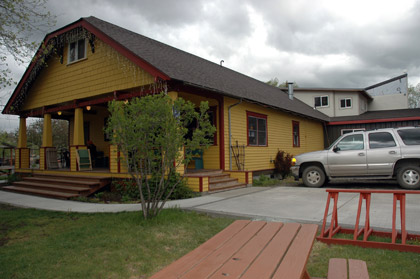
Peek behind the curtain and you’ll see Terminal Gravity Brewing in Northeast Oregon is bursting at its micro-seems, but you aren’t required to look. The pleasure here is, well, right here.

Every seat inside the pub-restaurant was taken within half an hour after it opened Saturday, although that only amounted to about two score customers. When a damp, chilling wind isn’t blowing there’s more outdoor seating at picnic tables or on the front porch than inside.

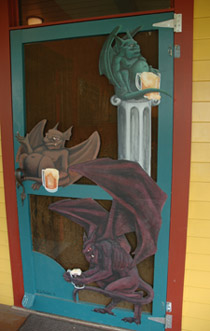
Door at Terminal Gravity BrewingSteve Carper and Dean Duquette built the place themselves – including fabricating the brewing equipment – in 1997. When it opened, they leased space to a baker and built a USDA-approved sausage kitchen. “We’re the brewer, the baker and the sausage maker,” Duquette said at the time.
The house that was the brewing operation is now surrounded in back and off to the side by a growing brewery.

Demand obviously comes from farther than the pleasant village of Enterprise (population 2020) or from tourists traveling to Lake Wallowa and the Hells Canyon recreation area. From the time the Horse Brass Pub in Portland put Terminal Gravity IPA on tap it’s been one of Oregon’s defining IPAs.

But the business of beer wasn’t a thought for three generations of a family occupying what feels like a living room upstairs — they sat in two couches, two easy chairs and the patriarch on the coffee table. They were talking about hiking and other outdoor activities.

We ate beside the foosball game (Sierra reigned there), on a wooden table built for card games. Sierra had macaroni and cheese, Daria ate a salmon sandwich and I enjoyed the pesto pasta. All were excellent. The beers share a certain similarity — like the grapefruity IPA they are generally a bit chewy. That didn’t serve the seasonal tripel as well as it did the breakfast porter (roasted nuts, coffee and cream, wonderful texture).

The beers are good enough to drive all the expansion going on in back, but they aren’t going to taste as good anywhere else as they do here.

Colorado breweries fund organic hops research

New Belgium Brewing has awarded a $20,000 grant to a Colorado State graduate student to further her research on growing organic hops in Colorado.

Odell Brewing — located in Fort Collins like New Belgium and CSU — has been supporting Ali Hamm’s work for several years.

Hamm’s plan is to figure out what kinds of hops grow best under organic conditions in Colorado. “Nobody thinks about growing hops in Colorado – well, not until this year,” Hamm said.

New Belgium currently uses organic hops from New Zealand in its organic Mothership Wit, and obviously would like to be able to use some that aren’t shipped half way around the world.

Larry Bell: Brewer and (now) farmer

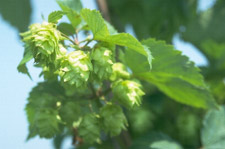
Michigan hopsThose are Michigan hops on the right.

How can I tell? It’s a trick. I shot the picture in 1995 when we were on our way to visit Kalamazoo Brewing, as it was known then, and talk with founder Larry Bell for a story Daria was writing for Brew magazine. We stopped at a roadside farm stand, chatted with the woman selling produce from her farm and she mentioned she was also grew hops for Bell.

Not enough for even a decent size batch of beer, but that wasn’t the point. A few years later Bell bought some six-row barley — you know, the stuff America’s largest breweries use &#151 grown on Michigan’s “Thumb” to brew a batch of Homegrown Ale.

So a recent transaction seems perfectly consistent. “I’m becoming a farmer,” he told the Kalamazoo Gazette after signing a $400,000 sales agreement with a farmer near Mount Pleasant who will grow two-row barley for Bell’s Brewery, as its known these days.

A subsidiary of Bell’s Brewery Inc., called Bell’s Brewery Farms LLC, purchased an 80-acre farm in Shephard. Bell said that land is being prepared to grow soy beans as part of a regular crop rotation. That land should produce barley by next year. Turnwald has already used 40 acres of another nearby property to grow barley for Bell’s.

That barley will most likely be used for a new specialty brew, Bell said.

“Our preliminary plan right now … is to introduce a new brand in November and it’s not for sure at this time, but it would be a Christmas ale made with Michigan barley and, partial, Michigan-grown hops,” said Bell.

Isn’t it winemakers who are supposed to be farmers?

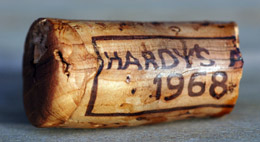
The 1968 Hardy’s – It didn’t suck

Perhaps we should have headed to one of the nearby casinos last night. It takes a certain amount of luck to open seven bottles of Thomas Hardy’s Ale and find them all outstanding. Particularly when the last one is 40 years old.

Thomas Hardy's aleBy the time we got to the 1968 the sun had set on the Sandia Mountains — we drank these beers on our back portal — and the lights had come up in the Rio Grande Valley. We weren’t comparing how each beer looked in the glass or taking notes; instead talking about things friends talk about, although that certainly included the aromas and flavors from the succession of beers.

For the record, they were from 2003 (the first batch brewed at O’Hanlon’s), 1999 (the last batch brewed at Eldridge Pope), 1995, 1994, 1993, 1992 and then the 1968. [See yesterday’s post for details about how we got the 1968.]

Sorry, I don’t have a lot of adjectives for you. Perhaps that’s not in the spirit of blogging, but those are going to stay out there in the cool New Mexico air.

OK, since you guys pitched in with such friendly suggestions about dealing with the cork, just a few details. This was an “A” bottle, with the cork protruding from the top. When I gave it a gentle tug it broke off, leaving nicely solid cork in the neck.

That came out easily and cleanly with a corkscrew, emitting a surprising pop. We briefly discussed the implications — a little something wild going on after 40 years? First impressions included funky, adhesive and sewer water . . . but in a good way.

Within minutes those volatiles had faded. Still a lot going on in the glass, both great and not-so-great.

The best part? It sure as heck was still beer. And it sure as heck had soul.