(No, I haven’t gone bonkers. This was written Monday, so I decided to stick with my usual theme even though I’m not able to post it until today – Thursday. I went ahead and added links to stories to read that I came across today.)
Last week during a delightful dinner in a small bistro along Quai de Valmy in Paris, Sierra posed this question: “Is food better from a small kitchen than a big one?”
She asked because the kitchen at Roele Deux Carottes is quite small, and because she recently watched a few cooking shows on BBC. On those she’s seen several spectacularly presented dishes that generally come from large kitchens with lots of personnel to prepare them. A great conversation followed, but I’ll spare you the transcript. The rather obvious comparisons to brewery size and beer quality never came up, but I already knew I’d be writing about it here.
Instead, because the bistro also offered wi-fi and I was able to download a boatload of blog entries (for those offering text rss feeds, thank you), including one from Andy Crouch headlined “The Myth of Handcrafting . . .” Nice piece that originally appeared in Beer Advocate magazine, so pardon me if it is old to you.
“Handcrafted” does not translate perfectly to kitchen/brewery size, but Andy’s column turned my thinking another direction. Go read it, and if you don’t come back I’ll forgive you. However I do have a couple of niggles with it:
* Many of the cutting edge beers that Beer Advocates covet are handcrafted, that is touched each step of production by a human being we hold accountable (and consumers call by first name – “Ron, Tomme, Adam, Vinnie” and all the other names you know well).
* He also writes, “That a brewer lugging fifty pound bags of grain has been replaced by a computer nerd watching the sparge represented in animation on a glowing screen is a positive thing for everyone involved.”
No, brewers haven’ been replaced by computer nerds — when geeks are in charge of our beer we’re (insert your own expletive verb) — but their job descriptions have changed.
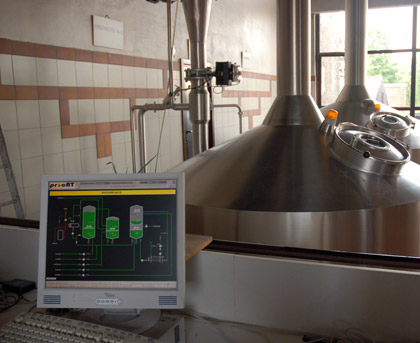
Week before last sales manager Jef Versele showed off the terminals (picture above) that run the brewhouse at Brouwerij Van Steenberge in Ertvelde, Belgium. He made it clear they are a tool, their usefulness is limited by a brewer’s own skills. “The problem is when they push the buttons because the computer tells them to,” he said. “You should know why. When they don’t know it makes me mad.”
He would be happy watching Andy Farrell man the screen at Bell’s Brewery in Michigan. “The three shift managers have more than 30 years brewing experience,” Gary Nicholas, director of quality control, explained in July. “The best use of their time is not being able to read a clock (to open a valve or add another ingredient).”
Farrell illustrated what he does when the system spots a problem. He popped open a screen that showed a list of recent alarms. Some were false; for some the solution was obvious but for others a decision had to made. Farrell took action at the keyboard, but if he had to he could walk over to the brewhouse and fix almost any problem with his hands. Instead he touches the necessary valves using a mouse.
The week before New Glarus Brewing co-founder Dan Carey was even more emphatic. Carey is still a boots-on guy, happiest when he is in his Wisconsin brewhouse, even though he no longer has to clean filters by hand (as he was first time we visited long ago).
“The automation does not mean you push a button and walk away,” he said. “I’d say it takes more talent and skill to operate an automated brewery.”
This is evidence that supports what Couch has written, so don’t think I am beating up on him. I agree we really shouldn’t describe the bulk of the volume of what’s called “craft” beer as handcrafted, nor should we be bothered it is not.
However handcrafted is part of the culture of the breweries where those beers are made. If they lose that then their beer will suffer.
Stuff you should read
– Boak and Bailey provide a first hand reports from London’s upscale Beer Exposed. Bottom line: “Overall, a success, we think. I hope there’s another one next year with the wrinkles ironed out. If there is, we might well get a bunch of our ‘not that fussed about beer’ friends and take them along.”
– Wine writer Steve Heimoff reacts to the notion that beer might be the new wine after seeing the suggestion posed in the Atlanta Constitution. “Beer and wine have always been on opposite sides of the great divide in America’s social wars,” according to Heimoff. You know where I stand: Beer is not the new wine.
– Sorry to make it two wine links, but this one (and the comments) just made me giggle: Is Yellow Tail a “gateway” wine?

 We’ll be in Brussels (still