Monday beer musing: What’s ahead in Italy?

Last night we ate in a restaurant in Florence that, like plenty others in Italy, boasts it serves “products of the region.”

More than half the customers were American tourists — it’s Florence — but if you didn’t listen too carefully the place didn’t feel touristy. There were local meat dishes to choose from as well as pizza (Daria declared her’s the best she’s had on our trip), calzones, all that you would expect.

We drank Chianta. We’re in Tuscany, it was poured from a barrel and it cost €4.80 for a half liter.

But as I paid the bill at the bar I noticed a dang fine beer selection lined up above. Rochefort 8, Orval, Duvel, Achel, St. Bernardus Tripel among others. But no Italian craft beer.

I’ve heard more than one non-Italian brewer compare what’s going on with Italian beer to 20 years ago in the United States. Sometimes that’s not intended as a compliment, but as a reference to a technical brewing gap. Mostly it’s about the excitement generated by brewers and their fans.

It’s grown because Italians haven’t tried to recreate America circa 1988, when U.S. brewers were just beginning to explore basic styles. They are drawing from the world, adding flowers, using chestnuts, tossing in tobacco . . . basically being Italian. They are making some really interesting beers we all want to drink.

However they remain small and, like American craft breweries in 1988, not all that well known in their own country. This might surprise American drinkers, because new Italian beers seem to arrive daily. And their beer sells for more in Italy than, for the sake of comparison, Trappist beers do in Belgium (or Orval does in Italy, for that matter). Additionally, Italy began feeling the economic downturn before many other countries.

To cut to the quick, this is not as simple as “brew great beers and they will come.”

More thoughts on this in a week or so, including why this is important to pay attention to even if you don’t drink in Italy. In the interim, I’ll be in research mode.

History according to Stella. Lager contains “only the four traditional ingredients of beer” — malt, water, hops and maize. Learning stuff like this is why Boak and Bailey’s Beer Blog is essential reading.

Get well, Uncle Jack. Fortunately, Jack Curtin “only” lost an appendix, a lot of time to the hospital and some weight. Send him your best.

Pissing in the steets. There are many good reasons to read Pete Brown’s blog. I recommend subscribing to his rss feed because he might go three weeks between posts. Always worth the wait. I had a damn hard time deciding what to quote from the most recent.

Hands up – every now and then, maybe once every couple of months, I take a leak in some dark street corner on the way home. I’m not proud of it. I’m faintly disgusted by it. But here’s the thing: the British Public Toilets Association (yes, there really is such a thing) reckons 45% of public conveniences have closed in the last couple of decades. They occupy prime real estate – one former public toilet was recently sold for £125,000 as a flat.

And be sure to read the comments.
 

#15 – Where in the beer world?

Where in the beer world?

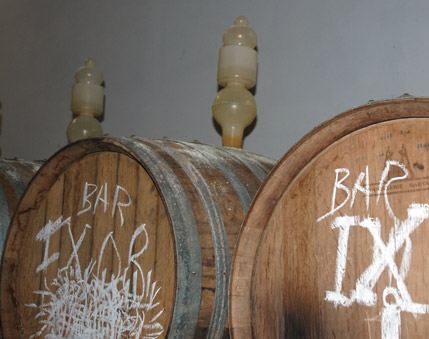
Think you know where in the beer world this photo was taken?

Leave your answer as a comment. Also feel free to add a comment simply because the picture inspires you.

As I’ve written before this is not really a Jeopardy-type contest, where the first to answer wins something. However, after we’re back in the United States then it will be possible to hand out a few prizes to those who’ve joined the discussion here.

The weekly hint: There’s more here than a brewery.

Updated Nov. 4, with the answer

The photo was taken at Birrificio Torrechiara south of Parma, Italy best known in the United States for brewing Panil Barriquee Sour. The brewery is also a winery (thus the hint) and uses two large (40 hectoliters each) barriquees to age the Panil Sour. The tuns are 50 years old, having previously been used by the winery operated by the family for four generations.

More about brewery when I write what is looking like many more posts on Italian beer.

Meanwhile, having badly missed the deadline this week, I will suggest Where in the Beer World? will return next week.


#13 – Where in the beer world?

Where in the beer world?

Geez, could I make it harder? Is it really fair to ask you where in the beer world this photo was taken? I am anyway.

Quite honestly, it won’t be a slam dunk when I post a second picture with the answer.

But stick with me on this. There’s a lesson, or maybe two, to be learned.

Rather than offering a clue this week, I’ll suggest a second question you might find it easier to comment on. What’s going on here?

Posted Oct. 18

Where in the beer world?

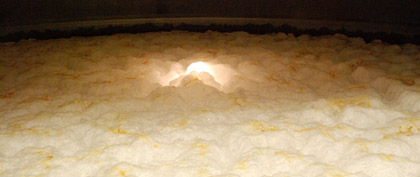
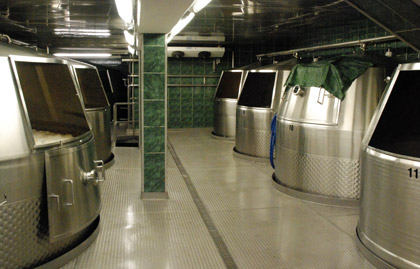
That’s a helles fermentation at the top in one of these ultra-modern looking fermenters at Private Landbrauerei Schönram in the German village of Schönram near the Austrian border.

Yes, Schönram uses open fermentation for all its beers, which account for almost 95 percent of production (46,000 HL). The unique fermenters allow for open fermentation and make it easy to skim the yeast daily (brewmaster Eric Toft believes this makes for smoother beer). What makes them different is that they can be closed and cleaned easily, eliminating the excuse many larger breweries use when they modernize and install closed fermentation vessels.

Ron Pattinson hit on why I posted this photo (see his comment below) — that’s a bottom fermenting yeast at work (and no even at high krausen). As he noted, open fermentation remains common in Bavaria, and not just for weiss beers. Common, but no universal.

There’s a lot more different about Schönram, but that’s a story that’s going elsewhere.

The weekly reminder about this feature.


Zoigl bier in London

Just because you might have missed the announcements . . .

Schafferhof Zoigl,
the variety we liked best (as I wrote at the time, that’s really an aside) last week in Neuhaus, will be among the beers on offer today through Sunday (or when it runs out) in London for an event at Zeitgeist (49-51 Black Prince Road, SE11 6AB).

Details at Stonch’s Beer Blog and Bier Mania. Lots of outstanding beers, including one from a brewery where we slept last week. They also have guest rooms — none of this passing out on top of tanks stuff.


The Session #20: German tradition lives

This is my contribution to The Session #20, Beer and Memories, hosted by the Bathtub Brewery. Head there for a complete recap.

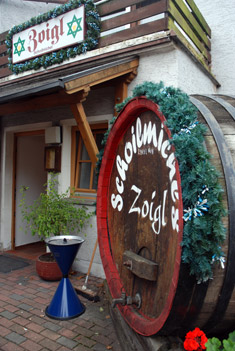
Zoigl brewery, NeuhausSchafferhof-Zoigl.

I drank it twice today, and I may never have it again. But if I do taste it I will be instantly back in Neuhaus, located in a bit of northern Bavaria known as the Oberfplaz. “Nobody in Germany comes here,” a Munich resident told us at the Teicher, run by the Otto Punzmann family, where we had another Zoigl beer. We were drinking, he explained, in an area lost to many Germans, between the north and Bavaria, between Prague and and the more prosperous west.

A good place to be on German Reunification Day, a national holiday and the only day of the year all the Zoigl breweries of Neuhaus (plus a few others – seven different in town, more if you wanted to drive a few miles) pour their beers. What the blank is Zoigl? Not a style, thank goodness. But beer from a community brewery that’s located in Neuhaus a short walk from the house breweries where the beer ferments, is lagered and served.

During the rest of the year each house brewery takes its own turn serving beer one weekend a month, usually Friday through Monday. In 2007 the breweries began what could turn into something wonderful. They all open on a single day.

Apparently the first round was a success, because sometime before 6 o’clock in the morning in New York (noon here) we pulled into the village of Neuhaus and saw cars lined up to the edge of town. The first brewery serving Zoigl was right ahead, the community brewhouse around the corner.

Each house brewery makes a beer to is own recipe. Schafferhof was the first we had, and our favorite, as if that matters. By chance it was our first, by design our last &#151 where we enjoyed it with a feast that cost us €11.60 (including beer) and would have been at least three times that on Munich.

The 20-kilometer drive back to our pension was as spectacular as the trip up from southwest of Regensburg on Thursday. As was the journey to Neuhaus in the morning. I should have stopped when we left Neuhaus, and might have were it not for a Mercedes looming in the rear view mirror, to take a picture. The hills were laid out below us in layers, two different villages with churches at their center surrounded by bright green fields and dark green trees.

Fall has arrived, but gently. Yellow and red leaves blend with a lot of green, and the red flowers in planters on the second and third stories of white washed houses perfectly complement red tile roofs.

That’s what I’ll remember should I come across a beer that reminds me of Schafferhof Zoigl.

But back to that conversation at the Teicher. The Munich resident made it clear why some Germans embrace Zoigl when I asked him why he decided to come to Neuhaus — he and 10 friends made the journey via train. He looked around the room, beer and and conversation brimming everywhere.

“This is tradition,” he said.