It was a winter afternoon in Juneau, Alaska, more temperate than most in the Lower 48 would imagine but cold enough for frozen lakes and plenty of snow. A day of work done, Alaskan Brewing Company co-founder Marcy Larson headed out on cross-country skis with her dog, Jasmine, at her side.
They were headed to the Mendenhall Glacier when they came across Romeo, a black wolf well known to local residents. “People let their dogs play with him,” Larson said. “In my mind that’s a mistake. Then he’s not a wolf anymore.”
Romeo trotted toward Jasmine, signaling he wanted to play, but Larson and her dog moved on. When they reached the cliffs near the base of the glacier Jasmine was the first to spot a mountain goat about 30 feet above them. They paused again.
“We left him behind and went skiing,” Larson said. “But later I thought where else can you ski to the base of a glacier, run into a black wolf and then a mountain goat?”
*******
Life is different in Alaska — you feel the tension between man and wilderness everywhere — and sometimes that means brewing beer a little differently.
“Our goal is to keep growing without having any negative impact by being here,” said Ashley Johnston, who doubles as Alaskan communications manager and sustainability spokeswoman.
That’s put Alaskan on the cutting edge — in 1998 it was the first craft brewery in the country to install a carbon dioxide recovery system, with Sierra Nevada only recently becoming the second — and even in what could be uncomfortable territory.
No, not uncomfortable for Alaskan Brewing. Co-founder Geoff Larson spoke in no uncertain terms last June when the brewery was still in the process of putting a mash filter press online, only the second installed in North America (Molson Coors owns the other). “We’ll extract more from the grains that we want, not what we don’t,” he said.
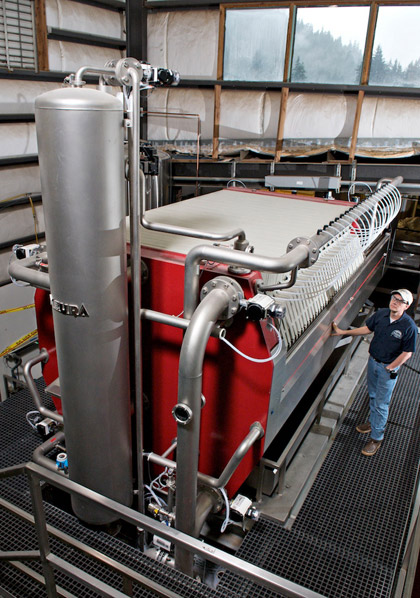
Plant engineer Brandon Smith is pictured with the mash filter press.
But uncomfortable for some other brewers. “In North America, like this is forbidden land,” Alaskan plant manager Curtis Holmes said.
That’s because malted barley grains are milled more finely than in conventional mashing and that more is squeezed out of them. Which is why a mash filter press is more efficient (using about 6 percent less barley malt to make the same amount of beer). The concern I’ve heard when visiting other breweries and talking about the process is that the resulting beers wouldn’t have the same mouthfeel they would otherwise and might even taste astringent.
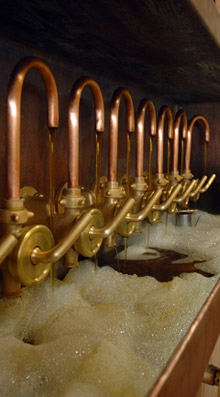 It’s easy to understand the skepticism, because this is a serious break with tradition. I happen to be a sucker for grants myself, like from Orval (right). I appreciate the magical role they play in gentle but efficient lautering (or sparging) — although, just to be clear, few breweries still employ grants as part of the lautering process. I value tradition; it’s in the mission statement and why all the words here about the mash press.
So back to that. What press coverage there’s been about Alaskan installing a mash press focused on news about savings — less water consumed, less grain used, less spent grain to deal with, and less energy used — that are good for the bottom line. Where’s the discussion about what the beer tastes like?
In the lab at Alaskan, as a matter of fact, where a tasting panel of company employees convenes every weekday morning at half past ten. They come from all parts of the brewery, because more than half the people who work at Alaskan are BJCP certified judges.
Panelists first tasted test batches from the mash press back in 2000, which is also when other blind taste testing began. “I think it was 1998 or so when I first heard about mash presses and was curious,” Holmes said. By then there weren’t enough cattle in all of Alaska to dispose of the spent grain Alaskan Brewing was producing. In 1995 the brewery bought a grain dryer – another rarity among craft breweries – so it could dry grain (making it lighter) before it was shipped to Seattle.
In 2000 Meura, which is based in Belgium, sent Alaskan a three-barrel pilot mash filter press to test. “Our biggest issue was flavor. Would it be the same?” Holmes said. “We tested it with our old 10-barrel system, comparing what we got with beers off our 100-barrel system. There were no flavor concerns.”
Alaskan wasn’t ready to make the investment until last year, then spent eight months dialing in the recipes before fully implementing the mash press in February. “We took our time and waited to get it right,” said Dave Wilson, operations manager. The recipe for each brand was tested, then brewed using the lauter tun one week, the mash press filter the next.
The biggest challenge was matching alcohol levels, because the new system is more efficient. “There were no issues with flavor and mouthfeel,” Wilson said. “It was pretty easy to match fully attenuated beers within a month. The maltier beers were a little harder.”
The savings are real: 360,000 pounds of malt a year, one million gallons of water, and 65,000 gallons of diesel fuel. Spent grain now contains less water than in the past, making it easier to dry now and laying the foundation for using a biomass boiler in the future.
That’s good business, but not why the crew at Alaskan initiated this and many other energy saving programs. “In a town where we get 90 inches of rain per year you’re not necessarily thinking about saving water,” Geoff Larson said. “But this is about discharging less waste water down the drain and energy usage.
“In the U.S. we have a wasteful mindset. We’ve had the luxury of living where we do, but that’s changing.”
*******
The Larsons aren’t native Alaskans but clearly they are Alaskans. “There are different elements that affect us, obstacles and challenges we’ll encounter that others don’t,” Marcy Larson said.
She, Geoff and Jasmine are all certified for search and rescue operations. In some of the lower 48 states they’d likely be specialists, called upon for specific emergencies. That’s not the way it works in Alaska. “Our search dogs are trained to do a multiple number of things,” Marcy Larson said. “That’s the way it is in Alaska. There are fewer of us to do more things.”
The day I visited last year I met Jasmine because she had ridden to work with Geoff in his truck. This was not long after an avalanche knocked out hydro power in Juneau, briefly sending electricity prices skyrocketing five-fold. To help companies through the crisis the city sent out energy auditors who then suggested ways to conserve energy. The one who visited Alaskan Brewing told Geoff the brewery was already doing everything he might recommend.
And this was before the mash filter press was operating.
“The uniqueness of our location means we don’t always do things like others,” Geoff Larson said.
 Matt Van Wyk at
 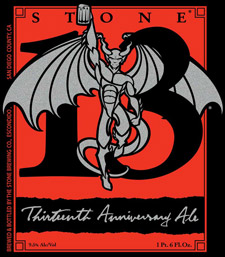 Turn up the volume another notch or two from big-ass and you have Stone 13. That was the impression out of the tank when I tasted it, before it was dry-hopped for the second time. For the record Stone calls this a 90-plus IBU beer, but the first batch in the bottle measured dead-on one hundred. The lads in the brewery added four and a half pounds of hops per barrel, more than any Stone beer ever.
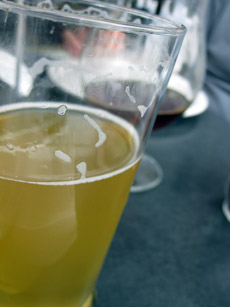 What style beer do you think the one pictured at the right might be?
 This is my contribution to The Session #28, hosted by