Secrets of carbonation and other weekend reading

This week a group of scientists reported they’ve discovered how mice taste carbonation. Feel free to wonder why you should care about a bunch of Champagne-swilling mice. Not light reading but the relationship between carbonation and how we perceive sour tastes certainly pertains to beer.

– Philadelphia beer writer Don Russell visits Baltimore Beer Week and further examines “the sudden emergence of the Beer Week phenomenon.” He’s one of the founders of the first and biggest, Philly Beer Week, but that possible bias doesn’t change perfectly valid positives: Beer Week is a tourist attraction; Beer Week spreads the gospel; Beer Week honors the tavern; and Beer Week promotes civic pride. You need to go look, if only to confirm that Boog Powell is no longer Mr. Miller Lite.

– UK writing heavyweights (but not big-waisted fellows) Roger Protz, Pete Brown, Zak Avery and Jeff Evans describe “the 50 best beers” for The Independent. Only bottled beers, but not limited to Britain (at all). Curious that The Independent files this under “gadgets and tech.”

– Not sure how I missed this before, but from the Rogue Ales Wire Service that Sarah Palin did not seek the Rogue Nation approval in choosing to call her new book “Going Rogue.”

We are proceding on 2 tracks:

1. The matter has been referred to Brian Schweppenheiser, the Attorney General for the Rogue Nation.
2. Led by Captain Sig Hansen of the Deadliest Catch and the Newport fishermen who ply the Alaskan waters, we are investigating where she was born and other issues of character.

– Just in case you hadn’t noticed, Lyle Lovett has a new recording coming out Tuesday and it includes a song by Townes Van Zandt. This follows recent releases by Robert Earl Keen and Guy Clark that have Van Zandt songs (of course earlier this year Steve Earle recorded one with nothing but). Which is an excuse to point you to this story about Kerrville, Texas, even though its in the “homes” section of the New York Times because Keen talks about song writing: “The refrigerator there is full of beer and Big Red. I’ll spend several days writing and eating bologna sandwiches. Every man should have a shed.”
 

Yes, I want to taste this beer

1990 Boulevard Wheat Beer

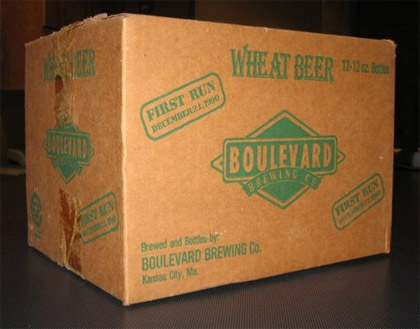
Last week a customer returned a 12-pack of Boulevard Wheat Beer that’s nearly 19 years old to the brewery.

The Pitch, a Kansas City food blog, reported:

“My office is pretty close to Boulevard and they’re a real admirable company. I just thought they might be interested in having it,” says (Eric) Henry, co-owner of the City Cement Concrete Construction Company at 65 Southwest Boulevard in Kansas City, Kansas.

He remembers buying what would have been some of the first Boulevard Wheat sold in the city at a liquor store on the corner of 43rd and State Line. It was just before Christmas — the box is stamped with the words “first run, December 21, 1990.”

He decided to store the 12-pack in his basement, keeping it dry through two moves by storing it between the floor joists above the rock foundation of his basement. As to why he never opened it, Henry can’t say exactly.

Boulevard likely will put the box on display in its tasting room. I wish they’d sneak a couple of bottles into the mix for the daily sensory evaluation of Boulevard beers. Wouldn’t you like to be a fly on the wall for that?

Five years ago I was lucky enough to be at the Duvel/Moortgat brewery in Belgium a few days after a customer had given Michael Moortgat a half crate of 20-year-old Duvel. He opened one of the bottles. The usually pale Duvel poured copper-colored and with little of the normally abundant head. Not surprisingly all of the hop character was gone and you had to hunt to find any of the typical Duvel flavors.

Anyway, there’s more history in the box pictured above than anybody would have expected in 1990. No way Boulevard founder John McDonald could have predicted that his wheat beer would turn into such a powerful flagship. In fact in the mid-90s the brewery almost dropped the beer. At the time it was filtered, but would occasionally appear cloudy because of chill haze (a temporary cloudiness that disappears at it warms) and customers feared there was something wrong with the beer. Here’s a sneak preview from Brewing With Wheat:

Boulevard’s leadership rightfully worried about the brewery’s overall reputation and considered killing the brand. Instead they returned to an earlier plan, to test selling the beer unfiltered, starting in the brewery tasting room bar. Not until Boulevard added a centrifuge was the beer bottled. Sales jumped after the Grand Street Café began serving Unfiltered Wheat with a lemon wedge. Like the Dublin Pub in Portland, the café was a place where other servers hung out and — this is starting to sound awfully familiar — the practice quickly spread across town.

“Soon every bar wanted to get that cloudy beer you serve with a lemon, and the rest is history. The cloudy appearance and uniqueness of the combination made for an easy-drinking beer that was now special, a beer with character,” (John) Bryan said. “The domestic beer drinker was transitioning into craft with this brand, and given the relative lack of Midwestern competition from other craft breweries, we were able to dominate the category and grow very quickly into the brewery we are today.”

Boulevard doesn’t sell nearly as much Unfiltered Wheat as Widmer sells Hefeweizen (popularized at the Dublin Pub about 10 years before UFW took off) and sales of both will likely look tiny compared to the new Bud Light Golden Wheat but it seems likely that when the numbers are in for 2009 that Boulevard will sell more em>Unfiltered Wheat alone (about 65 percent of its sales) than Anchor Brewing makes overall.

Looking at that box I’m pretty sure you’d blame the beer rather than the packaging.


Free beer of the week: BrewDog Atlantic IPA

This post begins, as perhaps all blog posts must from this day on, with disclosure. I did not pay for the bottle of beer that I’m about to write about.

BrewDog in Scotland brewed it. Katrina Taft from the Rose Group arranged for it to be sent to me. A friendly UPS guy delivered it, the truck making its way up a dirt road maintained by the village of Corrales, New Mexico. Our daughter, Sierra, alerted me that UPS had left a box at the door so the beer did not linger in the New Mexico sun.

Thus, to satisfy the FTC, I’m alerting you that if I write anything nice about any of the folks above it could just be the beer talking. Did I mention how clever I think Sierra is?

As you can see I wasn’t the only beer blogger to receive a bottle of this rare and expensive beer (960 330ml bottles for all of the United States, suggested retail price of $25.95). It’s not like I’m special, it’s not like BrewDog needs the publicity, given the attention heaped on Tokyo* and Nanny State, it’s not like I don’t already know I like BrewDog’s beers . . . and it’s not like I wouldn’t have posted this video, which tells the story of the beer better than any words, and mentioned an obvious link to Pete Brown’s Hops & Glory.

Taft really didn’t have to volunteer to send me the beer. But she did, I said yes and so a few words about the beer and then the $26 question.

Atlantic IPA is, or maybe I should type was, an exceptional beer. I’m geeky enough I wish they’d done a “control” batch, that is bottling an equal number of beers that didn’t get on the boat. Then it would be easier to suggest what character the time at sea added.

It’s malt-rich and spicy hoppy, with wonderful depth — a little like Firestone Walker’s Double Barrel, but more intense — and layered flavors. Seems salty/briny, but perhaps that is the power of suggestion. A sipping beer, one bottle easily enough for two. A contemplative beer, so there’s time to think about . . .

Is it worth $26 for a little over 11 ounces?

I couldn’t make the decision on a relative basis. I wouldn’t trade Hops & Glory (about the same price if you have to get it shipped from Canada) for it. A bottle isn’t 24 times “better” than one of Stone IPA, relevant because I can buy a case of Stone at Costco for a little more than $27 or so.

Yada yada yada . . . let’s cut to the chase. I’d have to feel richer than I do most days to spend $26 for a bottle, but $7 for 3 ounces, I could do that.


‘Signature’ beers versus signature character

Signature beersOne more thought roused by Mark Dredge’s “New Wave” post. If you lined up a bunch of beers, some of which you might never have tasted, and drank them “blind” could you pick out the brewery they were from?

I ask this because Dredge wrote, “each with their own authoritative stamp which makes the drinker know that they’ve just enjoyed a beer by that particular brewery.”

I’m not simply talking about if you recognize a particular beer, so it’s a little tricky. You have to be pretty familiar with a brewery’s work to play this game so naturally you’ll know some beers. Let’s say Racer 5 and Hop Rod Rye from Bear Republic. But when you try two other beers from the brewery do you think you’d say, “Ah, Bear Republic?”

Another example would be Lagunitas Brewing, known for its “C” beers (crystal malts and hops that begin with the letter “c”). Or Jolly Pumpkin Artisan Ales, America’s leading example of why somebody should invent a good name for what might otherwise be called beer terroir.

This is different than the notion of a signature beer. For instance, you can easily pick out New Glarus Wisconsin Belgian Red in a crowd. I’d call that a signature beer. It helped make New Glarus Brewing famous, but Spotted Cow accounts for half of sales and the new and wonderful Crack’d Wheat tastes totally different from those two.

So does New Glarus have an authoritative stamp? Bear Republic, Lost Abbey, Russian River, Rogue*, Goose Island, [fill in the name of the brewery of your choice]? Or what about the star of Dredge’s post, Dogfish Head?

* Added just for Jeff Alworth. Oh, and here’s one more, Pelican Pub & Brewery.