Innovation, corporate style

Four Innovation Lessons from Anheuser-Busch.
(Thanks to Lager Heads for the, well, heads up).

It’s popular to write that [fill in the name of a large brewing company] could replicate any beer in the world if it really wanted to. But could it? Would its corporate culture let it?

Think of any innovative beer you cherish popular beer of the moment (amended 2.13.2010 to make the conversation about beer rather than marketing terms) — last weekend it might have been Pliny The Younger, this weekend Red Poppy 2010. Think these beers are a result of a “team” getting together, a bunch of test batches, focus groups, middle managers and upper managers signing off on everything?

Or one person, could be a single crazy and could be a few like-minded we-work-together collaborators, saying screwitthiswillbegreat?


Mr. Rock prefers that beer be the star

Jean-Marie Rock began brewing beer professionally in 1972. For the last 25 years he’s been in charge of the Orval Trappist monastery brewery. He understands brewing cred. Celebrity? Another matter.

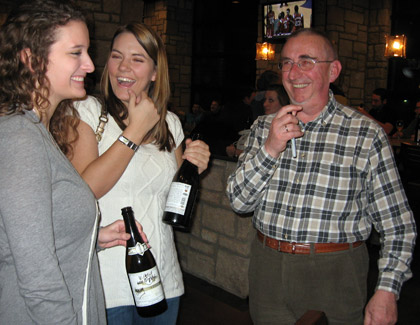
He’s been to Kansas City twice recently. Posing for pictures, signing empty beer bottles, he found out quickly he wasn’t in Belgium any more.

“The biggest change is the contact brewers have here with the customers,” said Steven Pauwels, a native of Belgium who became brewmaster at Boulevard Brewing in 1999. When Rock agreed to collaborate with Pauwels to brew a beer he probably didn’t realize that 160 people would show up at a Lawrence, Kansas, hotel to celebrate the release of Smokestack Collaboration No. 1.

“The American people are so kind,” Rock said. “You cannot refuse to answer their questions.”

Rock, who is 61, oversees the production of a single beer, Orval. (The brewery also makes Petit for the monks at the monastery to drink and to sell at the brewery’s inn — that is simply a watered down version of the mother beer.) The ongoing production of special, or seasonal, beers is something that makes New American beers (I’m using that term instead of “craft” to see if it sticks) different. Likewise the notion brewers might be celebrities.

Rock, who visited Kansas City first to brew the beer and then again two weeks ago for the debut, left no doubt he found brewing something different just plain fun. When Pauwels suggested the possibility of the collaboration last year Rock knew immediately that he wanted to brew a strong pilsner using a hopping technique from 30 years ago.

Rock first worked for the Palm Breweries, then for Lamot in Mechelen, brewing lagers. At 8 percent alcohol by volume Collaboration No. 1 is about one percent stronger than the beer Rock was thinking of. Although it is labeled an “Imperial Pilsner” is does not resemble beers such as Samuel Adams Imperial Pilsner.

Hopped with excessive quantities of German Hallertau Mittlefrüher (as it is spelled where it is grown) Boston Beer brewed an 8.8 percent abv beer that had 110 International Bitterness Units (IBU).

Collaboration No. 1 is hopped entirely with Czech Saaz and brimming with hop flavor, although with 30 bitterness units it appears almost pedestrian compared to 110 IBU.

Where does the flavor and aroma come from? First wort hopping, a practice no longer used in Belgium. “No, no, no, no, no, no,” Rock said. “It doesn’t exist any more.”

A quick primer for those who aren’t homebrewers, commercial brewers or among those who spend too much time with either. Brewers boil hops a an hour or more to extract bitterness. In the process flavor and aroma are lost. That’s why brewers make flavor and aroma additions later in the boil.

In this beer two-thirds of the hops were added before the beginning of the boil (or “first wort”), but their flavor ended up in the beer. German also brewers used the method at the beginning of the last century (you can read much more here, including results of tests conducted in 1995.)

“It seems like a contradiction. You’d think you’d get more bitterness and less flavor,” Pauwels said. “It’s more subtle, almost crisper. Sometimes with late hopping it can get vegetative.”

These days many American brewers are experimenting with first wort, and even mash, hopping (recall at the steps Deschutes took in making Hop Henge). Additionally dry hopping (adding hops after fermentation is complete, sometimes shortly before packaging) to produce even more aroma is commonplace.

“You can try all the things you want,” Rock said. “A lot of brewers they are doing all they can dream. The dream is not always the reality.”

Rock is happy with Collaboration No. 1 (“Not just because it is our beer”). “It has a taste you don’t get when you use late hopping,” he said. “You get an old taste. That is my opinion.”

You know, old like the good old days. When a brewer could go to the store to buy a loaf of bread and didn’t have to stop to sign autographs.

(Photo courtesy of Boulevard Brewing.)


Pabst tall boy

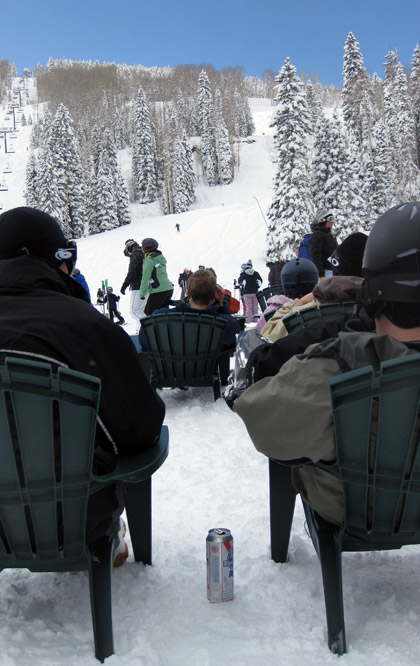
Taken 01.23.10 at Durango Mountain Resort, still known to many of us as Purgatory Ski Area. These guys could have done better (the one on the left had his can of Pabst to the left of his chair). Several Durango beers on tap, including SKA’s Euphoria, an aromatic bomb.

Euphoria’s also available in cans, 12-ouncers. Durango had 36 inches in snow in the four days before we arrived. Euphoria, indeed.


More lists, new (whatever that means) and old

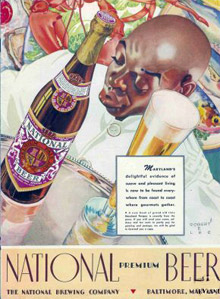
National Premium beerDon Russell and Jack Curtin (twice, in fact) point out a few of the problems with “The Best 25 New Beers in America” from Maxim magazine (in pdf format).

Like that some of the beers aren’t exactly new. In fact, isn’t Pyramid Haywire Hefeweizen 25 years old (new name aside)?

Jack, in a wonderful turn of the pen, calls it Truly Dumb Shit. But Don finds a reason to like it because the article labels Philadelphia its favorite beer burg. Did I mention he lives in Philadelphia? That’s the charm of lists, ending up on them. They not only provide fodder for conversation — 25 best new beers and none of them wild or barrel-aged? — but what brewery doesn’t want its beer mentioned in Maxim?

Also it never hurts to consider the view from outside the world of the beer obsessed looking in. Call it serendipity, but while moving files about my office the last couple of days (using the word “organizing” would be an overstatement) I happened across an article from 1975 called “The Great Gulp: A Consumer’s Guide to Beer” that appeared in Oui magazine.

Rock critic Robert Christgau kindly archived it at his website. Dinosaur that I am I printed it out, which meant I had to find a place to file it — some day I’ll get this digital thing down. The real serendipity is how I stumbled across the piece to begin with. Christgau labeled James McMurtry’s “We Can’t Make It Here” the best song of the aughts (I’m good with that, and you can make up your own mind by listening here), leading me to Christgau’s site, leading me to the beer story.

Christgau and Carola Dibbell, with the help of a tasting panel, provide grades for 46 American beers and 11 imports. They didn’t taste everything available in the United States at the time but made a heck of an effort, which itself makes a statement about America’s beer monoculture in 1975.

To assess the ratings presented below, we not only sampled beers blindfolded but tried to live with them as well. This technique had its debilitating consequences, but after months of unpremeditated naps, we had learned to distinguish some of our beers all of the time, and all of them some of the time. However, because beer is fragile, we may not have sampled all of them in optimal condition, and some beers, particularly the smaller and more westerly ones, were unobtainable.

Although I recommend spending time with all 4,600 words a few highlights for those reading this at work:

  • “One of our conclusions was that if you’re thirsty, there’s no such thing as an undrinkable beer – therefore our ratings, which ordinarily descend to E-minus, stopped at D-plus. Many of the best beers in the country are virtually unknown, but the size of the company is no clear indication of mediocrity.”
  • About Anchor Steam: “The beer also contains four times the usual amount of hops, the flower that gives beer its bitterness. ‘Steam’ just means carbonation. Our bohemian friends found it winy, but we found it one more instance of San Francisco’s chronic confusion of eccentricity with quality. B.”
  • About Shopwell Premium (purchased in New Jersey): “As with all house brands, the first virtue of supermarket beer is bulk-order economy. But whereas Ann Page jams and Jerseymaid yogurt also taste good, all the supermarket beers we’ve sampled are best consumed quickly, very cold and under pressure of great thirst. This one was made in a brewery in New Jersey that Shopwell refused to name and told us was in Pennsylvania, doubtless for fear of reprisals. From the taste, we figure it’s economical because it uses a lot of water and we daren’t imagine what kind of grain. It’s called ‘Premium’ because words are cheap. D Plus.”
  • About Ballantine Ale (not graded): “. . . is metropolitan New York’s only surviving contribution to the brew-master’s craft, and the Indian Pale (‘aged in wood’) is so bitter it starts conversations at parties.”
  • About Dixie: “Traditionally the white beer in New Orleans (Jax and Falstaff shared the black market), Dixie emerged from the civil rights years with a nearly four-fold increase in sales, while Falstaff’s sales went down dramatically after a liberal ad campaign up North. B Plus.”
  • As you can see, not necessarily long on beer expertise but maybe Maxim should hire Christgau for an updated story on what’s new since 1975.