Perspective

If you followed Ray Daniels’ tweets earlier today you know that a presentation by Symphony IRI to members of the Brewers Association confirmed that “craft beer” sales are kicking butt, that mainstream beer sales are in the dumps and that IPAs seem destined to rule the world.

You also know that Blue Moon Belgian White Ale from MillerCoors and AB InBev’s Shock Top Belgian White grew 27 percent and 34 percent respectively (Shock Top off a much smaller base). But because the numbers fly by rather fast during a 55-slide, one-hour presentation some things take a while to sink in. Like that Stella Artois outsells Sierra Nevada Pale Ale, but not Blue Moon Belgian White.

Since I seem to be in numbers mode these days I assembled a chart that mashes up the top 15 selling craft (IRI does not include Blue Moon in that group, but does include beers from the Craft Brewers Alliance although those aren’t craft beers according to the BA definition), super premium and imported beers. These are all beers consumers pay more for.

The IRI figures are based on scans at grocery stores, drug stores, convenience stores, some liquor stores and a few other locations. Signature IRI does not capture every sale, or include draft sales, but more than enough to paint an accurate picture. They are for the first six months of 2010, and — just for fun — compared to the first six months of 2006. Sales are in millions of dollars.

   2010    2006
Corona Extra    $207.0 $224.5
Heineken    $129.7 $132.4
Michelob Ultra    $106.8 $106.7
Corona Light    $64.5 $60.1
Bud Light Lime    $61.3 ***
Tecate    $44.5 $36.9
Blue Moon White    $40.2 $14.1
Modelo Especial    $32.3 $23.4
Stella Artois    $31.2 ***
Sierra Nevada Pale Ale    $27.8 $24.8
Heineken Light    $27.7 $18.8
Newcastle Brown    $26.9 $21.1
Samuel Adams Boston Lager    $26.3 $21.8
Samuel Adams Seasonals    $25.7 $10.8
Guinness Draught    $23.9 $24.2

*** Bud Light Lime did not exist in 2006. Stella Artois was not among the top 15 selling imports (No. 15 on the list sold $12 million).

A couple of other notes: New Belgium Fat Tire sales are up more than 14 percent to $18.2 million (compared to $11.4 million for the first six months of 2006. Michelob Amber Bock outsold Blue Moon White in 2006 ($15 million to $14.1), and now it outsells Shock Top ($9.9 million to $8.5 million).
What the heck is a Nano Brewery?

I was tempted to type the headline, add (eom) and see what happened . . .

I understand the concept of nano brewery (or nanobrewery). But if we are going to have a rule about when a brewery is too big to be called micro shouldn’t there be one for nano?

I ask because the Green Dragon in Portland, Ore., is sponsoring its second Nano Beer Festival next week — “25+ nano breweries and food from Portland’s food cart scene.” Referred to as Nano Food Carts (a nice touch) on this poster.

If you give the poster a good look you’ll notice Upright among the breweries. We visited Upright last year and there’s a 10-barrel brewhouse at the heart of that system. The guys at Berkshire Brewing in Massachusetts cranked out 6,000 barrels one year on their seven-barrel system. Granted, they had to be crazy, and microbrewery has been defined on the basis of production rather than size of each batch, but nano generally refers to something very, or even extremely, small.

A nanosecond is a billionth of a second. Feel free to check my math (because it is probably wrong), but the amounts get too small if we try this with billionths. Start with a 700-barrel brewhouse — mega breweries make even bigger batches but consider of the Anheuser-Busch plant outside of Fort Collins, Colo., which is gigantic. Divide 700 by 1,000,000, then multiply by 31 (that’s how many gallons are in a barrel). Multiply that by 128 (ounces in gallon) and we’re at a batch size of less than 3 ounces. That’s a millionth of 700 barrels. Divide that by 1,000 for a billionth.

Screw it. Let’s just call them breweries. Much more concise.

Big breweries, small batches – been there, done that?

So MillerCoors has launched a separate company to manage its portfolio of (existential warning) craft beers and imports, calling it “Tenth and Blake Beer Company.”

Is this different than what America’s megabreweries breweries tried in the mid 1990s? On the surface, but maybe not that different. Will Tenth & Blake prove more successful? We’d be guessing, wouldn’t we? Before you do, consider a bit of history.

1995. “We are behind the curve, no question about it. We need to learn about specialty beer,” Scott Barnum, then general manager of Miller American Specialty Craft Beer Co., told All About Beer magazine. That’s the year that Miller bought a stake in the Celis Brewery and Shipyard Brewing. Leinenkugel and Miller Reserve were the other key brands in the ASCBC portfolio. “We have people in here helping us train our palates and our noses, working with our sensory development. We listen to guys tell us how they built their microbrewing businesses, about investment, capital. We talk to entrepreneurs. We are immersing ourselves in this world.”

Anheuser-Busch formed what it called the Specialty Group of Anheuser-Busch. “We are trying to think differently,” said Jeff Jones, who was senior product manager for the group. “That’s the whole thought process of the specialty beer business. I do have a passion for beer. We have to think differently from a large brewer, and that was the purpose for separating out our group.”

Coors established its own specialty group, Unibev, much earlier than the others, and in 1995 its star was Killian’s. The year before bock, Oktoberfest and wheat beers all flunked various trials. However, Unibev managing director Tex McCarthy said that a new brand, Blue Moon, wouldn’t carry the Coors name. “We want them to be disassociated from the Coors family. . . . If people see a major brewer’s name on a micro it loses some of the cachet that makes the beer interesting to begin with.”

You know the rest. It didn’t happen over night and it didn’t happen because Coors threw a bunch of advertising money behind the brand but Blue Moon Belgian White became the best selling wheat beer in America ever.

1997. Miller remained focused on working with regional partners rather than brewing specialty beers (the Reserve line had been axed by then). “We’ve said before that this is a regional business,” Barnum said. “More and more, you will see people contracting, narrowing their focus.”

That didn’t exactly work out. Miller ended up buying out Pierre Celis and his family and by 2000 had closed the Celis Brewery. Miller sold its stake in Shipyard back to Alan Pugsley and Fred Forsley and that company has thrived.

Forsley explained what happened a few years after he and Pugsley regained full control of their brewery: “I think initially the plan was well conceived, where Miller was focusing on portfolio selling. The whole Miller network was designed so their sales force could come in and sell their whole portfolio of beer. American Specialty Craft Beer had a relationship on the sales side with Molson, the imports, Asahi, and so on. That way a salesman was responsible not only for Shipyard but Molson. They had a variety of resources to pull from. When it changed from being a portfolio sale to a priority sale, as acknowledged by everybody in the organization, the goal became to make Miller’s main brands their focus. That really caused major problems for us. Up until then the sales efforts were working very well.”

A press release from MillerCoors indicates Tenth & Blake “will own the strategic business drivers — marketing, trade marketing and an independent sales organization dedicated to the craft and imports business.” That’s the something different. But it’s not all it takes.

“We didn’t really fit into the Coors distribution system until about five years ago,” Keith Villa, who wrote the recipe for Blue Moon White, said last year when I visited Coors while doing the research for Brewing with Wheat. A sales force is not what made that beer. Many readers here feel obliged to beat up on Blue Moon White, and yes it has became hip, a badge even. But Villa put a beer in the glass that drinkers who are willing to pay more want to drink.

Fifteen years, and more, after the people working at the nation’s largest breweries said they were ready to think like smaller breweries how many successes similar to Blue Moon can you point to? Maybe it’s not a matter of training. Maybe it’s company DNA.

Excellent beer related idea of the week

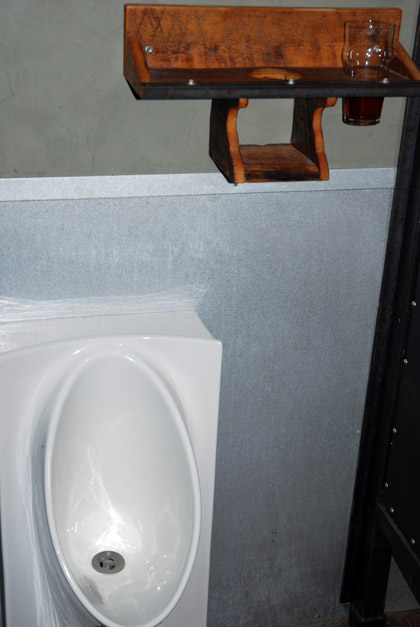
The bathrooms at Sam’s Tap Room and Kitchen, which is the tap room for Red Lodge Ales Brewing Co. in the Montana town of Red Lodge, has glass holders like this one in both the men’s and women’s bathrooms.

The holders — set beside the toilets, the urinals and the sink — hold both large and small glasses. I don’t usually carry my glass with me into the bathroom, but it appears some people do.

Red Lodge Ales has the largest solar thermal array in the state of Montana up on the roof. That warms water to heat the brewery in winter (radiant floors) provides warm process water in the summer. The beer garden faces the mountains and hops plants decorate the garden walls (in season).

Did I mention the sampler trays are cool? They are. None of these delightful amenities would matter, of course, if the beer weren’t pretty damn good. It is.

NOLA Brewing: Tales of the un-cocktail

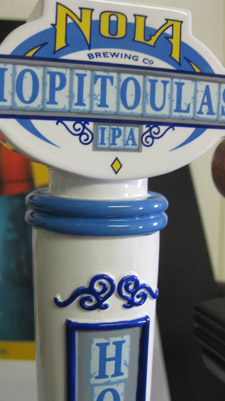
NOLA Brewing Hopitulous IPAThis week New Orleans hosts Tales of the Cocktail.

We went last week.

Not because we have anything against cocktails, but because that’s when the birthdays fall. In fact, we drank hurricanes at Pat O’Brien’s and cocktails at the Carousel Bar in the Hotel Monteleone. We also had pretty good wine with dinner at Irene’s Cuisine.

But mostly we drank beer. Finding flavorful beer in New Orleans has been relatively easily for a long time. Thank the students at Tulane for supporting places like Cooter Brown’s and The Bulldog. However the city was, and is, the poster child for BMC (Bud Miller Coors) markets. “When we opened a year and a half ago (they) accounted for 95 percent of beer sales,” said NOLA Brewing founder Kirk Coco. “I don’t mean all light lagers. Just beers from Bud, Miller and Coors.”

NOLA (New Orleans Lager and Ale) hasn’t even begun to approach the status of Abita, but the fact that Crescent Pie & Sausage, located in Mid-City and one of the city’s hip new dining spots, offers three NOLA beers on tap signals that change is at hand.

We built our itinerary around eating, and there was much to be said to finding Abita or NOLA beers available at almost every turn. Beer and food should go together in New Orleans, Coco said. “We have the right attitude. We’re not afraid of calories.”

He pointed out New Orleans’ shortage of diet po-boy shops and promised, “You’ll never see a NOLA Light, not as long as I’m alive.”

These are not necessarily “Big Ass Beers” (as seen on signs throughout the French Quarter). NOLA Blonde, 4.9% abv, outsells all the others three-to-one. Coco’s favorite is NOLA Brown, at 3.9% abv tame but rich. A beer some would surely describe as quaffable.

Hopitulous IPA — the brewery is located on historically important Tchoupitoulas Street; Tipitina’s is at the corner of Tchoupitoulas and Napoleon and if I need to explain Tip’s please just Google Professor Longhair — was supposed to be a seasonal, but proved too popular not to keep brewing. It’s more about hop flavor than bitterness (60 IBU, calculated). Brewmaster Peter Caddoo, a veteran of Dixie Brewing, adds Nugget hops while running wort into the kettle. He uses Warrior for bittering, Columbus and Cascade for flavor, Simcoe late in the kettle, then more Simcoe in the whirlpool. He dry hops it with Simcoe and Amarillo.

It’s a fine food beer. I might just mail in “eating the Mixed Grill (a plate of house-made sausages) at Crescent Pie and Sausage served Hopitulous” as my entry for The Session #42. Each made the other better.

*****

Two other bits I should probably save for future stories, but can’t resist passing on:

– When did Peter Caddoo begin homebrewing? “The day John Lennon died.” That was Dec. 8, 1980 and he was a student the the Culinary Institute of American in Hyde Park, N.Y. He and the other students made “Lennon Lager” and drank it on New Year’s Eve.

– Although Cooter Brown’s, The Bulldog and d.b.a. (in the Marigny/Bywater neighborhood) remain fine places to drink and have been joined by Bulldog Mid-City, The Avenue Pub on St. Charles has vaulted to the top of the class.

This joint has been around forever (maybe the nineteenth century). Story is that more recently celebrity chef Emeril Lagasse played pool in the back room after he go off work. When we first visited several years ago the beer was OK, and sitting beside one of the windows looking onto St. Charles was pretty terrific. However, a few years ago (not long before Katrina and on a Jazz & Heritage Festival weekend) somebody suggested it hard turned into a dive.

Not today. After her father died Polly Watts turned it into as good a beer place as any of us should need. For instance, Garrett Oliver of Brooklyn Brewery is in town this week for Tales of the Cocktail so the pub is featuring special Brooklyn beers all week. Oliver will make an appearance Friday.

Perhaps he heard that Craig and Kim Giesecke of J’Anita’s took over the kitchen after their place on Magazine closed. They’re not afraid of calories.