Friday beer: For want of a ‘narfer narf’

The SessionI have at this moment a deep and abiding thirst for something called a narfer narfer narf.

You see, the topic for today’s 88th gathering of The Session is traditional beer mixes. In making the announcement, hosts Boak & Bailey list several options from Richard Boston’s “Beer and Skittles.” The choices appear in a chapter titled “The Public House” and although the book predates Sierra Nevada Brewing by only a few years (1976 versus 1980) it describes a world that seems more like a setting for an HBO series than one you find in these parts.

Consider a few words from the chapter:

1 The quest

All the pub’s a stage, and all the men and women merely players. Everything about a pub is theatrical: the exits and the entrances, the dialogue, the eating and drinking, the games. … Opening time and closing time even give each session the dramatic structure of beginning, middle and end postulated by Aristotle as necessary to a well-made play.

2 The people

… then there’s the Why-my-wife-left me bore, the Send-them-back-to-Ireland/West Indies bore, the useless information bore. The drinks bore is one of the worst …

Boston discusses choices of drinks within this context. Although it might appear on the surface I could settle in at the bar at a nearby establishment with a considerable number of beer options my chances of ending up with anything similar to a granny (mixing old and mild) or blacksmith (stout and barley wine) Boston might recognize pretty much don’t exist. Even though finding stouts and barley wines is easy. Beer at AnyplaceinAmerica in 2014 has about as much to do with beer in Boston’s England in 1976 as beer and ale had to do with each other in England in 1542.

And a narfer narf, half a pint of mild and half a pint of bitter? Get serious. (A narfer narfer narf is half a pint of the mixture.)

Recognizing this reality, that I would not be writing about actually drinking narfer narfer narf, Tuesday night at Busch Stadium I decided to try a ballpark blend. Before emptying my plastic cup of Urban Chestnut Schnickelfritz, which remains about the perfect 90 degree/90% humidity ballpark beer, I mixed the remainder with an equal part of Schlafly Pale Ale. I did not wake up Tuesday morning wondering what flavors I’d find if I cut Schnickelfritz with Pale Ale. I chose these two because they are the ones I drink most often at the ballpark. They are local and they are refreshing. I like that combination. I suppose there was a little more, or at least different, fruity character in the blend. More hops, for sure, than Schnickelfritz alone, earthier. But mostly refreshing, and better so because they were brewed locally by other people who live in St. Louis.

(Understand that I grew up in central Illinois, not St. Louis, rooting for the Chicago Cubs, and therefore against the Cardinals. They now serve Goose Island Honker’s Ale and IPA at Busch, beers I really like that originated in Chicago although they are now brewed elsewhere. But at a baseball game in St. Louis I’m drinking a St. Louis-made beer. Once in a while Boulevard Wheat, which is also brewed by people who pay the same state taxes I do, but not Tuesday, even though the Cardinals were playing the Royals. I am not arguing this allegiance to local is rational, but it is real.)

Finally, an aside. I could have done my blending at the Budweiser Brew House at recently opened Ballpark Village. You can actually watch a game from a deck in the Brewhouse (sort of like the Wrigley Field rooftops). They’ve got maybe all of the A-B Inbev beers sold in the U.S. on tap somewhere within the complex. By chance, taps for Goose Island Matilda and Faust, an A-B throwback beer, are side by side. That was probably a missed blending opportunity, you think?
Friday beer: Cerveja Extra Tipo Pale Ale

Papa couldn’t tell us and it didn’t make no sense
When the teacher told us we couldn’t talk no French no more.
Do you hear me calling, do you understand?
Once it is gone, it ain’t never coming back no more.
Hé, mon cher garçon,
Est-ce que tu me comprends?

    – Zachardy Richard, “No French, No More”

Interesting things can happen in the space where cultures overlap.

You can listen to Zachary Richard sing “No French, No More” here (in French). It is hard to imagine that visiting the south of Louisiana (“Cajun country”) would be as sublime had the French Acadian language been wiped out, because — of course — that initiative was part of an effort to flatten the culture.

Last weekend in Florianopolis, Brazil, Leandro Emmel told a story about when his grandfather was sent to prison 70 years ago for speaking German. Emmel’s company sells ingredients and equipment to homebrewers and small breweries in Brazil. His grandfather grew up in Pomerode, a town of about 27,000 just outside of Blumenau. Blumenau, population 300,000, is famous for hosting the second largest Oktoberfest in the world, second to Munich. (I’d like to see proof it is bigger than Stuttgart’s Oktoberfest, but that will have to wait. Maybe it was the beer there, but we ended up getting drunk before we were even able to find parking at Stuttgart airport, when we landed there the first time.) German immigrants settled Blumenau in 1850, and Pomerode a few years later. Like Florianopolis, they are located in the state of Santa Catarina, the most affluent in Brazil.

Blumenau flaunts its German heritage, but rightly Pomerode lays claim to being the most German town in Brazil, and hence outside of Germany itself. The schools are bilingual and about 80 percent of residents still speak German. In fact, day-to-day life often takes place in German.

Restaurante Wunderwald

I visited Pomerode last Sunday along with eight Brazilian homebrewers, John Palmer, and Brad Smith. John, Brad and I gave technical presentatiions at Congresso Técnico para Cervejeiros Caseiros in Florianopolis. (Disclosure: the homebrewers paid our way.) On Sunday we headed north, eating lunch at Restaurante Wunderwald, then touring two breweries. The plan was to include a stop at Blumenau’s Oktoberfest grounds, but it got dark first.

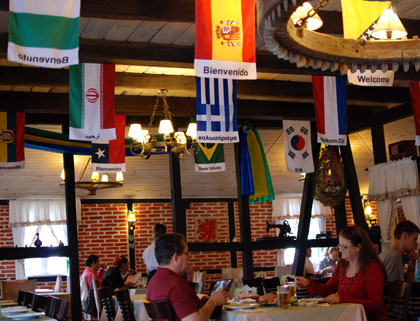
The restaurant was buzzing — sure enough, the hosts at the door greeted some customers in Portuguese and others in German — and platters of meat looked and tasted of the Black Forest. I had a bottle of Bierbaum Lager, a helles brewed nearby but also tasting of Bavaria. German brewing tradition is prominent in the southeast of Brazil, which is also where most of the new small breweries (they use the word “craft”) have opened, perhaps 150 in all of Brazil, 40 in the Sao Paulo area alone. American hops are as well.

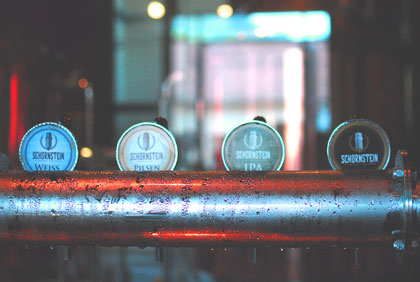
At Cervejaria Schornstein in Pomerode I drank Schornstein Weiss, properly cloudy and banana sweet, but most of the homebrewers went with the IPA. (I had that the night before at Liffey Brewpub, which makes its own beer and also serves a nice selection of Brazilian and imported beers). Schornstein operates both the brewpub and a larger packaging brewery north of Sao Paulo.

Cervejaria Schornstein

The streets of Pomerode are cobblestone and many of the houses look like they’ve been imported from Tettnang. In fact, the region has a bit of the Mediterranean feel of Tettnang, although the flora is more subtropical. There are goats and cows grazing beside the brewery.

By the 1930s, Brazil had the largest German population outside of Germany, but the country took the allied side during World II (after Nazi Germany attacked Brazilian ships). The government banned any obvious expression of German culture, including speaking German. That’s when, and why, Emmel’s grandfather was sent to prison. It’s understandable, and not as embarrassing as, say, the Japanese internment camps in California. German culture is apparently a little less prominent each year, but it is more than just a tourist attraction. Almost half of the population of Santa Catarina is of German or Austrian descent, compared to 15 percent or less in the other states.

Brazil is the world’s third largest beer market, dominated by Brahma and a bunch of other pale lagers you couldn’t sort out in a blind tasting. A bottle of one of those costs what amounts to about a dollar. A bottle of Brooklyn Lager (Liffey had a Sorachi Ace tap handle, although it wasn’t pouring Sorachi Ace) is more like $4. In the Sao Paulo airport, hardly a place to price beer, a 355ml of Bohemia was $5.86, one 500ml of Erdinger Weiss $12.17, a 440ml of Guinness $12.62, a 355ml of Heineken $5.86, and 275ml of Stella Artois $5.86.

Perhaps somebody smarter than I can predict where the “not pale lager” market is going. As mentioned earlier in the week, Beeronomics wrote IPA “it is almost completely nonexistent in Brazil for example.” My sources (homebrewers) agree that’s pretty much true. But they are making hop-forward beers themselves and they know the commercial breweries that are as well. The homebrewers are also making beers with yeast sourced from Belgium and with “wild” yeast. Interesting times ahead, and my best guess is the direction will be determined by some combination of German tradition, other non-Brazilian influences and ingredients, and — this might be the most important part — Brazilian inspiration.

I brought home a bottle of Cerveja Extra Tipo Pale Ale, a collaboration between Bierland, a Blumenau brewery, and Antares in Argentina.1 Bierland has established a solid international reputation, winning awards in German and U.S. competitions across a variety of styles. I drank a lot of Antares when I was in Argentina last year. I would haven’t stopped at one were the beers no good. Tipo Pale Ale is made with hops from Argentina’s Patagonia region and guaraná — a stimulant that contain about twice the concentration of caffeine found in coffee beans &#151 from Brazil.

This is not a beer that is going to climb the charts at the beer rating sites, but is a solid pale ale, subtly fruity, firmly bitter, a bit earthy. A good Exhibit A when arguing local ingredients need not be a gimmick. I also brought back a beer from Cervejaria Coruja flavored with pitanga fruit (apparently cherry-like; I haven’t opened that bottle), and had homebrewed beers flavors with local fruits. This is likely only the beginning. Garrett Oliver recently said, “I think Brazil, over the next five to 10 years, is going to possibly be the big story in beer.” He provided sugarcane juice as an example. And maybe he should have mentioned the unique Brazilian woods used for making barrels . . .

*****

1 More disclosure: Rubens Deeke of Bierland, one of many commercial brewers at the conference, gave it to me.

Data points: White trumps IPA

Shanken News Daily has a bunch of numbers about 2013 beer sales. Sometimes they use cases and sometimes barrels, but if my math is right then Blue Moon White continues to outsell Samuel Adams Boston Lager and Sierra Nevada Pale Ale put together, and by more than 20 percent.

All Blue Moon brands sold 1.98 million barrels (which is more than 27 million cases), and Blue Moon White accounted for 83 percent of that. Boston Lager sales grew to 10.4 million cases and SNPA to 8.1 million. Anheuser-Busch’s Shock Top Belgian White slipped a bit, but still sold 7.7 million cases, not that much less than SNPA. Although sales of Sierra Nevada’s Torpedo Extra IPA grew 18 percent to 2.4 million barrels, that’s is a lot less than 7.7. One more bit of data: Leinenkugel’s Summer Shandy was up 24% to 5.5 million cases.

The small business of small breweries

This plum is too ripe!
– Sorry!
Take away the golden moonbeam.
Take away the tinsel sky.
What at night seems oh so scenic
May be cynic by and by.

     – From “The Plum Is Ripe” and the musical The Fantasticks

Yesterday at CNNMoney Rob Sands of Constellation Brands explained why his company it not interested in taking a stake in any craft breweries — for instance, like Anheuser-Busch InBev buying Blue Point Brewing.

“Although the craft beer industry is growing very rapidly, it’s a very local business,” he said. “It’s not clear that these brands can be expanded beyond their locale.”

For Constellation, that’s a negative. For some of us, not so much.

Friday beer: Why deny the obvious child?

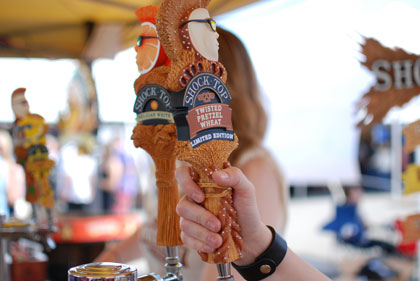
Shock Top Pretzel Wheat tap handle

Last weekend at the St. Louis Microfest — which has been around since 1988, raising money for Lift for Life Gym and not at all self conscious about keeping the word micro in its name — a local brewery, Anheuser-Busch, showed up with one of the more intriguing beers poured.

Shock Top Twisted Pretzel Wheat smells and tastes just like pretzels. You wouldn’t pair it with a pretzel because that would be redundant. You might buy one during the fifth inning on a muggy evening at the ballpark instead of hunting down a pretzel and a beer. Except that’s not really an option, at least right now, because A-B is offering it only at beer festivals this summer.

It’s one of those “how do they do this?” beers. If Short’s Brewing brought it to the Great American Beer Festival people would line up for it just like the do Key Lime Pie and PB&J.

Like other Shock Top beers, for instance Honeycrisp Apple Wheat or Lemon Shandy, Twisted Pretzel Wheat is not subtle. But beyond the obvious pretzel aroma and flavor it tastes like beer. Professional brewers at the festival I talked with about it were impressed, homebrewers not so much. Make of that what you will.