Chocolate Ale from Boulevard Brewing still reminds me of Brugge: “Cocoa dusted truffles. Rich dark fruits. Caramel and rum. A rush of aromas that themselves must be fattening.”
And it tastes like beer.
These are good things.
Chocolate Ale from Boulevard Brewing still reminds me of Brugge: “Cocoa dusted truffles. Rich dark fruits. Caramel and rum. A rush of aromas that themselves must be fattening.”
And it tastes like beer.
These are good things.
Questions about barley prices in the short term keep popping up and it is no small deal for breweries. However if Brewers Association members are going to sell 20 percent of the beer brewed in the United States in 2020 there’s a bigger conversation at hand.
Bart Watson and Chris Swersey only mentioned malt production in passing during their presentation at the American Hop Convention, because they were there to talk, obviously, about hops. They drew a contrast to how quickly hop farmers have reacted to growing demand from all brewers for what they refer to as “aroma” hops. They are planting different varieties and building out infrastructure. Swersey and Watson added considerable detail about both hops and barley in the current issue of New Brewer magazine, the publication for BA members.
… there is already increasing evidence that the demand for malt grown and malted specifically for all-malt beer production has not been met by domestic malsters. … Further, much of the malting capacity developed during the 20th century was capitalized and owned by large brewing companies and this continues today. This makes the malt industry less flexible than the hop industry.
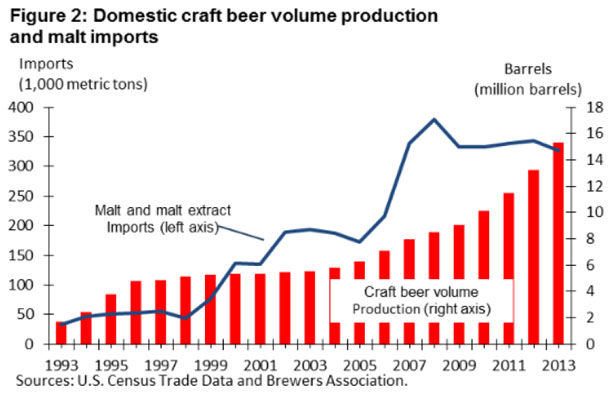
What they refer to as the disconnect between BA member demand and U.S. malt supply can be seen in the increasing share of imported malt used by domestic brewers. There are several reasons for an increase in imported malt, shown in the chart at the top. Much of the malt is coming from Canada, in part because barley growing has moved north as a result of climate change. American brewers would much prefer to use malt grown somewhere in North America, and to have input on what is grown.
Processing will be just as big a deal. Like with hops, the investment extends beyond the fields.
Current estimates of U.S. malting capacity show the ability to malt between 2.2 and 2.3 million metric tons annually. given that the U.S. malting infrastructure is used not only to supply domestic demand but also Mexican brewers, industry insiders see total production as using 95 percent of that current annual capacity, but much of that capacity is committed and unavailable to craft brewers. Our analysis of consumption and production confirms that current uncommitted U.S. malting capacity is unable to meet current craft demand.
They project that brewers of all sizes will use 25 percent more malt by 2020. They figure the cost of expanding capacity will be $500 million at a minimum.
I remember attending a seminar at the 2007 Craft Brewers Conference, so we are talking not quite eight years ago, where the discussion focused on the cost of stainless steel and what it would take to build enough brewing capacity for BA members to reach ten percent market share. Simpler times, I guess.
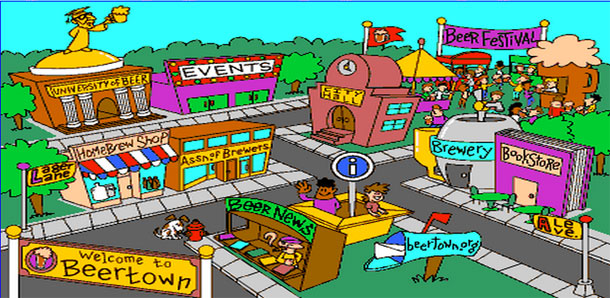
Remember this illustration? (You can visit it at the Wayback Machine.) It greeted visitors to the Association of Brewers website in the 1990s, at the time the parent of both the Institute for Brewing Studies and the American Homebrewers Association — and the organization that merged with the Brewers’ Association of America to create the Brewers Assocation.
Yesterday evening, Andy Crouch posted a point of order about defining “craft brewer” and “craft beer.”
@BrewboundFurn Not true. It once tried to define craft beer as well a decade or so ago. Quickly backed off.
— Andy Crouch (@BeerScribe) January 30, 2015
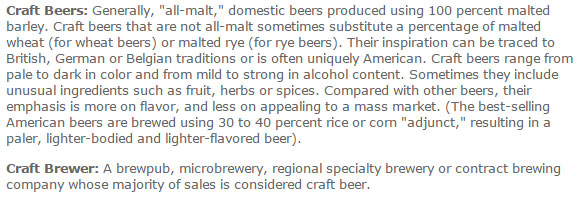
Yep. This is the sort of history included in the story I wrote for the current issue of All About Beer Magazine (V. 36, No. 1, date March 2015). Meanwhile, one more from the Wayback Machine, in this case from April 23, 2003:
Boak & Bailey follow up on the Wall Street Journal’s story about contract brewing in Belgium (“In Belgium, Battle Builds Between Brewers and ‘Beer Architects”) by examining what the requirements might be for a credible beer architect. Their list:
– has a qualification from a great brewing school;
– has worked hands-on in breweries;
– has studied hops, malt, yeast and water in the laboratory;
– knows the history of beer and its place in culture;
– pays painstaking attention to detail and
– has a well-trained palate and excruciatingly good taste.
They also introduce the term “ghost brewed” — which seems like it should be useful in this argument that is never going to go away.
One bit of disclosure. I made my bias obvious when Joe Stange tweeted “Beer ‘architects’ is utter bullshit. Any asshole can think up a beer idea and google a decent recipe. Only brewers make them drinkable” and I replied “It insults both real brewers and real architects.”
Now onto the rest, which goes beyond who conceives the plan for a particular beer (but feel free to let that “ghost brewed” idea rattle around the back of your head). Who physically makes the beer matters. To me. Maybe not to you. And apparently not to Sebastien Morvan, one of the principals in the story. I don’t mean to get all touchy-feely on you, or hipster-foodie (think of the couple in Portlandia who take a look at a free-range chicken’s “papers” before ordering). But there’s an acquired level of skill involved, and a respect for the process.
As I already wrote, I am biased going in, but this was also my takeaway from two books last year: “We Make Beer: Inside the Spirit and Artistry of America’s Craft Brewers” and “The Brewer’s Tale: A History of the World According to Beer.” The title of the former gives away its intent. In the introduction of the latter, Williams Bostwick writes, “Because if beer’s essence can be dstilled to one idea, it’s this: beer is made.” Some parts of this book can feel a little forced, which could be a function of trying to spin the history of the world around beer, but when the narrative revolves around the process of making beer then it’s a five-star book (currently 8 for 8 at Amazon).
An accredited beer architect presumably would know just how to do this. Morvan doesn’t exactly come across thinking he needs to.
He creates beers with the aid of mass tastings, crowdsourced recipes and Internet forums. And then he gets someone else to brew them. “I get frustrated at people acting like the guardians of the temple of brewing culture.”
“Guardians of the Temple of Brewing Culture” sounds like my kind of summer movie blockbuster, preferably starring Ralph Fiennes.
Here we are again. Boak & Bailey have invited bloggers to “go long” and I must once again turn to Plan B, which is digging something out of the archives. This is a story written in the fall of 2010 for American Brewer magazine about beery lesson brewers have learned from their travels. Visit Boak & Bailey’s Beer Blog for more #beerylongreads.
Jason Oliver brews a pretty mean Vienna-style Lager in Roseland, Virginia. Likewise Alastair Hook in London.
Two questions immediately come to mind. How did they learn to brew such beer, and why do they bother? Oliver has never been to Vienna, nor had he been to Germany before a trip in November. Hook traveled extensively on the continent and trained at Germany’s famous Weihenstephan brewing school. But he knew full well when he started brewing lagers they didn’t attract much an audience in the United Kingdom. After the first brewery Hook worked at closed, famed British beer writer Michael Jackson wrote, “One the problems was that the beers were too good: drinkers in Britain have become accustomed to the notion that lager should be tasteless, as most of the ‘famous’ international brands intentionally are.”
Their stories are a bit different, but share much in common with scores of others who have left home to drink beer, even to explore other breweries, and come home having learned lessons they weren’t looking for.
After Oliver graduated from college in 1995 he traveled across the country. He drank more Busch Natural Light than anything in college, but on this trip looked for local beers, quickly noticing that beer from old line Midwest regional breweries tasted different than beer in Virginia and from beer in the state of Washington. “I remember picking up a six-pack of Wheathook (from Redhook in Washington),” he said. “It was the neatest thing. Here this hazy cloudy beer.”
He and friends soon took the ferry from Washington up to Alaska. “Pitchers of Alaskan Amber cost the same at Budweiser,” he said. He was hooked.
When he returned to Virginia he had no idea what he might do with a degree in history. He found a book that listed unique careers. “Brewer” was listed at the end of the Bs. “That’s as far as I got,” he said.
He didn’t know he’d be drawn to brewing with a German bent, but that course was set by the time he completed the California-Davis professional brewing program in 1998. “I like the precision of it, the process,” he said. He was drawn to methods not commonly used in American brewpubs. ‘I wanted to learn those old techniques,” he said. Six years-plus with the Gordon Biersch chain of restaurant breweries prepared him well. Devils Backbone Brewing Co. opened in 2009 and won four medals at the Great American Beer Festival in both 2009 and 2010 as well as four at the 2010 World Beer Cup.
Hook was only 17 years old when he stuck Jackson’s “Pocket Guide to Beer” in a back pack and went beer exploring all over Europe. “I learned that the whole CAMRA (Campaign for Real Ale) mantra was bunk,” he said. During the 1980s he trained first at Heriot-Watt in Scotland, then at Weihenstephan.
It might be just as important that he traveled regularly to California, also during the 1980s, among other things becoming a lifetime member of the Boys and Girls Clubs of San Francisco. He visited New Albion Brewing, and got to know the beers of Anchor Brewing and Mendocino Brewing. “It made me make look at beer in a different way,” he said.
He continued to do that before opening Meantime Brewing in 2000 and has managed to since. He recently began brewing a beer called London Lager made from East Anglian malt and Kentish hops, serving an unfiltered kellerbier version at the brewery.
Hook talks about technical excellence with the enthusiasm of any Weihenstephan-trained brewer, but reserves the same passion for “the creative spirit of the U.S.” It wasn’t easy for him to turn down job offers in America, where his technical skills are in particular demand, but it wasn’t really hard. “As much as my creative instincts are with America, I’m a Londoner. You can’t take London out of a Londoner,” Hook said. “If you grow up a fan of the Charlton Football Club your ultimate dream is to go back you play for that club.”
Oilver’s and Hook’s experiences illustrate that a traveler never knows what lessons he or she will bring back. Here are ten from a few such brewers.
1. Beer tastes different in its own home.
Ted Rice, director of brewing operations at Marble Brewery in New Mexico, had never tasted a Kölsch before he brewed one in 2003 that won gold at the Great American Beer Festival. He laughed when asked to compare that beer with what he eventually drank in Köln. “I can see some similarities,” he said.
Drinking Kölsch in Köln or Helles in the south of Germany put the classic styles in perspective. “You see how delicate and refined they are. What happens when a number of breweries around a town or region all focus on one style they elevate it,” he said. He drew an analogy to Double IPAs in southern California. “Even a simple. . . ,” he said, pausing to consider his choice of words and making certain there was no misconception is this discussion of pilsner, “everyday beer gets better.”
2. Beer culture is different in its own home.
Southampton Publick House brewmaster Phil Markowski had only recently started homebrewing when he first visited Great Britain, the Netherlands and Belgium in 1986. “I wouldn’t go so far as to say there were any beer epiphanies, but it solidified my suspicions about the culture,” he said.
“Seeing the social aspect of large glasses of weak beer with flavor,” he said, his voice dropping off. “Twenty-five years distant this is really the only beer I get excited about.”
That trip finished in Belgium, where he saw what’s much more common knowledge today. “Every beer had to be served in the proper glass, even in the most mom and pop bars,” he said. “It was an indication of how entrenched beer is in their culture.”
3. Techniques don’t give a hoot about style.
In 2007, Matt Brynildson of Firestone-Walker Brewing traveled to England to brew a batch of beer at Marston’s, the last UK brewer to use a union fermentation system similar to Firestone’s. In Paso Robles, F-W brewers transfer beer from stainless steel to wood one day after fermentation, then blend it back with beer fermented in steel a week later. At the time Brynildson was working on the recipe for Union Jack IPA, a beer he thought might lean on British malts and contain a measure of beer fermented in wood. Ultimately Union Jack went another direction, featuring leaner American malts and no wood, becoming a hallmark of the “West Coast” style.
Brynildson didn’t return home with any genuinely new ideas. “It all reminded me of the party-gyle system so many brewers used to use. Fuller’s makes three beers off one mash,” he said. Firestone’s Big Opal (a wheat wine) and Little Opal (a low alcohol saison) draw on that approach. “We started thinking in terms of first wort beers, then using the second wort in another place.”
At the Westmalle Trappist monastery, Markowski was struck when he learned the brewers aged Westmalle Tripel cold for four to six weeks. “I realized they were carrying over techniques from their training with lager brewers (the dominant style on the continent),” he said.
4. It’s alive, no matter where you are.
Brynildson recently traveled to Russia, to Brazil and to Germany representing the Hop Growers of America. “For me it’s an excellent education just hearing what their challenges are,” he said. “(In Russia) for craft beer there is this really interesting approach right out of the gate. This is ‘live beer.'”
Beer is packaged in PET bottles and stored cold in grocery stores. Consumers are taught that craft beer has a short shelf life. “We (Americans) never did that,” Brynildson said. “I don’t know how I take this home and use it. How do we teach this to our consumers? I never think it is too late.”
5. You don’t have to produce beer in a clean room.
On this first trip to Belgium Markowski learned, “You can brew beer with all sorts of things you didn’t think you could brew with,” he said. Visiting Franconia years later he discovered you can make beer on all sorts of equipment you might not think you could brew with. “The revelation was that some of the breweries were pretty unsavory looking,” he said. “That things seemed far from ideal and far from German.” One of the reasons, of course, is the training required to brew in Germany, considerably more than in the U.S. (or Belgium). “You can’t find a poorly made beer in Germany,” Markowski said.
6. Remember to dance with the one who brung you.
A brewer sometimes learns something about his own brewery visiting another. “It made me focus,” Brynlidson said of his trip to Marston’s. “We’d migrated away, a bit, from talking about our barrels. We emphasized that we were the expert on pale ales. I went fully back the other direction.”
7. Imitation is not always the sincerest form of flattery.
Jean-Marie Rock – brewmaster at Abbaye d’Orval, one of Belgium’s six Trappist monastery-breweries – has become the consummate host in recent years, opening his brewery doors to many visiting Americans. But he’s also fond of playing the role of brewing curmudgeon, admonishing Americans to quit trying to imitate Belgian-brewed beers.
In the fall of 2008, New Glarus Brewing co-founder Dan Carey stopped at Orval on the way home from Germany. A conversation with Rock inspired him to make Crack’d Wheat. “He said, ‘I don’t know why everybody wants to copy my beer. They should invent their own style.’ So Crack’d Wheat is my beer.” It is much different than the very traditional hefeweizen Carey also makes. Cascade and Amarillo hops on top of Hallertau Tradition, including a solid dose of dry hops, turn make it what could only be called “an American beer brewed with wheat.”
8. The more often you brew a beer the better the beer it gets.
Returning to the lesson Rice learned about everyday beers, he was talking about both appreciating and brewing them regularly. “When you taste those beers (in this case Kölsch) you get layers of hop flavors. But also the malt; everything is so balanced. There are no flaws,” he said. That’s one of the advantages of making the same beer over and over. “We (American brewers) try to make a broad range for everybody. That’s what we excel at. The things we make every day we do better.” At Marble that’s an IPA that accounts for about half of production.
9. The Germans still know a little about brewing.
There’s a reason that Carey makes it to Germany almost every year – other than the fact he loves drinking in and around Bamberg – and that others like John Mallett of Bell’s Brewery and Brynildson annually visit Brau Beviale, a giant trade show. “The Germans are light years ahead of us when it comes to equipment, plant design, saving energy, how to build a brewery,” Carey said.
The influence of English brewing is obvious in most American breweries. However when Brynildson travels to countries now looking to American for inspiration he sees something else. Craft brewers in Russia, Brazil, Japan and other countries undergoing a beer renaissance initially focused on German styles. “It’s the German who have more influence sparking interest in craft beer in other countries,” he said.
10. Be humble.
Leonardo Di Vincenzo, founder of Birra Del Borgo in Italy, is a man of some experience. He has brewed collaboration beers with Sam Calagione both in Delaware and his own brewery outside of Rome. He’s one of the brewing partners in the brewpub project atop Eataly in New York City, and he blended beers at Cantillon in Brussels.
Standing at Cantillon he talked about beer with other Italian and American visitors. The American took a sip of something Jean Van Roy had hauled out of the cellar. “Humbling,” he said. Di Vincenzo smiled, the look of a man who already knew what he’d be told.
“You can’t get to New Glarus from anywhere,” Carey said, talking about the challenges of traveling from Wisconsin and back home. Yet he’s a frequent visitor to Bamberg as well as other destinations associated with beer. “You stay home and you brew beer. It’s incestuous,” he said. “You think you are better than you are. The more I travel the more I realize how little I know.”