The week that was: Lagunitas and sharks not jumped

MONDAY BEER LINKS, MUSING 09.14.15

It was a very noisy week, on Twitter and via my rss feed. Noise that wasn’t about things that interest me at this moment and that was so loud you couldn’t hear the other stuff. But it seems it was an Important Week, so here are a bunch of links you may or may not think belong together — followed by some “sit back and enjoy a great beer” ones.

Craft beer brewers just got downgraded to ‘sell’
[Via MarketWatch]
Lagunitas’ Magee speaks on Heineken deal and craft beer’s ‘next phase
[Via Chicago Tribune]
That Lagunitas-Heineken deal.
[Via Steve Heimoff]
Shakeup at craft beer giant Stone Brewing.
[Via Fortune]
‘Craft beer’ crumbling.
[Via I might have a glass of beer]
Signposting Craft.
[Via Hard Knot Dave]
Welcome to Starbeers.
[Via Fuggled]
The Curse of Craft strikes again.
[Via Ed’s Beer Site]
Craft Beer Sales Are At An All-Time High (Part I)
Craft Beer Sales Are At An All Time High-and why this could be scary.
[Both via The Hop Tripper]
We need to dial it back a notch.
[Via All About Beer]
And in Every Town.
[Via St. John’s Wort]

OK, a lot of words, and I am leaving most of the heavy lifting to you. My thoughts are mostly related to the last three links. Many of the “things that concern (Mitch Steele) about the future” are related to brewing and selling beer on a larger scale. Nothing wrong with that, and certainly keeping with the theme in Jason Notte’s story (first link). You can decide how it meshes with this from Greg Koch (fourth link): “There are two ways of operating a business – commodity or artisan. We operate as an artisan. We make decisions based on our passions. … Anybody that thinks commodity can operate as an artesan is ignoring the basic facts about how businesses operate.”

But as regular readers know, I cannot buy into the notion that breweries must always be growing. There is another way. Jeff Alworth’s commentary for All About Beer includes many amen sentences, words to drink by, and most importantly this: “Going forward, I’m planning to focus less on the specific products and breweries of the commercial sphere—they will come and go, inevitably—and more on the act of sharing a beer with someone I enjoy.”

And I certainly agree with this:

But beer companies? They are organs of commerce, however wonderful the brewers and publicans they employ may be. We feel good about beer, so we place that good feeling on the institution of private businesses. And in many cases, that feeling is well-placed. Breweries are collections of humans, after all. When they make good beer and create a wonderful space to enjoy it, they rightly earn our loyalty. But they’re also businesses, and sometimes their owners decide to sell to different owners—and then we have to make new judgments all over again.

But not with this:

Magee’s announcement is a spectacular Trump-like masterpiece of overstatement, and for me it was the moment Craft jumped the shark into over-seriousness.

No, Lagunitas is not a proxy for “craft.” No brewery is. And most drinkers don’t give a hoot what Tony Magee has to say. (Pausing for a moment of introspection: a lot more care than wonder about what I am thinking, so perhaps I should quit typing now).

Daria and I spent much of a week ago Saturday afternoon on the deck at Piney River Brewing, which is located on a farm 26 miles south of Plato, Missouri, a town that will remain the official “population center” of the United States until the 2020 census. Inside, the superintendent of a nearby school system was playing guitar and singing. Outside, volunteers were selling hot dogs and brats (Piney River does not serve food) to raise money for the Houston Education Foundation. Beer was the part of some conversations, not included in others. I don’t expect much changed this week. More concerned discussion about the St. Louis Cardinals’ recent slump, some comparing of notes about the kids’ new teachers, idle talk about the sudden and welcome arrival of cooler weather.

To be clear, Piney River also is not a proxy for “craft.” And it is a business. The brewery recently expanded, adding capacity that would allow it to produce 10,000 barrels a year. Founders Brian and Jolene Durham want to brew beer “in and about the Ozarks for the Ozarks.” When they first opened the tasting room one day a week (now it is open three) they expected a few friends would show up. Turns out they must have more friends than they realized, Brian said. It’s places like this that capture my attention these days, and beers that reflect where they are brewed, the where not necessarily being the brewery itself.

So there’s a reason that what Jordan St. John wrote (the final link) seems so brilliant to me.

. . . there’s the craft model. It’s not specific to craft beer. It’s a 19th century manufacturing model. It’s generational, driven possibly by the lifespan of the founder and the interest of his partners or progeny and it’s on a vastly more human scale. The smaller production level means that the owner is answerable to a community. The wealth that it generates will end up flowing back through the community in which it operates.

I’ll try to include the spirit of that thought in “Brewing Local.”

Meanwhile, those other links I promised . . .

Researcher recreates Viking beer.
The story this week I most want to read more about. [Via Knut Albert’s Beer Blog]

Young wine writers: don’t be too smart.
“Generally, in life, I reckon that less smart people are often happier. If you are too smart, I suspect that you’d find popular culture so inane as to be depressing, you’d be frustrated by the general low level of most journalism, and you’d spend a lot of the time quite bored. And as a writer you’d find that anything you wrote would only really appeal to small segment of the population.” [Via jamie goode’s wine blog]

Behind the new Abbey: How we changed the malts.
There have been several stories recently about breweries retooling their IPA recipes (for instance, this one from Bryan Roth). Tweaking recipes is hardly new — recall Ed mentioning Rochefort had begun using Aramis hops. But talking about it seems to be. I’m looking forward to this week’s discussion about choosing a new yeast. New Belgium co-founder Jeff Lebesch talked about that yeast candidly in “Brew Like a Monk.” He cultured from a Chimay bottle. “What I learned later is that Chimay could get kind of wild, so who knows how reflective what I got out of that bottle was of Chimay? I was doing all my culturing from bottles then, keeping them on plates in the house. Somewhere in the early 1990s I did a major cleanup of our yeast. It really changed the character of the beer.” [Via New Belgium Brewing]

Hype for hops helps farmers break into beer business.
This story overlooks most of the obstacles those who would grow hops outside of the Northwest face. Those challenges were at the top of my mind last week because I writing a story about it for New Brewer magazine. Perhaps that’s why when I saw the news of the Lagunitas-Heineken deal I thought immediately about the implications for hops, and in terms of real estate (because brewing is always about time and space). If Lagunitas is going to be selling two million more barrels per year, for instance, that means they could need more than three million more pounds of hops per year. That’s about 1,500 more acres of hops. Growing 1,500 more acres of corn in Iowa is not a big deal. But 1,500 more acres of hops just about anywhere, that’s a chunk. [Via CBS News]
Authenticity and the future of Belgian beer

MONDAY BEER LINKS, MUSING 08.31.15

First the important stuff

Meantime stretches authenticity of London Lager.
[Via Beer Insider]
#EBBC15 – Belgian Family Brewers and the Future of Belgian Beer Culture.
[Via Chris Hall | Beer Wrier]
And Chris Hall’s tweets from EBBC.
Questions about authenticity, heritage, transparency. Again. Here, to say that Meantime “stretches authenticity” is being kind — and lack of transparency leads to rumors like the one that the London-brewed Meantime London Lager was being blended with Grolsch to make it go farther. From the European Beer Bloggers Conference, Chris Hall managed to “live blog” the Belgian Family Brewers presentation, then followed with a series of tweets that made me think I’d like to see a transcript of the presentations and somebody really needs to profile Jean Hummler (unless you already did, @Thirsty_Pilgrim, and I missed it).

Yeast terminology, part 1.
Lovely yeast family tree, which helps make sense of sentences like this: “Brettanomyces is a genus, not a species.” [Via larsblog]

In REGION You Must Try BEER
I will leave it to you to fill in REGION and BEER for the U.S., or maybe we just pencil IPA in for each one. [Via Boak & Bailey’s Beer Blog]

A Beginner’s Guide to Drinking Beer in Belgium.
Belgian beer and Airbnb. How hip is that? A useful guide for THOSE who don’t want to visit along side a bunch of beer bloggers (see above). [Via First We Feast]

Tunbridge Brewery Plans to Stay Small.
“We don’t have plans to grow much bigger right now. We enjoy our day jobs, and don’t plan to leave them to go full time at the brewery. The next step for us is to start distributing kegs to area restaurants. We also hope to expand to other farmers markets as time allows.” But what are the consequences of taking that next step? [Via Valley News]

Craft beer scene yields to burgeoning local heroin industry.
“The local beer feel was getting awfully crowded, and even a little bit played out. There’s only so many ways to make an IPA, and once you started seeing tasting rooms opening up in East County, you knew it was time for the next thing.” Yes, at the point I am finding and passing along items like this is it seems fair to suggest I need to get out more. [Via San Diego Reader]

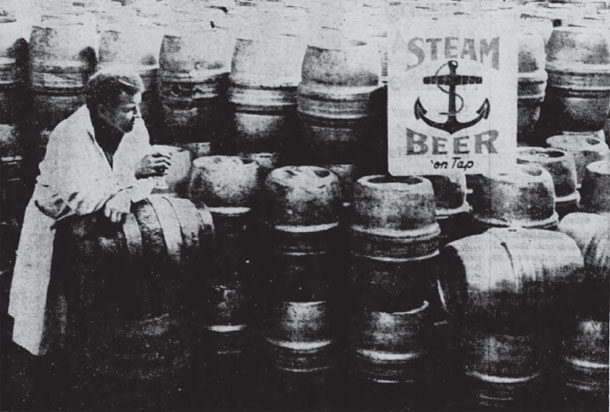
Anchor Steam 1962. Already sincere.

Anchor Steam, 1962

You might recall that six weeks ago Joe Stange suggested we consider the concept of postmodern (and post-postmodern) beer and wrote about “a return to sincerity.”

It seems that Anchor Steam beat us to the punch.

This from a July 14, 1962 story in the San Rafael Daily Independent Journal (three years before Fritz Maytag bought Anchor Brewing):

Steam Beer is naturally carbonated; neither additives nor presevatives become it. “The Sincere Beer,” it is called by some.

It is truly a “health food,” its devotees assert, containing more malt and hops than other beers, and without corn or rice to lighten it.

Of course the story also explains that steam beer might have been called steam beer because a “‘Doctor Steam’ (whose first name has been given variously as Frank, Heintz, or Charles) invented the process.”

Why Wilko Bereit is my new beer hero, and other Monday links

MONDAY BEER LINKS, MUSING 07.20.15

While waiting for interesting posts that might result from the 2015 Beer Bloggers Conference in Asheville …

CRAFT Magazine – An embodiment of the German craft beer zeitgeist?
I posted a photo of the cover of this new magazine after Barry Masterson broadcast it via Twitter. He was followed up with this rather complete summary of what’s in the magazine. Now I really wanted to buy a beer from Wilko Bereit: “He wants to expand, but no more than 4000 HL a year, as he wants to stay micro. He uses only organic ingredients, but does not care for certification for his beers, as he just does it because he feels the beer tastes better, not to gain any marketing advantage. He and his partner talk to every one of their 70 customers selling their beers, as communication and partnership is key. But I do him a disservice. He don’t like using the craft label, at least in the German sense, as he considers it a term that is too, well, unthinking.” [Via The Bitten Bullett]

Smell your beer. Does it reek of gimmickry?
Joe Stange elaborates on his thoughts about “sincere beer” (linked here a couple of weeks ago). He poses a bunch of questions, and here are a few:
– Do you know where your beer is made? Are you sure?
– Is the label clear about the beer’s origins? Is it clear about the ingredients?
– If the beer is made locally, does the name include a foreign city?
– Any yeast in there? Is the beer alive, or merely embalmed by refrigeration?
– Would your grandpa have liked it? Do you think it might still be around for your own grandkids to try one day?

He also did some wondering out loud that I answered on Twitter: “That reminds me of one of the classic pieces of advice for writers, which I received as a young reporter: Imagine your reader. Name him. Talk to him. I wonder if many brewers imagine their drinker.” On Thursday the answer was Nathan Zeender at Right Proper in DC, and on Friday it was Rod Murray the The Public House down the road in Rolla. I’m pretty sure I could crank out one a day for a very long time. [Via DRAFT]

Beer with a Sense of Place.
One convert at a time. [Via The Public]

Tapped in: Craft and local are powerful trends in the beer aisle.
“According to a recent Nielsen study of craft beverage alcohol conducted online by Harris Poll, 35% of adults 21 and older say they’re more interested in trying an adult beverage labeled craft. Among men 21-24, that figure jumps to 46%. But craft can often mean different things to different consumers. Overall, most people who buy alcohol are most likely to associate the term with three main traits as it relates to alcoholic beverages: a) coming from a small, independent company (56% of people surveyed); b) part of a small batch (50%); c) handcrafted (43%).

And, “22% of beer drinkers said they think the importance of being made locally has grown over the last couple of years, compared with 14% of wine drinkers and only 5% of spirit drinkers.” [Via Nielsen]

Pabst will brew beer again in Milwaukee at site of historic brewery.
Not to be a curmudgeon — after all, I’m a sucker for a feel good story and like the idea of Pabst actually making some of its own beer, brewing it the city where it was born, tapping into historic recipes — but the brewery and tasting room will have five to 10 employees. When Pabst closed its Milwaukee brewery in 1996 it eliminated the last 250 jobs. In the 1960s, according to The New York Times, there were thousands of brewery workers in the local union (that included workers at several other breweries). [Via Milwaukee Journal Sentinel]

PBR is dead.
Not so sure about this, but an interesting companion to the story above. Plus, for this line “Not only did the new beer (Narragansett) lack the metallic aftertaste of PBR, it exuded authenticity rather than irony.” [Via NY Post]

Toppling Goliath brewery puts Decorah Iowa on the beer map.
“Taproom manager Todd Seigenthaler estimated that 80 percent of the people who walk through the doors of Toppling Goliath’s taproom are out-of-towners.” And it’s not liking getting to Decorah is easy. Interesting report about how beer tourists (and Internet noteriety) have created interest among local in their hometown brewery. The story really should have included the rather public dispute between owner Clark Lewery and brewer Mike Saboe, who wrote the recipes for what turned out to be a silly number of cult beers. Saboe left the brewery in February and did not return to brew until last month.
[Via Chicago Tribune]

Tasting notes are really bad, aren’t they?
If this is true for wine it is likely true for beer. “Tasting notes scare people away from wine.” [Via jamie goode’s wine blog ]

Hopstate NY: 2015, not 1879

Imagine Iowa without corn, or Illinois without soybeans.

That’s what it would have been like in the 1870s to think of New York without hops. By 1879 New York grew 80 percent of American hops. Four years later, The Western Brewer provided an industry overview: “It will be seen that in 1850 hops were raised in 33 States and Territories; in 1860, in 37; in 1870 in 36; in 1880 but 18. … It remains to be seen whether California, Oregon, and Washington Territory will increase their production; or, in a few years, drop off as so many others have done. It is probable that New York will always remain the banner hop state.”

Instead, within 10 years the Pacific Coast produced more hops than New York, and by the time Prohibition began New York farmers grew less than 4 percent of the national crop. This happened for multiple reasons: lower yields in New York than on he West Coast, hop disease issues, higher labor costs, and small inefficient operations.

Hop Growers of America estimates New York farmers strung 250 acres of hops in 2015, two-thirds more than in 2014. That’s considerably less than the 39,072 acres in 1879, when 10,000 New York farmers harvested 21.6 million pounds, but the pace of expansion has picked up. The first commercial field to operate since 1954 was planted in 1999, but 11 years later farmers harvested only 15 acres.

“We have a real mix of people,” said Steve Miller, hired by the Cornell Cooperative Extension in 2011 as the state’s first hop specialist. “There are only a couple of growers who’ve had hops in for more than 10 years in the state. The vast majority of growers have only had them in for a year or two.”

Last year, Miller estimated there are now about 75 farmers there with two to five acres of hops, and most have the potential to expand. Yields on farms with mature plants have topped 1,500 pounds per acre. In 1879 the average was 554. “It’s based on people becoming growers, not hobbyists,” Miller said. “People who have knowledge and equipment and barns.”

The state of New ,supports this revival in a variety of ways, including funding Miller’s research. So has Brewery Ommegang outside of Cooperstown. From the time Ommegang opened in 1996 its press releases mentioned it is located in the former center of U.S. hop growing. This always seemed a bit curious, because at the time nobody in New York was growing hops and you wouldn’t describe any of Ommegang’s beers as hop focused. Although the brewery recently released its first IPA and brews a range of hop forward pale ales, hops still aren’t what you think of first when somebody says Ommegang.

Ommegang posted the photo above last month, showing the small hop yard at the brewery. It is growing test varieties for the Cornell Extension program and will trial them in beers. The brewery also bought one and a half tons of New York hops last year. A good portion of those went into Hopstate NY, a pale ale released only in New York state a couple of weeks ago. It is brewed with Cascade, Nugget and Chinook hops, so it is brimming with citrus aroma and flavor, its resin character lingering beyond the finish.

No melon or blueberry or other exotic New New World aromas or flavors, but something different than New York hops offered in 1879.

A bit of disclosure: We don’t live in New York. I was able to taste the beer because the brewery sent me some. I certainly would buy it if I lived in New York. I won’t claim that at first sip, or third for fourth, that I thought, “Oh, this tastes of New York” (or the rolling hills around Coopertown, of which I am quite fond). But I could see it becoming a familar taste. One of place.

Last month when I was in California I had a lengthy — rambling, you might say — conversation with Brian Hunt at Monnlight Brewing about what makes a beer relevant. I’m going to be a while sorting that out, but I’m pretty sure than Hopstate NY is an example of relevant.