A noble point of order

It’s Monday, so what the heck . . .

– Last week, Jeff Alworth endeavored to shame 10 beer myths. He chose “noble hops” as one of them. I certainly prefer the term landrace hops and I agree that marketers amplified “noble” to sell their hops. However, the origins go back to the 19th century. I’ve written more extensively about this in print, but here is a short version of the story.

What bothered me more was the discussion of cohumulone. Arguments about co-eightch, as is known among both friends and foes, have centered on if hops with higher levels impart a harsher bitterness. Research at Oregon State University pretty much debunks that. And as far as “IPA hops” go, an average lot of Simcoe will have a lower level of COH than an average lot of Saaz.

A big difference between landrace varieties and modern bred varieties is the alpha to beta ratio. One reason that Coors stepped up to support Cascade hops more than 50 years ago was that Cascade had a ratio of about one to one, more like the landrace varieties large brewers were using at the time. It turned out that Cascade had other qualities (like plenty of geraniol) that didn’t quite fit in their beers. It’s not necessarily the a-to-b that makes the difference, but it serves as a marker for auxiliary bitter compounds.

Father Martin, Benedictine Brewery

Father Martin has a new hat. We are traveling, so access to my photo archives is limited. Otherwise I would also post a photo of Father Martin wearing the Benedictine Brewery “dad hat” he was wearing the last time time I saw him almost two years ago. If you visit the brewery “our story” page and scroll dad hat you’ll see him with the old hat, which was black in its youth and gray in later years.

The story is about a 50-year partnership between the abbey at Mount Angel, Oregon, and Coleman Agriculture. Previously, the monks tended to hops grown on the land that Coleman Agriculture now leases. The beer to celebrate their partnership is brewed with Simcoe hops, grown in a field across from the the brewery tasting room.
2 links before we fly away

Last week, the upper left coast (a couple of photos); this week, the right coast (might collect some photos).

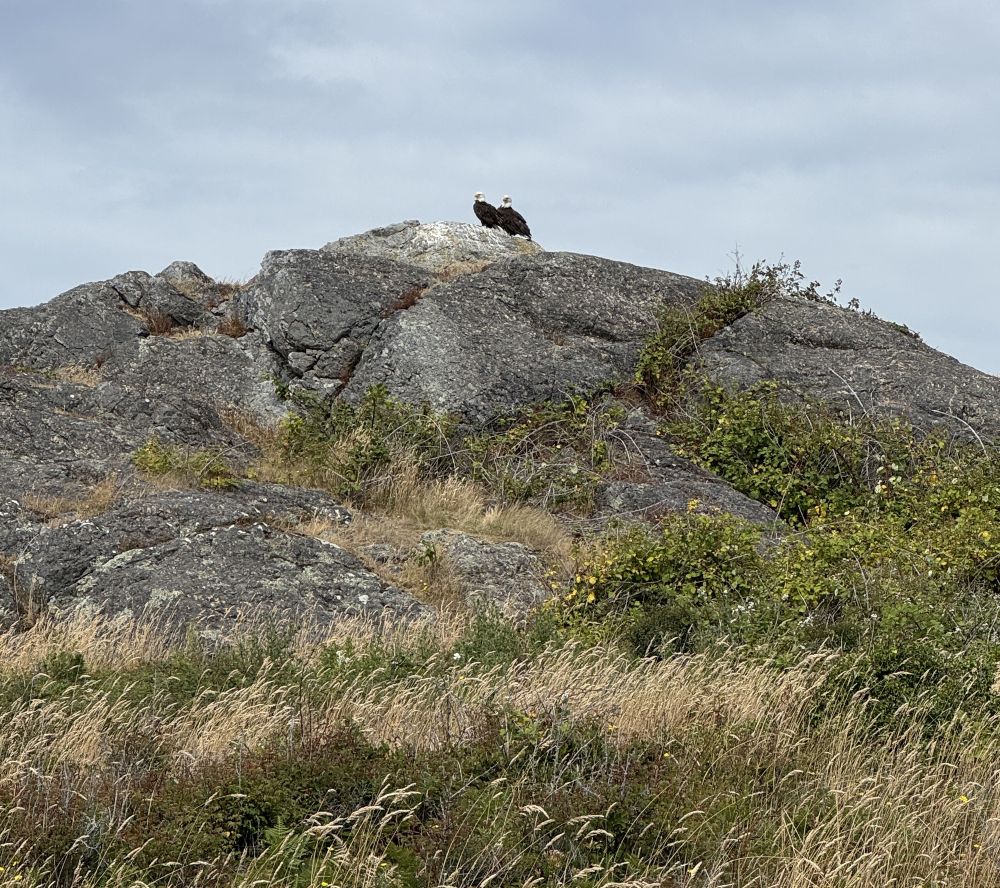
Two eagles, spotted on San Juan Island

Eagle departing after tourist approaches. San Juan Island.

But first, a couple of links.

– David Jesudason rounds up The Session #149. As co-author of the Time Life “Brewpub Cookbook” I should have been there. We were otherwise occupied.

– This from hood canal cody at Bluesky. I am probably doing this wrong, but pointing to an entire thread at Bluesky seems tricky. This will drop you in at #58. If you scroll to the top you will reach #9 and see a link to take you to #1. There’s plenty here to disagree with and plenty to agree with. Check your pulse and take your picks.

It’s Monday, and look, a link (in fact, make that two)

The observation that made me laugh most loudly last week:

Tom Brewer of ABinBev is “clearly very dedicated to his job. I would even say passionate if that wasn’t something that only craft brewers are capable of feeling.”

From Ed’s Beer Site.

And as long as I am here . . . the kids in breweries story is back. Or maybe it never went away. We’ll see if I can successfully share a link. This is a version where brewery owners are considering banning children.

“These owners cited instances of children throwing rocks or running around unsupervised, staff being forced to act as babysitters, and even one occasion when a parent pulled out a travel potty for a toddler to use in front of other guests.”

Beer dinners, ah yes, we remember them well

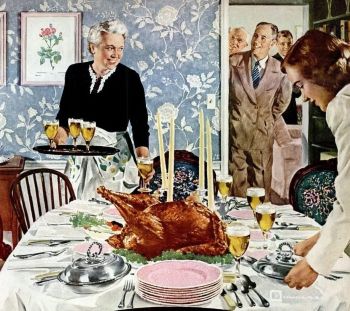
Thankgiving dinner -- one of a series of illustrations as part of the Beer Belongs campaignA couple of days ago, a story in Inside Hook asked, “Is the beer dinner dead?”

You’ll have to touch the link to see what the answer might be. My comment would be that anybody who has been to a beer dinner at Good Word Brewing and Public House in Georgia would answer, “Hell, no!”

And I’ll use the story for an excuse to link to a series of posts from almost 17 years ago, in which I asked, “If you could invite four people dead or alive to a beer dinner who would they be? What four beers would you serve?” The first to answer was Neal Stewart, then marketing director at Flying Dog Brewery. A few months before, the brewery launched a website called BeerDinners.com. I’m not sure how long after they let the domain name go, but it is now for sale for $2,695. (Sighs deeply).

And the rest . . .

Steve Hales
Sean Paxton
Andrew Mason
Lisa Morrison
Rick Sellers
Stonch
Alan McLeod
Tomme Arthur
Eric Delia
Martyn Cornell

It’s Monday and these are links, but don’t get used to it

Last week, Alistair Reece wrote that he is stuck in a rut and looking for a way to break a log jam that keeps him for completing writing projects he has started.

His plan? “So here is my crazy idea, I am just going to write whatever random boozy thoughts pop into my head each and every day for the rest of July, including when I am in Florida on vacation.”

A couple of days before, in his twice-a-month email dispatch Jay Hoffman at The History of the Web pointed to a earlier post about the evolution of blogging. He tells the story in terms of generations (somewhat analogous to something Jeff Alworth wrote last week).

– “In their earliest days, webloggers stood as gatekeepers to the web’s ever-growing well of content. Each day, these URL pioneers would post a few new links and sprinkle in their own commentary. Blogs acted as a signpost for web users, and following a few key blogs was enough to keep track of just about everything new on the web.”

– “But on the fringes, a new type of blog was emerging. The personal blog. These sites ditched the curated links and focused exclusively on commentary. Bloggers used their site to chronicle their personal journey, from the almost boring and banal to the weird and wonderful. This new type of blog was less an alternative media source and more akin to an online journal or diary. And these writers saw themselves not as gatekeepers to the web, but as sharers of their own identity.”

Read more