About change (and why I miss blogging circa 2009)

All aboard the Time Travel Machine, when civilized discussions occurred in blogs. We all learned something, and perhaps contributed to the conversation (in the comments).

We don’t want Belgian beer to change – and that’s our problem

They don’t want Belgian beer to change – and that’s their problem*

I want Belgian beer to change – because it is a problem*
(From Facebook, scroll down for English version)

Multiple voices. Multiple views.

Counting bubbles

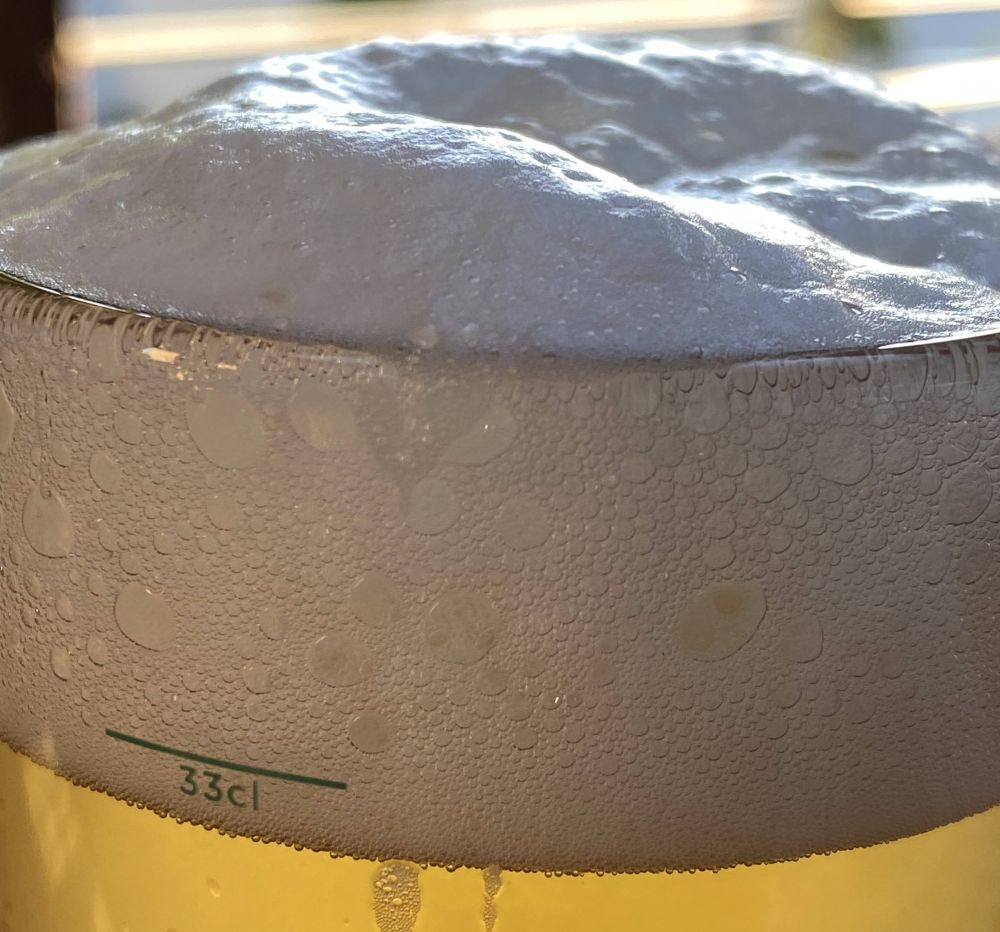
How many bubbles in this beer foam?

I recently wrote a story about beer foam for Brewing Industry Guide (“Foam Loves Hops (Except When It Doesn’t”). As happens, I had to leave a few darlings on the cutting room floor in order to have room for some key information. Such as, Dry hopping with Cascade pellets resulted in a near-linear decline in foam stability using the Nibem method, a standardized way of measuring foam stability over time.

This was one of those paragraphs:

There is more to monitoring beer foam than counting bubbles, although they are the foundation. They result from nucleation, and as those bubbles climb to first form or then replenish the foam head, proteins and bitter substances are carried into the bubble wall, forming a matrix that holds the skeleton together. In his doctoral thesis, “Beer Foam Physics,” A. D. Ronteltap calculated that a foam 3 centimeters high (a bit less than 2 fingers) in a glass 6 centimeters wide (a bit less than a Willi Becher) made up of bubbles with an initial radius of .2 mm (twice the width of a human hair) would contain 1.5 million bubbles distributed over about 100 layers.

What does it mean to grow ‘more’ hops?

Roadkill -- as seen during hop harvest in Oregon

Hop harvest has begun in Oregon (where I’ll be in two weeks). This is roadkill from a previous harvest.

Perhaps I will try to make “fun with numbers” a semi-regular Friday feature. We’ll see.

When I received an email last week declaring “Oregon Retakes No. 2 Spot for U.S. Hop Crop” I was en route to Argentina, so wasn’t inclined to do some necessary math. Several sites have since posted the information.

It is a fact that Oregon farmers strung 5,421 acres for harvest and Idaho 5,109. But . . .

Last year, average yield per acre was 1,732 in Oregon and 2,273 in Idaho. If yields are identical this year (they won’t be) then Oregon farmers will harvest 9,389,172 pounds of hops and Idaho farmers 11,612,757. In my mind, more pounds of hops trumps more acres.

This is not to say that the difference in yield will be as large this year. Idaho farmers will harvest far fewer acres of Helios this year (the USDA has withheld the numbers to avoid disclosing data for individual operations) and last year the average yield for Helios was 3,092.

Expect ad update in December, when the USDA posts final results of harvest.
Women’s sports bars, and maybe even brewery taprooms

Message on the entry door at Lady Justice Brewing in Englewood,  Colorado.

The photo above is from the entrance of Lady Justice Brewing in Englewood, Colorado (think of it as Denver extended). They aren’t included in “The Rise of Women’s Sports Bars in the United States” by Ruvani de Silva, but they would fit in perfectly.

“Community, safety, inclusion and accessibility are at the core of the women’s sports bar ethos. ‘People are tired of not seeing themselves reflected in traditional sports bars,’ says Chelsea Fishman, owner of Atlanta’s recently opened Jolene Jolene. ‘Women’s sports bars are answering that call by creating inclusive, intentional spaces for fans who’ve always been here but haven’t always felt welcome.’”

Read more.

Categories DEI

‘Median’ German drinks 20% less beer than 2005

The story is behind a paywall, but you can get a look if you share your email address.

“In 2005 the median German quaffed 112 litres of the stuff. The figure is now less than 90. Germany remains the sixth-biggest beer market in the world. But whereas Germans once downed more than anyone bar the insatiable Czechs, they are now eighth in the per-person league table. Worse, the decline is gathering pace. ‘Panic’ has gripped some breweries, says Gerrit Blümelhuber, a consultant.”