Michelob Celebrate – Does it suck?

It seems safe to say that Todd Haefer does not like Anheuser-Busch’s Michelob Celebrate Vanilla Oak. He writes:

“I get the suspicious feeling that this is a beer that originated from marketing, not from brewers. It also appears that it was approved by marketers who only drink wine, or Perrier water, or soda pop. I can’t imagine anyone who seriously enjoys beer tasted this in advance and approved it for public consumption.”

And the flavor?

“So what does the beer actually taste like? Creme soda or a vanilla wine cooler without much of a head. The beer is too sweet, the vanilla too strong and the body is very watery. The oak characteristic is virtually non-existent, as is malt. It also left an unpleasant aftertaste, like Red Bull. I suspect imitation vanilla is also an ingredient.”

Haefer writes a weekly column for the Appleton, Wis., Post-Crescent, but his “reach” is broader, because many other newspaper in the Gannett chain that owns the P-C also run his review. That might or might not make his words more useful to you than those from a particular poster at Rate Beer or Beer Advocate.

Or than those of us who write 75-80 words about a beer every other month for All About Beer magazine. Here’s what I wrote about Celebrate last December:

“Could we label a beer packing 10% alcohol by volume and a distinct smack of bourbon introductory? Celebrate may well familiarize more Americans to wood-influenced beer than hundreds of small-batch brewers have in 10 years. A double blast of vanilla, from freshly milled vanilla beans plus bourbon barrel staves added during maturation, dominates from the nose to a sweet finish. Bourbon almost as prominent, more as it warms. An uncomplicated introduction.”

Do you get the feeling that this is a beer I’m not going to spend money on but understand others might? That would be good.

I’m not opposed to Haefer expressing his opinion assertively. That’s a lot better than a critic who feels obiliged to write something nice about every beer. I do wish he’d bothered to learn a little about the beer, because sometimes the story behind a beer becomes part of the beer.

For me, another part of the story is what others think of the beer because – like Haefer – it has more “reach” than any bourbon-oak-vanilla beer made by a small-batch brewer. Check out the Rate Beer reviews and those at Beer Advocate and you’ll see they are mixed – which given that this is an A-B product and most reviewers at those sites are biased against A-B indicates that quite a few people like Celebrate.

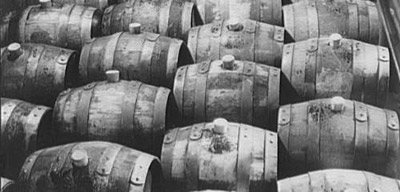
Barrels

It doesn’t hurt any “reviewer” to remind yourself not everybody shares your tastes. I much prefer, and am much more likely to praise, a beer that tastes like beer and certainly one with more complexity. A-B gets credit for experimenting with freshly milled vanilla beans. A small-batch brewer gets more for coaxing that flavor out of the wood. To me a beer that is aged in bourbon barrels rather than on staves has an almost unfair advantage.

So is there a lesson here? You have to decide if you want to read newspaper reviews, hang out at beer rating sites, lean on friends for advice, even trust what I write about these beers.

Meanwhile I get to tell one more story.

When I asked a distributor why his company chose not to stock Celebrate Vanilla or the new Celebrate Chocolate this year he said his bosses thought the price was too high for the average customer. Imagine what it would be if A-B had added in the cost of moving beer in and out of bourbon barrels instead of tanks that hold 1,400 barrels (its smallest) and more.

On the other hand it took Tomme Arthur of Port Brewing/Lost Abbey just a moment to do the math.

“We’d go out and buy the extra 834 oak barrels,” he said.

More on aging beer

The International Herald Tribune writes Some beers really do get better with age.

Nasser Eftekhari, owner of Beer Mania in Brussels, makes a good point: “Beer isn’t better after a few years, but different.”

Sometimes it is better, which is why we mess around with cellaring beer. (See the previous post and be sure to read Stephen Beaumont’s comment.)

Here’s how Jeff Boda describes a 1970 bottle of Chimay Grand Reserve: “Gone were the telltale signs of beer: the bitterness, the carbonation and the foamy head. In their wake was a thick brew that tasted solely of chocolate with a little dried fruit, something to be savored with only the best of friends.”

Thoughts on aging beer like wine

Don’t you think the discovery of truly vintage beers at Burton-on-Trent – one of the world’s most famous brewing centers – is a bit more exciting than when some Califronia hikes found a few 50-year-old cans of Coors?

Here’s how beer authority Mark Dorber described what he tasted of the UK beers:

“It’s amazing that beers this antique can still taste so delicious. Established wisdom would say beers this old should taste of vinegar, damp rags and Marmite. Instead, many show flavors of raisins and sultanas, baked apple and honey. The oldest – “ the 1869 Ratcliff Ale” – is bright and luminous like an ancient Amontillado sherry and has a meaty character like smoked partridge with hints of molasses. It’s amazing it tastes this good after 137 years.”

Beer writer Rupert Ponsonby added: “Ripe, sweet an dclean nose like oloroso sherry, sweet and smoky. Great balance with Christmas pudding and honey/dried fruit. Also syrupy roast coffee.”

The discovery caused George Philliskirk, the chief executive of the Beer Academy, to add, “This shows a potential for vintage beers to be taken seriously. Some top restaurants have started providing beer lists. Perhaps they should start including vintage brews.”

How good an idea is it to begin comparing aging beer and aging wine?

We’ve got more “vintage” beer in our chest freezer/cellar than almost anybody you know, but I still have reason to pause. One of the great things about beer is that brewers consider it ready to drink when they release it to the public. A winemaker might tell you have to wait 10 years or more for that multi-hundred-dollar bottle of red to “open up” and be at its best. He wants his money and caring for it between now and then is your job.

That noted, despite how well almost everything about wine has been scrutinized a recent artcile in Decanter noted “no one fully understands the process of wine aging.” Less is understood about beer.

In the best of circumstances new flavors will emerge, greater complexity, perhaps more balance, and even what the wine types call structure (yet paradoxically also a beer where the parts become seemless). Many beers handle age well – mostly those with a solid malt backbone, but also those – particular some from Belgium – where yeast continues to work its magic in the bottle.

I’m not saying laying down beer iasn’t worth doing – witness our cellar – but there can be disappointments. Both Dorber and Pohsonby use the word sherry in describing Ratcliff Ale. A beer aged for a much shorter time may already evoke comparisons to sherry or madeira. Some drinkers find that pleasing and others don’t. It shouldn’t be compared to a wine “opening up” since the flavors result from oxidation, which generally means the malt character is breaking down.

The next stop is a beer you won’t enjoy drinking, heartbreaking when you know there was once a delightful beer in that bottle. A couple of years ago in Belgium I had a bottle of Duvel that was more than 30 years old. Not a good idea.

There’s much more to discuss on this subject, in part because many American brewers are making beers that will improve for years rather than months – though maybe not decades. However, I think it’s best to fiish this post with a cautionary tale.

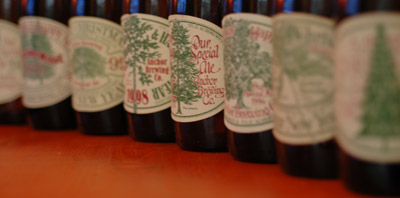
Anchor Our Special Ale

Last week a few beer writers and employees at Anchor Brewing Co. gathered at the San Francisco brewery to taste vintages of Our Special Ale dating back to 1995. Bill Brand wrote in his blog that the 1996 OAS was the star of the tasting.

Just two months ago I had the same beer. Our friend Jeff Scott was generous enough to share vintages from 1994 through 2001 (we quit at eight, when good sense prevailed).

Here’s what Brand wrote about the 1996: “Oh, would I ever like to have a couple of dozen of these. A dark brown color, with a slight head of foam and a bit of a licorice, malty nose with perhaps a hint of a medicinal note from, I guess, the spice-hop combination. Taste was quite full and malty.”

My notes: “Rich, chocolate nose, some roast. Sourness wrecks the flavor, but looking beyond that spice (spruce, ginger?) adds complexity. Tobacco, chocolate, then dry finish.” Four of us split a bottle and we didn’t finish the beer. Something happened in that bottle that shouldn’t have and oxidation made it worse. Did it happen when the beer was a year old, three, five?

The 2000 vintage was the second favorite of the tasting at Anchor and – honest to goodness – after the 1997, 1998 and 1999 bottles were all spot on the 2000 we opened seemed a bit sour (we weren’t sure if it was age or the combination of alcohol and spices).

The 2000 could have been a matter of different people tasting the same thing in a different way. Still, a lesson learned.

A mission Jimmy Stewart would understand

We love factory tours. You take the tour, see how products are made, and at the end perhaps enjoy some sampling – which could include eating, drinking or drawing with crayons.

You also may buy some of whatever is being made. We’ve hauled home Utz potato chips from Pennsylvania, Jelly Belly “Belly Flops” (rejects that look different but taste the same) from California, and beer from more than a few breweries.

But none in Texas.

A few years ago Texas voters approved a measure that allows wineries to sell (limited quanties) directly to consumers. Wine tourism generates serious bucks in Texas, so that it took until 2003 and a ballot proposition shows that neo-Probitionists types pack some punch. But in the other corner the newly formed Friends of Texas Microbreweries look well prepared as they seek to legalize direct sales to consumers. The FTM is a coalition of Texas craft breweries and beer lovers, with every Texas microbrewery lending support.

“We can no longer ignore the fact that 14 out of 19 microbreweries have failed in Texas in part because current regulations disadvantage microbrewing small businesses,” said Saint Arnold Brewing co-founder Brock Wagner. “This common-sense proposal will allow Texas microbrewers to compete with out-of-state microbrewers on a level playing field.”

Saint Arnold is at the fore, and launched the St. Arnold Goes to Austin Blog. The name? “It evokes the idealism of ‘Mr. Smith Goes To Washington.’ We’re testing the idea that an organized campaign can succeed in changing the law through a little hard work and the grassroots support of the Saint Arnold Army.”

Texas is famous for several beers – most notably Lone Star and Pearl – that live on even though the breweries where they once were made closed long ago. You can’t tour them. Every Saturday morning Saint Arnold is open for tours. The only thing that might make those better is if you could take home beer or six.

When sommeliers meet beer

What To Drink with What You EatDepending on what you drink and where you eat you might have thought sommelier refers to a mythical character in a fantasy restaurant world.

But there seems to be no way these days for a small-batch beer drinker to avoid the concept, and perhaps the physical reality, of a person – whatever you call him or her – handing out expert beer advice.

Of late:

– Don Russell wrote last week that there must be a better name, beginning his Joe Sixpack column with a discussion of the “dreaded ‘beer sommelier.'” Worrying about the “winofication of beer” he suggests instead using the term cellarman (or cellarwoman). “Calling the position cellarman, not beer sommelier, would maintain beer’s proud tradition as a distinct and worthy alternative to wine,” he wrote.

– Stephen Beaumont of World of Beer countered in a post at On the House a single expert might tend to all our drink needs: “So rather than craft a new term, let’s simply reinvent the one we have and acknowledge that the sommelier should be well-versed not only in wines, but in beers, whiskies, waters and cocktails, as well.” Beaumont already teaches Ontario sommelier students the basics of beer in a one-day program that is part of their wine education.

– In What to Drink with What You Eat, James Beard Award-winning authors Andrew Dornenburg and Karen Page – both sommeliers – offer not only pairings for wine to go with food but also beer, spirits, coffee, tea and water. They clearly are not yet beer experts and a variety of spelling and categorizing errors will make a beer lover grimace and wonder just how seriously they take beer.

While the authors go into considerable detail, for instance, about wine choices with salmon, they simply write “beer, esp. Belgian ale, pale ale, or Saison, with grilled salmon.”

But Dornenburg and Karen Page have Credentials (with a capital C) and their book just won a 2006 Georges Duboeuf “Wine Book of the Year” award. It is printed on heavy stock with is filled with gorgeous pictures. Quite simply, beer finds itself it good company. Most of the people who buy this book will be wine drinkers who might look at beer a little differently.

This is not the book for somebody who drinks only beer, but for those of us who appreciate both grain and grape. For strictly a beer drinker, The Brewmaster’s Table by Garrett Oliver is a better choice. Or they can wait until next year when The Best of American Beer & Food by Lucy Saunders will published.

In fact, the authors leaned on Oliver for expert advise – and any wine drinker who pays attention to what he has to say about saison should become a convert – if not spelling tips. His suggestions are listed in the “Best on the Best” chapter, which features lists from stars of the culinary world and spotlights the “connect the dots” quality of the book.

This book will surely end up as gift under many wine drinkers’ trees this Christmas because it provides a catalog of proven pairings – first with a chapter on what drinks to pair with various food choices, followed by one starting with drinks and then considering complementary foods. But the introduction and the final chapters offer lessons that go beyond reciting lists. These are the ones that best serve anybody – wine drinker, beer drinker . . . tea (?) drinker – who thinks about flavor, about flavors and about how they interact.

Which takes us back to the opening. Last week in the New York Times (free registration), Eric Asimov wrote that restaurants are practically begging for qualified sommeliers. He was writing about wine types. Now we’re asking those folks to tack on considerable beer knowledge.

What to Drink with What You Eat illustrates the challenges of doing that and hints at the rewards. To their credit, Dornenburg and Page looked over a list of “corrections” related their beer entries and still were pleasant enough to answer questions via e-mail.

Why should you tell somebody (interested in beer) that you take beer seriously when there are a variety of “beer mistakes” in the book?

We’re blaming neo-Prohibitionists.

How did you choose your experts? Oliver isn’t the only one who talks about beer, but he is the only one specifically from the beer world.

Clearly the primarily thrust of What to Drink with What You Eat is on wine, and our primary sources restaurant sommeliers, but we consider our love of beverages democratic and wanted to also include a number of experts to round out such subjects as spirits, cocktails, coffee, tea, water, sparkling juices and – yes – beer.

We attended the IACP Cookbook Awards where Garrett had received his award for The Brewmaster’s Table, which had brought that book – and Garrett himself – to our attention. Our Internet-based research had also unearthed Carlos Solis, described as “America’s first beer sommelier,” whose CIA degree and dual chef-sommelier position made him another interesting choice.

We’ll look forward to the pleasure of interviewing other beer experts in the future.

Do you think its accurate to say that wine gets much more attention in the book? Why is that?

Yes. Readers of our previous books (e.g. Becoming a Chef, Culinary Artistry, Dining Out) tend to be fine dining enthusiasts as well as professional chefs and restaurant professionals, so our primary focus was on interviewing restaurant sommeliers for their expertise. While this is changing to include a fascinating array of beverage pairings (including sake, spirits, beer and non-alcoholic choices), their primary focus is still on wine.

Are there times you think beer and wine mix well on the same table?

Yes – when it’s done thoughtfully. We have personally enjoyed beer as part of a tasting menu pairing with an appetizer or dessert, and appreciated when it’s been served in an appropriate portion size and glassware to allow a smooth flow from one course to the next. Scott Tyree of TRU in Chicago has paired beer with a sausage-based appetizer, and chef Sandy D’Amato of Sanford in Milwaukee served us a dessert course paired with three different beverages – including a beer. During the course of our book tour, we’ve interested audiences in beer by having them taste a Belgian Framboise with cheesecake at the end of the meal, and watched the energy level go up because people just couldn’t stop talking about it!

What did you learn about beer while writing the book?

We both hold sommelier certificates, and generally consider ourselves to be wine-centric (especially Andrew, who grew up in the Bay Area not far from Napa Valley) – but creating this book has helped to make us both more beverage-centric. We’ve learned that there are instances when the ideal match is something OTHER than wine. We once ordered in $10 enchiladas mole from our neighborhood Mexican restaurant and paired them with a $2 bottle of porter – and were absolutely blown away by how fabulous the match was. We swore there was no bottle of wine on earth that could have tasted as good with it!

We’ve also learned how biased many people are against beer, which just makes us want to crusade even harder FOR it. Many people, it seems, have formed their opinions about beer after sipping an uncle’s Budweiser as a kid and being grossed out by its bitterness. Many otherwise worldly gastronomes haven’t even bothered to sample the wide variety of beers that are out there in the world simply awaiting their pleasure – and it’s a shame.

One of Karen’s greatest accomplishments on our book tour was to get a woman TV anchor who said she hated beer to taste a Belgian (kriek) beer on camera, and to admit that she loved it! Wine drinkers can be brought over to become beer lovers, one person at a time – or, in the case of the TV show anchor, whose show is viewed by hundreds of thousands – many more at a time. They just need to try what’s in the bottle.

We’re proud of the chart “If You Like This, You Might Also Like That” on pp. 16-17 of WTDWWYE, which we hope will get more Champagne drinkers sampling lambic beers, and merlot drinkers sampling Chimay Blue, and Riesling drinkers sampling Hoegaarden White, etc.