For the love of session beers

Lew Bryson, last mentioned here in the discussion of X beers (go directly to his comment, has joined the blogging ranks with a specific project in mind. He calls it The Session Beer Project.

I suggest that you go ahead and add Seen Through a Glass to your feed reader, bookmark it or do whatever you do with sites you want to keep track of.

He explains the project there and in The Buzz at his website, so read those instead of a lame recap from me.

The why behind why session beers get slighted by the media – and in this case I’m casting a big net, including everything online as well in print – probably interests those of us in the press more than it does you. For one reason, I field a lot of phone calls for print publications looking for a “story angle.”

They want to know about about stuff that grabs your attention right off – a little like the first whiff of an intense imperial stout – because of unusual ingredients, high levels of alcohol or ridiculous amounts of hops. Nobody ever wants to follow up on how Utah brewers make so many award-winning beers although they are limited to brewing those with 4% alcohol by volume.

And they want to write about the beer – not the people who make it or how they make it, not people who enjoy it or how and where they enjoy it, not the session. That’s a harder story and not as sexy a story.

In working on another project, I’ve been reviewing way too much 1980s literature about American beer. In one story a German brewer says he’d never export his beer to the United States because Americans can’t appreciate its flavors. He might still feel the same way, but the fact is ex****e beers helped change what was a pathetic image (both of brewers and consumers).

Does that mean Americans can’t brew session beers? Take a trip to Utah, drink a Firestone Walker beer, or just tune into Seen Through a Glass and see what Lew is drinking.

Does that mean Americans don’t appreciate them? Check out the growth of Boulevard Brewing, Blue Point Brewing or what the best selling beers are for many of the fastest growing breweries (you’ll see they are session beers).

Welcome Lew to the blogging world by joining his conversation about them.

<
Time for a beer blogging day

Drinking buddiesAll the best ideas end up with beer.

Food bloggers have their own cooking day once a month. Wine bloggers have Wine Blogging Wednesday.

It seems that beer bloggers around the world should have something similar. So let’s start one, an event that will occur on the first Friday of every month. It doesn’t have to have a name (yet) or a logo (like wine), just participants who want to have a little fun and don’t mind learning a little along the way.

Appellation Beer will host the first tasting March 2 (giving us time to get out the word), and the theme will be “Not your father’s Irish stout.”

There aren’t many rules. Simply pour yourself a stout (or stouts) and post on the topic March 2, looking ahead to St. Patrick’s Day or not and writing about any stout that isn’t Guinness, Murphy’s or Beamish (the Irish old guard – good beers but we’re writing about others). Should you worry about style? About getting the opinion of friends, about writing an official tasting note, about food? About the history of the beer or how its made? All optional.

After we do this a couple of months different bloggers will likely find different approaches we are comfortable with.

If you think you might participate please leave a comment or drop me an e-mail. Then invite a friend to participate too. After you post on March 2 send me the URL and I’ll write a wrap up with links to all the posts.

Alan McLeod of A Good Beer Blog will host the April gathering, announcing the theme shortly after March 2. If you have an idea for a monthly tasting, and particularly if you want to volunteer to be a host, send me an e-mail.

Tips for saving on beer

Nice work by Al at Hop Talk with tips for saving a bit when you buy beer. He starts from a post at the Personal Finance Advice which deals with beer the commodity, and turns it into a discussion about buying the beer we all drink.

Might as well start at the top:

1. If you have the choice, avoid purchasing your beer in bars and restaurants where they are typically much more expensive.
Well, duh! But what if that’s where your friends are? I’d rather have just a couple of good beers with good friends at the brewpub than to suck down a bunch a bottles at home alone.

Well said. (Read the rest.)

The bottom line is there is a difference between getting your money’s worth and getting the largest amount of beer for your buck.

Workingmen, beer and St. Louis

In A New Religion in Mecca: Memoir of a Renegade Brewery in St. Louis, among the many topics Tom Schlafly touches on are workingmen and the image of beer (maybe that’s just one topic).
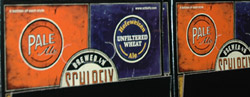
Schlafly, whose Saint Louis Brewery opened as a brewpub in 1991 and grew into a regional brewery, makes a fine point about the price of beer (and thus adds to the discussion about cheap beer) in a pub.

I am constantly mindful that customers in bars and restaurants willingly pay nearly three times as much for a glass of beer as the same amount of beer would cost in a supermarket. Considering that they could be drinking the same beer at home for nearly two-thirds les, what do bars and restaurants offer that’s worth such a premium?

EllieAnd who drinks Schlafly beer? The question is particularly relevant in St. Louis, where drinkers are understandably loyal to Anheuser-Busch and the union workers who work in its factories. When Saint Louis Brewery decided to sell bottled beer in 1996, Schlafly and his partners had good reason to look at their branding, and reconsider the elegant Swiss-looking logo they had chosen for their taproom.

Core, a local advertising agency, quickly took them to task. One of agency’s owners explained yuppies would buy products with a blue collar image, but blue collar workers wouldn’t buy products with a yuppie image. The issue didn’t have to be money. A bricklayer wouldn’t think of buying a Volvo, but would spend more money on a Dodge Ram pickup.

We acknowledged that there were those who regarded beer from microbreweries as “designer beer,” just as Evian was derided as “designer water.” The purveyors of such products were seen as duping consumers into paying exorbitant prices for something that wasn’t any better than the more reasonably priced mainstream version. We therefore made the conscious decision to position Schlafly as a traditional beer for everyone, not as a drink primarily for pretentious, overeducated elitists. We adopted the slog “Beer the way it used to be” as a means of underscoring this message.

The photo of a case box (above) gives you an idea of the result. This isn’t a matter of a brewery trying to “fool” customers. Schlafly writes, “We wanted every aspect of the package to remind consumer that we were offering beers that the mainstream breweries were no longer interested in making.”

Beers that workingmen drank more than a century ago.

Now, about the book itself. Even if you keep a beer at your side throughout you should be able to walk and talk when you are done reading. Schlafly writes in an engaging style and the book is just over 100 pages, without most of the business detail in recent books such at Beer School (Brooklyn Brewery) and Brewing up a Business (Dogfish Head Brewery).

I must note, though, that the book is much more entertaining if you already know the city of St. Louis, the Saint Louis Brewery and its two pubs, and particularly any of the people who work there.

Schlafly writes, “When we founded the Saint Louis brewery, we seemed to attract people steeped in liberal arts. faithful to the medieval preference for artes liberales over artes illiberales, almost no one had had any training that could be consider practical or useful when it came to operating a brewery.

Sixteen years later many of those same people are still there. Working men and women everyone.

How many beers before I die?

Jon Abernathy has completed his “50 beers to drink before you die” series at The Brew Site. Why would I mention this given that I’ve already declared the new Ten Best list from Playboy irrelevant to my beer drinking life?

I guess I’ve figured out that looking at one person’s opinion is more interesting than a list done by consensus. The Playboy list was a committee effort. Bill Brand has more insight on the selection process since he was a voter.

Abernathy took his inspiration from a BBC feature “50 things to eat before you die” – unaware that (the venerable) British beer writer Roger Protz wrote a book titled 300 Beers to Try Before You Die a couple years ago. At the time my thought was that tracking down the 300 beers might be a fun project, although once you got to 299 it would be best to stop.

(“Wait, Mr. Angel, I’ve still got a date with the Duvel.”)

Back to Abernathy’s list. What I like most is the spirit in which beers were chosen.

For No. 49 he picks homebrew, writing “Yep, just ‘homebrew.’ Any homebrew. I’m not going to quibble about style, or presentation, or region, or any of that. (Well, I hope it will at least be good.) But I don’t think anybody can call their beer drinking experience complete without drinking some homebrewed beer.” And No. 50 is “You local brewery’s beer.”

There are also “on the scene” picks – meaning go there (say Belgium) and drink beer unique to the region (say lambic).

What I like least – other than the presence of the godawful Cave Creek Chili Beer – is that there are only 50. I take one look at his American West Coast picks and think, no North Coast, no Lost Abbey, no Bear Republic, no Elysian … (stopping to wipe the tears) no Lost Abbey, no AleSmith, no Russian River (finally overcome and unable to go on).

What I thus decided is that my favorite list might be the one with the most beers. Thus this one is five times better than Playboy’s, but Protz has assembled a list that is 30 times superior.